


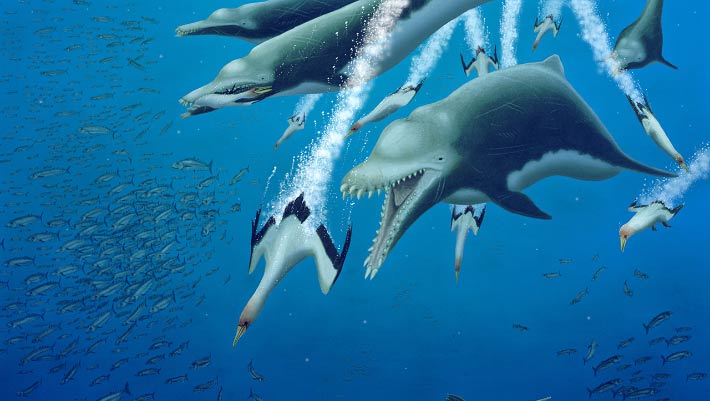
A newly identified toothed whale species, Ankylorhiza serratidens, lived in what is now South Carolina during the early Oligocene, about 30 to 28 million years ago. Its fossils reveal serrated edges on multiple teeth—a feature not previously reported in toothed whales—and suggest that it was a large-prey predator with a feeding style unlike that of modern killer whales.
An early large-prey predator
“The Oligocene was a critical period in cetacean evolution, marking the diversification of toothed and toothless baleen whales, with a significant increase in diversity and disparity and peak evolutionary rates compared to the mid- and late Eocene,” said Dr. Robert Boessenecker, a paleontologist at the University of California, Berkeley.
“This early stage of evolution is characterized by increased encephalization, the first appearance of whiskers, the evolution of echolocation, and an explosive diversification of feeding forms.”
Ankylorhiza serratidens belonged to a group of voracious toothed whales that fed on large prey, broadly resembling the ecological role occupied by modern killer whales. Its close relative, Ankylorhiza tiedemani, was already known as the largest toothed whale of the Oligocene, with an estimated length of 4.5 to 6 meters (15 to 20 feet).
“Modern megaphagous marine mammals are few in number, but killer whales, false killer whales (Pseudorca crassidens) and leopard seals (Hydrurga leptonyx) are examples; today, however, none has serrated teeth,” Boessenecker said.
“Fossils of extinct ‘killer whales,’ sperm whales, basilosaurid whales and giant dolphins such as Ankylorhiza show that different groups of cetaceans have filled the megaphagous apex-predator niche in the past.”
A fossil with serrated teeth
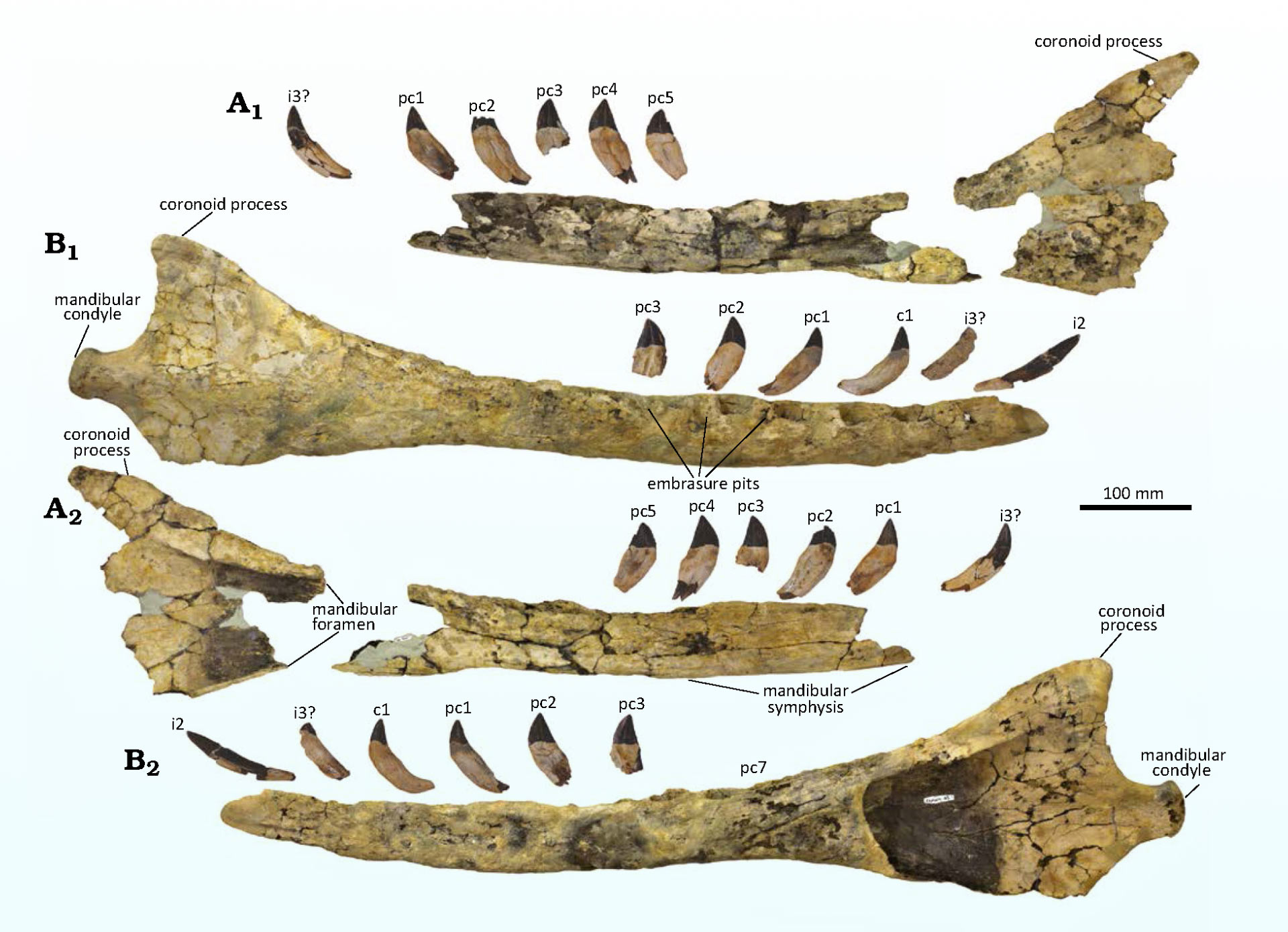
Ankylorhiza serratidens is known from a single partial skeleton housed at the Mace Brown Museum of Natural History at the College of Charleston. The fossil was recovered from the Edisto River area of Dorchester County, South Carolina, in the Ashley Formation, which has previously yielded specimens of Ankylorhiza tiedemani.
The remains include both lower jaws, more than a dozen teeth, the neck, part of the back and ribs.
“The dentition of this specimen has extensive serrations (0.9 to 1.3 mm) on the postcanine teeth,” Boessenecker said.
In some places, the serrations have worn away to expose the inner dentin, indicating that they are genuine tooth structures rather than damage or an artifact of preservation.
Serrated teeth are common in predatory dinosaurs, some ancient marine reptiles and many sharks. However, serrations extending across multiple teeth had not previously been reported in toothed whales. Modern killer whales and false killer whales have smooth teeth.
A grasp-and-tear feeding mechanism
The new species may have been more specialized for hunting large prey than Ankylorhiza tiedemani. Its rear teeth were larger, and the fifth lower cheek tooth had increased in size by about 26%.
The serrations are concentrated on the back teeth, suggesting that Ankylorhiza serratidens may have used its front teeth to seize prey and its rear teeth to process it.
“Roughly serrated vertebrate teeth act like saw blades, and the movement of the flesh parallel to the serrations results in a ‘grasp and tear’ action, concentrating tissue, including tough connective tissue and skin, into the incision, and tearing the tissue with the relative movement between the tooth and the prey,” the researchers said.
The study was published online on October 30, 2026, in Acta Palaeontologica Polonica.
Robert W. Boessenecker. 2026. “Serrated teeth found in a new species of early, large-feeding dolphin, Ankylorhiza.” Acta Palaeontologica Polonica 71 (4): 671–685. doi: 10.4202/app.01149.2024.
Source: www.sci.news