


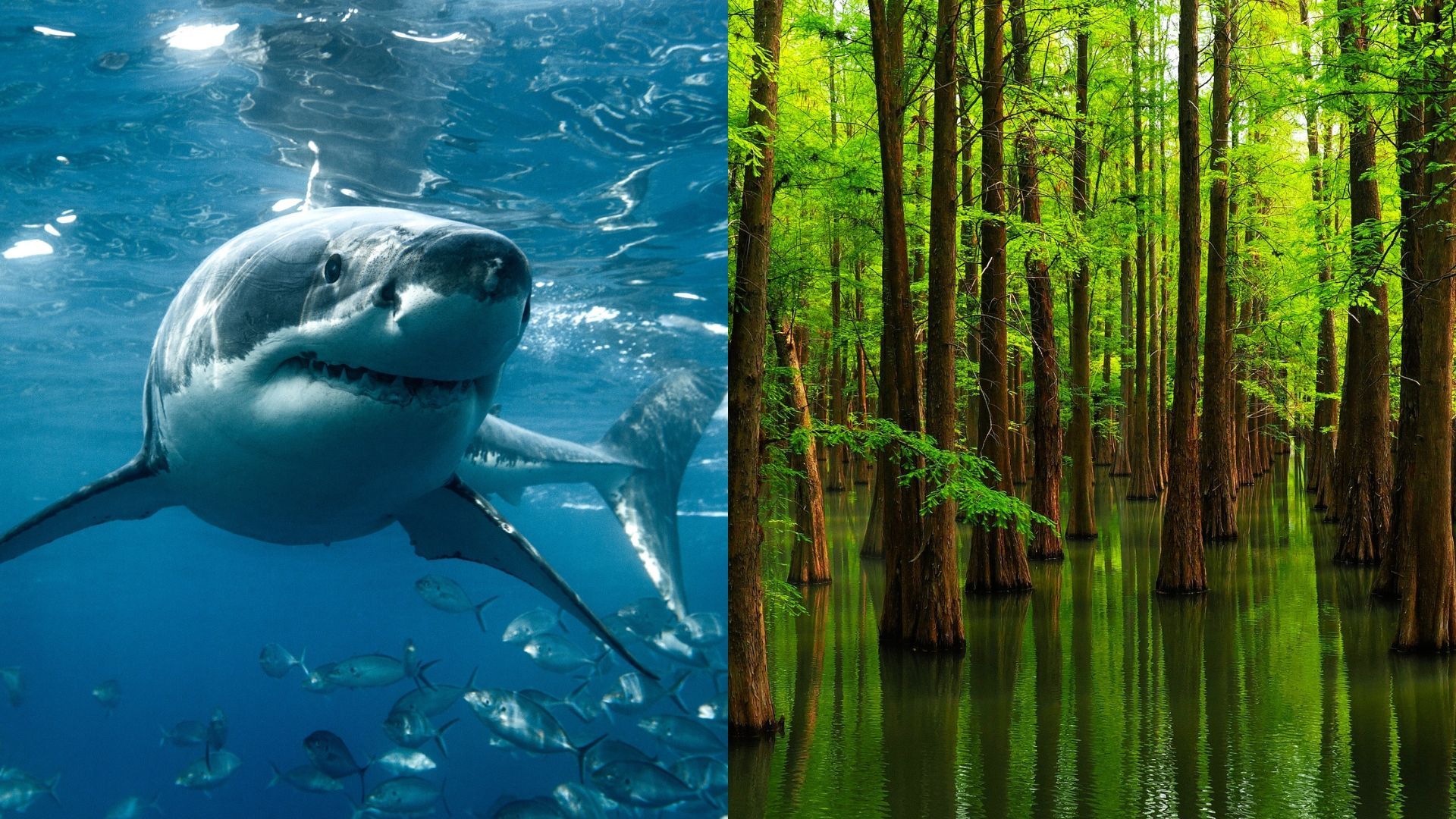
Sharks are often described as older than trees, but the claim depends on how scientists define both groups. The evolutionary lineage leading to modern sharks extends hundreds of millions of years into the past, while the earliest widely recognized trees appeared about 380 to 390 million years ago. However, modern sharks themselves first appeared much later, during the Jurassic period, about 195 million years ago.
It depends on what counts as a shark
“It’s all written in the fine print,” John Maisey, curator emeritus of fossil fish at the American Museum of Natural History in New York, told Live Science. “The important thing here is that shark lineages within fishes generally go back further than trees. But it really depends on how we define the word shark.”
The modern sharks seen today first appeared during the Jurassic period, about 195 million years ago. Fossils from that era can be traced to living shark lineages. By that definition, modern sharks are not older than trees.
Experts generally agree that trees first evolved during the Middle Devonian, about 380 to 390 million years ago. “I don’t think it was that controversial when we first planted trees,” Cindy Looy, a paleobotanist at the University of California, Berkeley, told Live Science.
The earliest trees in the fossil record
One candidate for the first true tree is Archaeopteris, an extinct genus discovered in a 385-million-year-old fossil forest near Cairo, New York. The plant had several characteristics associated with trees today, including a tall, woody trunk, leaves and a deep root system. The discovery is described in a study of the 385-million-year-old fossil forest.
Other early trees also appear in the fossil record. Eospermatopteris, found in an ancient forest at Gilboa, New York, dates to about 390 million years ago, while Karamophyton from southwest England dates to about 393 million years ago. These dates are based on studies published in Nature and the Journal of the Geological Society.
Shark relatives may be older than trees
The picture becomes less clear when scientists examine the extinct relatives of modern sharks. “That’s where things get a little shaky,” Maisey said.
Fossils of a sister group to modern sharks date from the Devonian and Permian periods, approximately 420 million to 359 million years ago. One important group is the hybodonts, extinct spiny fish whose cartilage had a distinctive pattern of mineralization similar to that found in modern sharks.
“This is called mosaic calcified cartilage, and it’s a very important feature of most shark-like fish and their ancestors,” Maisey said. He studied the fossils of a spiny fish called Doriodas problem from the Early Devonian period. Using this definition, shark-like fish first appeared about 400 million years ago, before trees appeared.
The rough skin associated with sharks may be even older. Dermal denticles—the tooth-like scales that give shark skin its rough texture—first appear in the fossil record about 450 million years ago.
A blurred boundary in deep time
These transitional fossils document fish gradually acquiring shark-like characteristics, creating a gray area in the definition of “shark.” “When you go back to the ancient past, it becomes a little more difficult because there are no longer living examples to compare,” Maisey said.
The fossil record is also limited. Many shark fossils consist only of animal remains such as loose teeth, so scientists are still piecing together when and how sharks arose. Each new fish fossil can raise further questions about which transitional fossils might still be undiscovered, Maisey said.
Looy added that much remains unknown about the early history of trees as well. Terrestrial fossils—particularly those preserving clearly visible parts of trees—are extremely rare. There is little evidence that trees existed before the Middle Devonian, and finding a petrified forest requires considerable luck.
“That’s why I think this fossil record is so interesting,” Maisey said. “Because while it may not give us all the answers, it certainly raises questions.”
How big of a shark fan are you? Find out with our Shark quiz!
Topics: life’s little mysteries
Source: www.livescience.com