


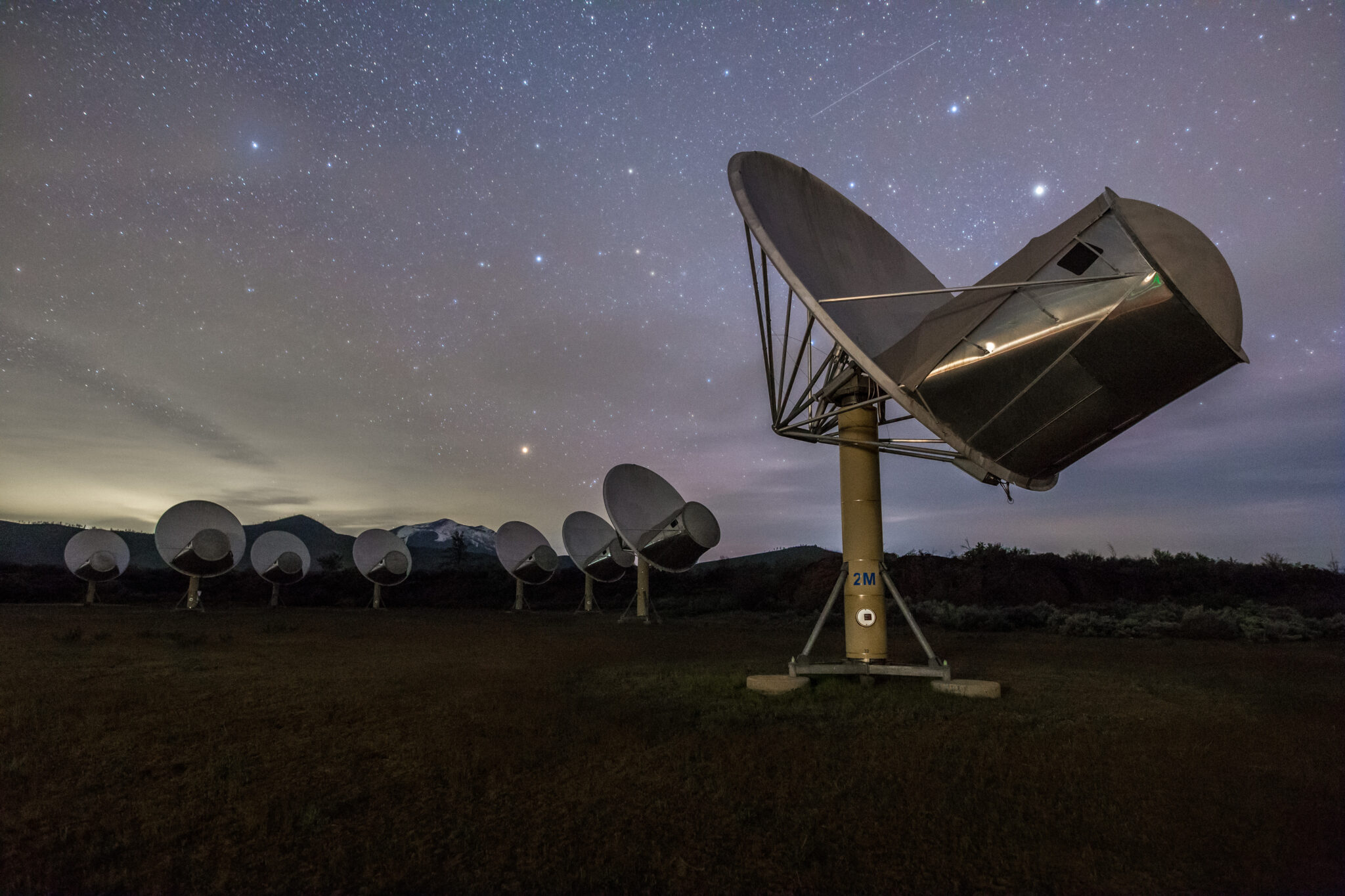
The search for extraterrestrial intelligence is increasingly turning to artificial intelligence—not only to detect possible signals from alien civilizations, but also to let human-built AI agents operate observatories and analyze data in real time. Breakthrough Listen and the SETI Institute are using NVIDIA Holoscan at the Allen Telescope Array in Northern California to connect natural-language requests with telescope equipment, data-processing pipelines and AI models.
Some scientists have proposed that extraterrestrial civilizations, if they exist, could be billions of years older than humanity. Those civilizations may have developed technologies far beyond ours, including advanced forms of AI. That possibility is prompting researchers to consider whether future searches may involve human AI agents listening for signals generated by alien AI systems.
At the Allen Telescope Array, AI agents can operate equipment, enrich and modify incoming data, and apply models to live data streams through a single natural-language request. NVIDIA Holoscan processes large sensor-data streams and gives agents live information they can use to act on the observatory.
This approach could make the search for potential signals from extraterrestrial life and technology faster and more adaptive.
“As our new agent observatories reach into space, what they discover may have much more in common with themselves than with the humans who created them,” said Andrew Siemion, SETI Chair at the SETI Institute and Bernard M. Oliver Principal Investigator of Breakthrough Listen. “But this is not something to be afraid of. Rather, it is a milestone in translation.”
Processing terabits of data in real time
Radio telescopes generate enormous volumes of data, creating a challenge for scientists who must identify potentially interesting signals while observations are still underway.
The Allen Telescope Array uses Daquiri, a Holoscan platform library, to ingest terabits per second of sensor data directly into GPU memory. This allows observations to be processed in flight instead of first being stored on hard drives.
Cyber Ether, a signal-processing framework developed at the SETI Institute, performs computations with the NVIDIA CUDA-X library, including CUFFT and Cubrus.
Nexus is a web-based observatory orchestrator that serves as an agent harness. It provides agents with a single source of truth for equipment status, computing resources and processing pipelines. Researchers can use it to monitor packet loss, view live spectrograms and rewrite signal-processing blocks through natural-language prompts.
The system can process 2.4 Tbit/s with an NVIDIA RTX PRO 6000 Blackwell GPU, while inference runs on-premises next to the instrument.
Together, these components allow an agent to steer the telescope’s antenna, calibrate and focus the instrument for a clean signal, capture and correct data errors, and plot the results. Tasks that could take human researchers weeks or years can be compressed into hours.
From science fiction to demonstrated results
The pipeline has already been demonstrated through the first real-time AI detection of a pulsar in the Crab Nebula. A pulsar is a fast-spinning stellar remnant that emits pulses like a cosmic lighthouse.
The team is now evaluating open models, including NVIDIA Nemotron. Such models are intended for situations where data locality and rapid turnaround are critical, including observatories that could operate offline on the far side of the moon.
Learn more about NVIDIA AI for Science.
Source: blogs.nvidia.com