


Close Menu
HitechubHitechub
    What's Hot
    Science

    Exploring the Impact of Endometriosis Beyond the Pelvis: Insights After Surgical Removal

    Science

    Unlocking DNA Secrets: A Review of Tuli King’s Expert Book Recommended by New Scientists

    Science

    Chronology of Earthquake-Induced Tsunamis in Japan: A Comprehensive Overview – Sciworthy

    Important Pages:
    • About Us
    • Privacy Policy
    • Terms & Conditions
    Facebook X (Twitter) Instagram Pinterest
    Facebook X (Twitter) Instagram
    HitechubHitechub
    Monday, June 22
    • Technology
      1. AI
      2. Gadgets
      3. View All

      This is the most popular CEO in the world

      Sectors in which “Chat-GPT” is most often used

      AI Pioneer Expresses Concern About Potential for AI to Surpass Humanity

      Artificial intelligence has begun to “swallow” professions

      What’s new in Android 14

      Europeans have about 700 million old mobile phones in their drawers

      Here’s how you can tell if your phone is being tapped

      “Sneaker X” – computer case in the shape of a sneaker

      Russian Gamers Unite to Prevent Nuclear War: Join the Fight Online

      Challenges of Space Travel: Why Journeying to Space is So Difficult

      NASA Astronaut Casts Historic Vote from Space

      Discover the Future of Comfort: What If You Could Wear a Chair?

    • Science
      1. Space
      2. Wheels
      3. View All

      Galaxies in the universe are growing more slowly than they should

      “Espace” presented the new lander “Apex 1.0”

      The largest asteroid sample ever collected has arrived on Earth

      (VIDEO) Incredible flight of the Parker Solar Probe

      Toyota wants to make a new generation battery with a range of up to 1,200 km

      Meet Toyota’s lunar “baby” that could make exploring the Moon easier

      Microlino – Is this the perfect city car?

      Alfa Romeo 4C gets an electric successor

      Two Key Signals That Might Indicate Contact with Aliens

      Why Am I Farting So Much? Discover the Surprising Science Behind Flatulence

      Next-Generation Highly Sensitive Radio Telescope Array to Be Constructed in Nevada Desert

      What Happens When Two Narcissists Fall in Love? Insights on Narcissistic Relationships

    HitechubHitechub
    Home » Astronomers Uncover Four Distinct Generations of Stars in the Tarzan 5 Globular Cluster
    Science

    Astronomers Uncover Four Distinct Generations of Stars in the Tarzan 5 Globular Cluster

    Share Facebook Twitter Pinterest WhatsApp
    Share
    Facebook Twitter LinkedIn Pinterest WhatsApp

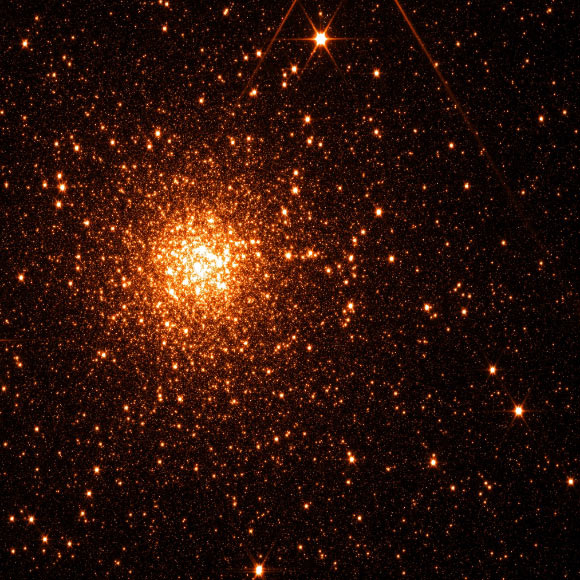
    Globular clusters are traditionally thought to host a single, ancient population of stars. However, groundbreaking observations from the NASA/ESA/CSA James Webb Space Telescope and the Hubble Space Telescope have confirmed the existence of two distinct star populations in Terzan 5, an ancient star system previously categorized as a globular cluster. These findings also reveal evidence of two recent rounds of star formation.


    This Webb/NIRCam image showcases the star cluster Terzan 5. Image Credit: NASA/ESA/CSA/Webb.

    Discovered in 1968 by Armenian-Turkish-French astronomer Agop Terzan, Terzan 5 is located approximately 19,000 light-years away in the constellation Sagittarius. Also referred to as ESO 520-27 and 2MASX J17480455-2446441, this stellar system is home to hundreds of thousands of various star types.

    Situated in the Milky Way’s inner bulge, Terzan 5 bears similarities to traditional globular clusters. However, a significant discovery in 2009 revealed the presence of two distinct star populations within this system.

    In 2016, Hubble’s observations provided initial age estimates of these populations, indicating one formed around 12 billion years ago, while the other formed approximately 5 billion years ago, just before the Earth’s formation. This complexity suggests a more intricate history than typical globular clusters.

    As Dr. Giorgia Zullo, a student at the University of Bologna, noted, “Webb’s new near-infrared observations, combined with Hubble’s archival data, enhance our understanding of Terzan 5’s history.”

    The study of Terzan 5 is challenging due to its location within a densely populated and dust-covered region of the galaxy. Luckily, Webb’s infrared abilities allowed astronomers to penetrate the dust, uncovering and cataloging more stars—including fainter ones—than previous research.

    By analyzing the stars’ color and brightness, researchers can categorize them by age and chemical composition. Webb successfully measured these crucial properties for every star within its field of view, including both Terzan 5’s and unrelated foreground stars.

    To isolate the stars unique to Terzan 5, researchers utilized Hubble’s long-term observational power. Hubble’s images taken over 12 years facilitated precise measurements of individual stars’ movements, known as proper motion, allowing scientists to differentiate between stars belonging to Terzan 5 and those from the Milky Way’s bulge.

    The synthesis of data from both Webb and Hubble revealed strong evidence of two additional stellar populations, one emerging 3.8 billion years ago and another 2.5 billion years ago. Researchers also refined the ages of previously known populations, finding they formed between 12.5 billion and 4.7 billion years ago.

    While the discovery of these multiple generations of stars raises questions, it does not rule out the possibility that Terzan 5 interacted with another significant cosmic body, such as a globular cluster or giant molecular cloud. Such interactions could have introduced new gas and dust, triggering additional star formation.

    Stellar composition measurements taken using the W.M. Keck Observatory and ESO’s Very Large Telescope indicate that Terzan 5 has a notably different population from typical globular clusters. Dr. R. Michael Rich, an astronomer from UCLA, explained, “As these populations age, they preserve a fossil record of heavy element enrichment from supernovae.”

    Terzan 5 managed to retain the raw materials necessary for forming multiple star generations, indicating a history of supernova events that generated heavier elements, which were subsequently dispersed by later star generations. In less massive systems, such explosions could result in the loss of residual gases and dust, as well as the crucial elements.

    Terzan 5’s ancestor possessed sufficient mass to sustain a cycle of star ejections, allowing new stars to form over billions of years. These findings suggest that Terzan 5 is likely a remnant of a much more massive star system that originated around 12.5 billion years ago.

    This star cluster is remarkable for its survival, having avoided merging or completely blending with the Milky Way’s bulge. Professor Francesco Ferraro from the University of Bologna stated, “For some reason, this unusual cluster formed independently of the bulge and was not obliterated during the bulge’s formation.”

    Terzan 5 is now considered a “bulge fossil fragment” due to its resemblance to the primordial mass contributing to the bulge’s creation.

    The survey results are documented in a research paper published in Astronomy and Astrophysics.

    _____

    G. Zulo et al. 2026. Terzan 5’s Multi-age Stellar Population Revealed by JWST. A&A 709, A212; doi: 10.1051/0004-6361/202659349

    Source: www.sci.news

    Share. Facebook Twitter Pinterest LinkedIn WhatsApp
    Previous ArticleAncient Monument Discovered: Possible Early Prototype of Stonehenge
    Next Article No Young Woman Has Died from Cervical Cancer in the UK for Years: A Positive Trend

    Related Posts

    Science

    Two Key Signals That Might Indicate Contact with Aliens

    Science

    Why Am I Farting So Much? Discover the Surprising Science Behind Flatulence

    Science

    Next-Generation Highly Sensitive Radio Telescope Array to Be Constructed in Nevada Desert

    Science

    What Happens When Two Narcissists Fall in Love? Insights on Narcissistic Relationships

    Science

    Severe Weather Disrupts U.S. Travel: Storms, Floods, and Heatwaves Coincide with World Cup and Holiday Rush

    Science

    Scientists Reveal: Earth’s Early Reproduction Was Far From Ideal

    Science

    Science Predicts the World Cup Winner: Here’s Who Will Take the Trophy

    Science

    113-Million-Year-Old Pterosaur Fossil Uncovers Diet of Ancient Flying Reptiles

    Add A Comment
    Leave A Reply Cancel Reply

    Stay In Touch
    • Facebook
    • Twitter
    • Instagram
    • Pinterest
    Top Picks
    Technology

    What has Tesla’s Optimus robot learned so far?

    Tesla has shared a video of its humanoid robot Optimus learning more and more tasks, now including performing yoga exercises and sorting blocks by color on its own.

    Exploring Ian Watson’s Sci-Fi Classic ‘The Embedding’: A Fascinating Yet Outdated Read

    Uncovering the Truth: The Migration of Ancient Humans from Africa Explained

    New Study: Larger Lizards Have More Extensive Wikipedia Pages, Say Ecologists

    Japan’s Eastward Shift: How the 2011 Earthquake Changed the Landscape

    Most Popular
    Science

    Flourishing Wildlife on Solar Farm Developed from Restored Peatland

    AI

    The unusual robot conductor of a concert in Seoul

    Categories
    • AI (13)
    • Gadgets (10)
    • Science (307)
    • Space (9)
    • Technology (37)
    • Wheels (9)
    Our Picks
    Science

    NASA Responds to Criticism Over All-Male Astronaut Crew for Artemis III Mission

    Science

    Incredible Footage of Jesus Christ Lizard Running on Water

    © 2026 Hitechub.
    • Home
    • About Us
    • Privacy Policy
    • Terms & Conditions

    Type above and press Enter to search. Press Esc to cancel.

    We are using cookies to give you the best experience on our website.

    You can find out more about which cookies we are using or switch them off in .

    Ad Blocker Enabled!
    Ad Blocker Enabled!
    Our website is made possible by displaying online advertisements to our visitors. Please support us by disabling your Ad Blocker.
    Hitechub
    Powered by  GDPR Cookie Compliance
    Privacy Overview

    This website uses cookies so that we can provide you with the best user experience possible. Cookie information is stored in your browser and performs functions such as recognising you when you return to our website and helping our team to understand which sections of the website you find most interesting and useful.

    Strictly Necessary Cookies

    Strictly Necessary Cookie should be enabled at all times so that we can save your preferences for cookie settings.