


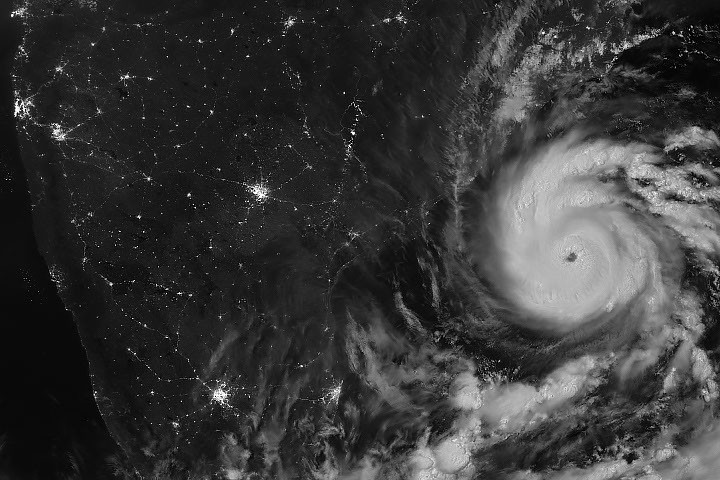
The first named storm of the 2026 North Indian Ocean cyclone season, Arnab (pronounced “or-nab”), formed in the Bay of Bengal on October 25—an unusually late start for a basin that typically produces named cyclones in April or May. The storm strengthened before reaching India’s east coast, where it brought damaging winds, flooding and disruption to Andhra Pradesh and nearby areas.
Arnab strengthens over the Bay of Bengal
A nighttime image captured by the Visible Infrared Imaging Radiometer Suite (VIIRS) aboard NOAA-20 showed Arnab’s circular cloud structure as it approached India’s east coast. The image was taken at 20:12 UTC on October 26, equivalent to 1:42 a.m. Indian Standard Time on October 27. The storm had sustained winds of about 140 kilometers (85 miles) per hour, according to the India Meteorological Department (IMD).
Landfall on India’s east coast
Arnab made landfall during the early morning hours of October 28. Sustained wind speeds reached 130 kilometers per hour along the Andhra Pradesh and Yanam coasts, the IMD reported. The agency classified the system as a “very severe cyclonic storm,” a designation described as similar to a Category 1 storm under the Saffir-Simpson scale.
The storm made landfall between Bapatra and Visakhapatnam, an area containing large cities, agricultural land and fishing villages. Reports said Arnab uprooted trees, flooded crops and homes, restricted fishing, and disrupted transportation and power networks. News coverage reported extensive damage, while Indian authorities evacuated tens of thousands of people from vulnerable coastal areas before landfall, according to the Associated Press.
El Niño and cyclone activity
Arnab formed during an El Niño event. El Niño is characterized by warmer-than-normal sea-surface temperatures in parts of the equatorial Pacific Ocean and occurs approximately every two to seven years. Changes in ocean conditions can affect the atmosphere and alter global patterns of rainfall, winds, tropical cyclones, fires and floods.
In the Bay of Bengal, research has found that environmental changes associated with El Niño are linked to reduced tropical cyclone activity. A 2019 study reported that tropical cyclones occur less frequently and with lower intensity in the basin during El Niño events.
NASA Earth Observatory image by Michala Garrison, using NASA VIIRS day/night data from LANCE, GIBS/Worldview and the Joint Polar Satellite System (JPSS). The story was written by Adam Voiland.
Sources
- Associated Press (October 28, 2026), Cyclone hits India’s east coast, killing 3 people and damaging homes and farmland. Accessed October 28, 2026.
- Bhardwaj, P. et al. (2019), Tropical cyclone activity in the Bay of Bengal associated with El Niño Southern Oscillation, International Journal of Climatology 39(14), 5452–5469.
- Colorado State University (2026), Current season Northern Indian Ocean (1991–2020 climatology). Accessed October 28, 2026.
- The Hindu (October 28, 2026), Cyclone Arnab’s landfall process continues along Andhra coast. Accessed October 28, 2026.
- The Indian Express (October 28, 2026), Cyclone Arnav hits Andhra coast. More than 84,000 people moved to evacuation centers. Accessed October 28, 2026.
- India Meteorological Department (2026), National bulletin archive. Accessed October 28, 2026.
Source: science.nasa.gov