


Close Menu
HitechubHitechub
    What's Hot
    Science

    How Hidden Manganese Stores Contributed to Earth’s Oxygen Formation

    Science

    New Scientist Recommends ‘Organ Speak’ by Julia Enders: An In-Depth Exploration of Our Body’s Organs

    Gadgets

    Best Gaming Laptops 2023: Powerful Portables for PC Games

    Important Pages:
    • About Us
    • Privacy Policy
    • Terms & Conditions
    Facebook X (Twitter) Instagram Pinterest
    Facebook X (Twitter) Instagram
    HitechubHitechub
    Friday, June 5
    • Technology
      1. AI
      2. Gadgets
      3. View All

      This is the most popular CEO in the world

      Sectors in which “Chat-GPT” is most often used

      AI Pioneer Expresses Concern About Potential for AI to Surpass Humanity

      Artificial intelligence has begun to “swallow” professions

      What’s new in Android 14

      Europeans have about 700 million old mobile phones in their drawers

      Here’s how you can tell if your phone is being tapped

      “Sneaker X” – computer case in the shape of a sneaker

      Russian Gamers Unite to Prevent Nuclear War: Join the Fight Online

      Challenges of Space Travel: Why Journeying to Space is So Difficult

      NASA Astronaut Casts Historic Vote from Space

      Discover the Future of Comfort: What If You Could Wear a Chair?

    • Science
      1. Space
      2. Wheels
      3. View All

      Galaxies in the universe are growing more slowly than they should

      “Espace” presented the new lander “Apex 1.0”

      The largest asteroid sample ever collected has arrived on Earth

      (VIDEO) Incredible flight of the Parker Solar Probe

      Toyota wants to make a new generation battery with a range of up to 1,200 km

      Meet Toyota’s lunar “baby” that could make exploring the Moon easier

      Microlino – Is this the perfect city car?

      Alfa Romeo 4C gets an electric successor

      Neil deGrasse Tyson Discusses New Book: Exploring Aliens on Earth and the Fascinating Science of Wormholes

      Red Stripes in Welsh Caves: Britain’s Oldest Art Finally Recognized After Natural Phenomenon Dismissal

      Timeless Math Memes That Have Captivated Mathematicians for Over a Century

      Exploring Distant Galaxies: Uncovering New Planets – Sciworthy

    HitechubHitechub
    Home » Atlantic’s Mysterious Cold Mass: Implications for AMOC Weakening
    Science

    Atlantic’s Mysterious Cold Mass: Implications for AMOC Weakening

    Share Facebook Twitter Pinterest WhatsApp
    Share
    Facebook Twitter LinkedIn Pinterest WhatsApp
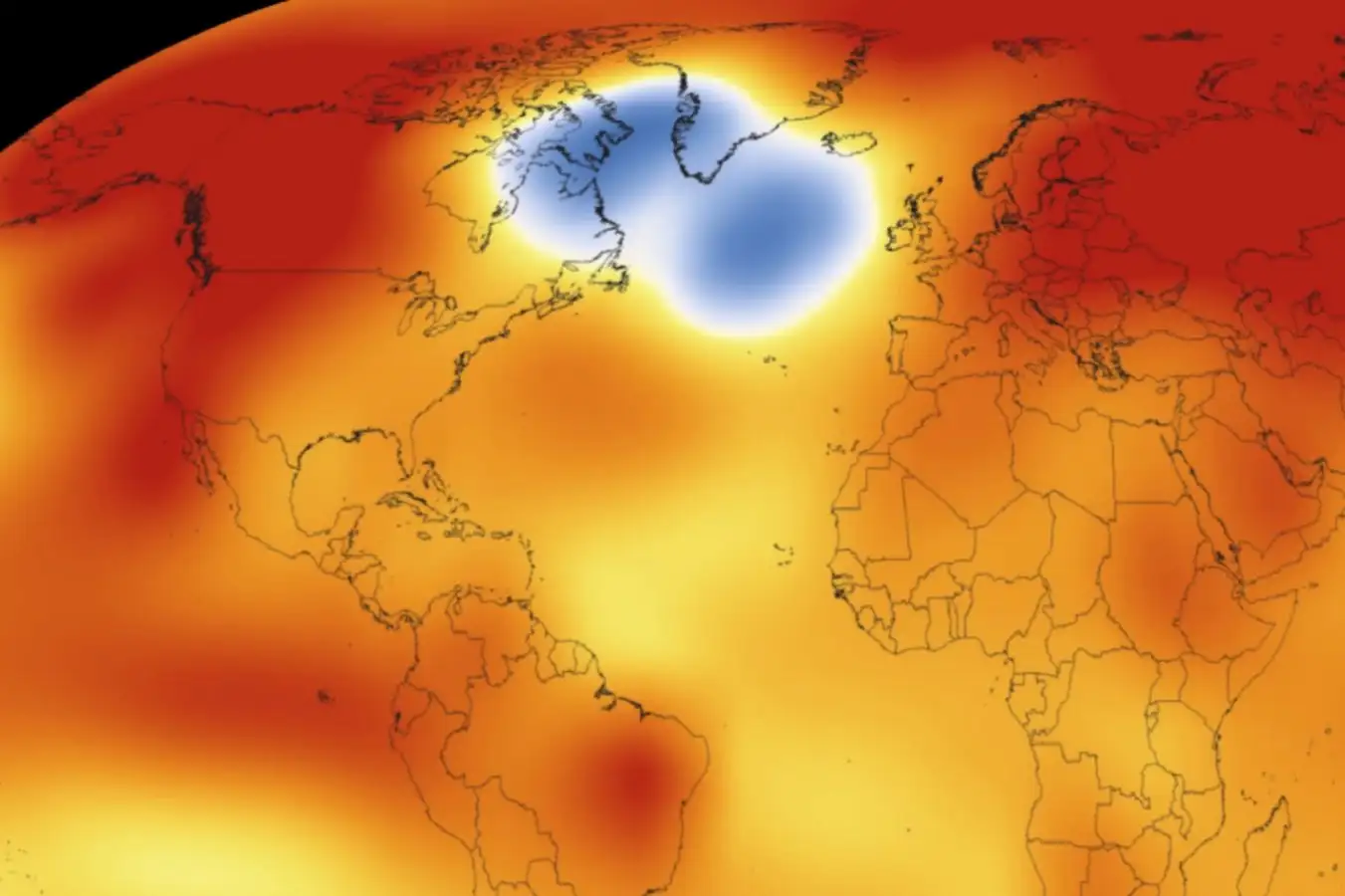
    Cold Blob Data Visualization

    A “Cold Blob” visualizes 2015’s average temperatures against 1951-1980 averages.

    Credit: NASA Scientific Visualization Studio/Goddard Space Flight Center

    The Earth’s surface has experienced warming over the last 150 years, with the exception of certain regions in the North Atlantic Ocean. This area, particularly southeast of Greenland, is known as the “warming hole” or “cold blob” and exhibits a temperature drop of up to 1°C.

    Experts remain divided on the cause of this phenomenon, with recent findings indicating that a weakening of the Atlantic Meridional Circulation (AMOC) could be a significant factor. The AMOC is a critical ocean current system responsible for transporting warmth from tropical regions to Europe.

    The AMOC conveys warm, salty water from the Gulf of Mexico to the North Atlantic, where it cools, sinks, and circulates back south along the ocean floor. Concerns arise that freshwater influx from Greenland’s melting ice may reduce the salinity levels, disrupting this vital ocean current and weakening the overall circulation system.

    Research has suggested that the AMOC could approach a tipping point within the next few decades, potentially leading to a collapse that could freeze parts of Europe and disrupt monsoon patterns crucial for agriculture in Africa and Asia. However, only 22 years of direct AMOC strength observations are available, which limits our understanding of clear trends.

    Climate modeling indicates that the AMOC’s slowdown results in decreased warm water flow to the North Atlantic, contributing to the formation of this cold mass. Alternatively, some studies attribute the phenomenon to atmospheric changes.

    In a 2022 study, He Chengfei and colleagues from Northeastern University found that rapid Arctic warming has diminished the temperature gradient between polar and tropical regions, pushing the jet stream northward into the cold blob area. This shift generates strong westerly winds that intensify evaporation, pulling heat away from the ocean.

    Increased evaporation leads to more cloud formation, which may also contribute to cooling in this region, while other studies suggest solar activity plays a significant role.

    Researchers such as Stefan Rahmstorf from the Potsdam Institute for Climate Impact Research are using climate reanalysis—derived from direct observations via satellites, buoys, and ships—rather than solely on modeling to investigate this cold mass. Their findings indicate a decrease in heat loss from the ocean surface in the cold blob since 1955. Notably, cooling is observed not just at the surface but also at depths of 1,000 meters, suggesting a decline in heat transport by the AMOC rather than increased heat loss due to atmospheric factors.

    According to Rahmstorf, “Wind and clouds can only explain a small part of the warming hole. While some modeling appears to attribute the cold blob to atmospheric effects, empirical data point toward an oceanic origin.”

    This research signals that the Atlantic circulation has been changing for many years, raising alarms not only about the potential collapse of the AMOC but also about the subpolar circulation—a massive eddy of currents surrounding the cold mass. A shutdown of this circulation could result in rapid temperature drops in the UK and neighboring nations, potentially more severe than an outright AMOC collapse.

    “The subarctic circulation nearing a tipping point could invoke drastic climate changes in Western Europe as soon as the 2040s,” warns Rahmstorf.

    However, directly measuring ocean surface heat fluxes remains challenging, leading to estimates based on modeling approaches. A 2021 study, utilizing similar reanalysis data, found that winds account for the majority of cold mass dynamics.

    He commented, “Inferring the energy budget of a cold mass from reanalysis is complicated.”

    While new research offers valuable insights, David Thornalley from University College London suggests that findings are “not definitive” regarding the causes of cold blobs. Limited data means alternate explanations cannot be entirely dismissed. Neil Fraser at the Scottish Marine Science Society proposes that a branch of the AMOC—the Norwegian Current—might be gaining strength, redirecting heat away from colder regions.

    “The cold mass aligns with a weakening AMOC,” Fraser asserts, “but conclusive evidence is still elusive.”

    Topics:

    Source: www.newscientist.com

    Share. Facebook Twitter Pinterest LinkedIn WhatsApp
    Previous ArticleHow Parenthood Can Impact Your Love Life: Keeping the Spark Alive After Babies
    Next Article New Scientist Recommends ‘Organ Speak’ by Julia Enders: An In-Depth Exploration of Our Body’s Organs

    Related Posts

    Science

    Neil deGrasse Tyson Discusses New Book: Exploring Aliens on Earth and the Fascinating Science of Wormholes

    Science

    Red Stripes in Welsh Caves: Britain’s Oldest Art Finally Recognized After Natural Phenomenon Dismissal

    Science

    Timeless Math Memes That Have Captivated Mathematicians for Over a Century

    Science

    Exploring Distant Galaxies: Uncovering New Planets – Sciworthy

    Science

    As Africa Splits in Two, Magma Surge Accelerates – Insights from Sciworthy

    Science

    Boost Your Mood Daily with a Glass of Fruit Juice: Study Insights

    Science

    Ancient Human Settlement Unearthed at 2,000 Meters in the Mountains: Experts in Awe

    Science

    Transforming Polystyrene with Sunlight and Sulfur: Innovative Upcycling Techniques – Sciworthy

    Add A Comment
    Leave A Reply Cancel Reply

    Stay In Touch
    • Facebook
    • Twitter
    • Instagram
    • Pinterest
    Top Picks
    Technology

    The end of passwords

    While passwords have long held the title as the most popular means of authenticating users, a number of problems surround the concept.

    What has Tesla’s Optimus robot learned so far?

    What will the first “Xiaomi” on four wheels be called?

    New Scientist Recommends ‘Organ Speak’ by Julia Enders: An In-Depth Exploration of Our Body’s Organs

    Microlino – Is this the perfect city car?

    Most Popular
    Space

    5 Fascinating Facts About Space

    AI

    10 Most Advanced Artificial Intelligence Robots in the World

    Categories
    • AI (13)
    • Gadgets (10)
    • Science (70)
    • Space (9)
    • Technology (37)
    • Wheels (9)
    Our Picks
    Science

    After the asteroid hit that wiped out the dinosaurs

    Science

    This is the food that makes you happy, according to science

    © 2026 Hitechub.
    • Home
    • About Us
    • Privacy Policy
    • Terms & Conditions

    Type above and press Enter to search. Press Esc to cancel.

    We are using cookies to give you the best experience on our website.

    You can find out more about which cookies we are using or switch them off in .

    Ad Blocker Enabled!
    Ad Blocker Enabled!
    Our website is made possible by displaying online advertisements to our visitors. Please support us by disabling your Ad Blocker.
    Hitechub
    Powered by  GDPR Cookie Compliance
    Privacy Overview

    This website uses cookies so that we can provide you with the best user experience possible. Cookie information is stored in your browser and performs functions such as recognising you when you return to our website and helping our team to understand which sections of the website you find most interesting and useful.

    Strictly Necessary Cookies

    Strictly Necessary Cookie should be enabled at all times so that we can save your preferences for cookie settings.