


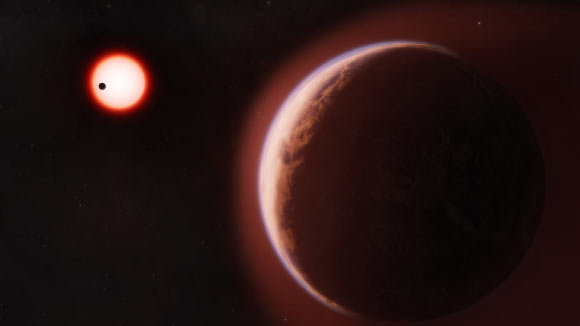
Astronomers have utilized spectral data from the Magellan-Cray telescope at Las Campanas Observatory to observe helium leaking from LHS 1140b, a rocky exoplanet situated within the habitable zone of the nearby low-mass star LHS 1140.
Artistic representation of the rocky planets LHS 1140b and LHS 1140c. Image credit: Melissa Weiss / Harvard University and Smithsonian Center for Astrophysics.
LHS 1140 is a dormant M-dwarf star, approximately 39 light-years away in the constellation Cetus, and is approximately 3 billion years old.
Also known as Gliese 3053 or GJ 3053, it possesses three orbiting planets: LHS 1140b, c, and d.
Discovered in 2017, LHS 1140b has a mass that is 5.6 times greater than that of Earth, along with a radius 1.73 times larger than Earth’s.
The exoplanet has an orbital period of 24.7 days, receiving 42% of the stellar radiation Earth does, leading to an equilibrium temperature of 226 K (-47 degrees Celsius, or -53 degrees Fahrenheit).
“Two decades ago, we questioned the existence of terrestrial planets,” remarked Robin Wordsworth, a professor at Harvard University.
“We subsequently discovered that they are common, particularly within the habitable zone. The next inquiry was whether any could sustain an atmosphere. We now have confirmation that at least one can.”
Astronomers observed LHS 1140b in 2024 using the advanced Warm Infrared Echelle Spectrometer for Extreme Dispersion (WINERED) on the Magellan-Clay Telescope at Las Campanas Observatory, identifying helium leaking from its atmosphere.
“After thorough analysis of the spectra, we observed helium being expelled from LHS 1140b’s atmosphere in 2024, driven by heating from the star’s X-rays and extreme ultraviolet light,” stated Dr. Shreyas Visapragada, an astronomer at Carnegie Scientific Observatory.
“However, observations in 2025 indicated no helium leaks, suggesting that atmospheric leaks may be variable.”
“Being able to observe atmospheric changes on exoplanets over such brief human timescales is a rare privilege.”
Combining these findings with prior observations and advanced models of exoplanetary evolution, the researchers deduced the presence of a well-defined atmosphere.
They predict that LHS 1140b has an upper atmosphere rich in helium and low in hydrogen, with other molecules like water likely trapped at lower altitudes near the surface.
No evidence of an atmosphere was found on planet LHS 1140c, suggesting that these two planets may exist on opposite sides of the so-called cosmic coastline.
On one side are planets retaining their atmospheres for billions of years; on the other, planets with atmospheres that quickly escape into space.
“Atmospheres are vital for planets to support life as we understand it,” explains Dr. Colin Cherubim of Harvard University.
“This marks the first discovery of an atmosphere on a rocky planet within the habitable zone of another star.”
“With helium present and escaping, the pressing question remains: Is LHS 1140b a solid rock devoid of atmosphere, intermittently releasing gas, or does it maintain a steady-state atmosphere similar to Earth, which occasionally leaks material?” questioned Dr. Jason Dittman from the University of Florida.
“The next four to five years of Webb data will be focused on searching for water. If water is detected in the atmosphere, it likely indicates a stable atmosphere.”
For further insights, refer to a study published in today’s issue of Science.
_____
Colin Cherubim et al.. Helium emissions from the atmosphere of a nearby rocky exoplanet situated in its habitable zone. Science, published online on July 16, 2026. doi: 10.1126/science.aea9708
Source: www.sci.news