


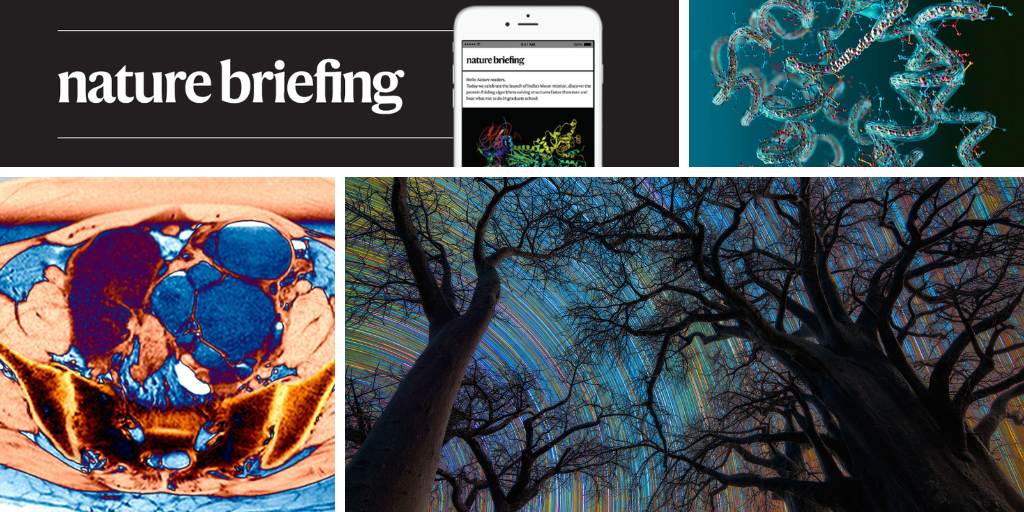
Nature Briefing: Stunning star trails, AI protein watermarks and a promising endometriosis treatment
Hello Nature readers. Would you like to receive this briefing free in your inbox every day? Sign up here.
Stunning Botswana star-trail photograph wins skyscape prize
Credit: Stefano Pellegrini
This psychedelic photograph of star trails above Botswana was the winner in the Skyscape category of the ZWO Astronomy Photographer of the Year Contest.
Photographer Stefano Pellegrini combined 340 individual exposures taken on an August night in 2025. The image reveals the apparent movement of the sky above Botswana’s Nusaypan National Park, photographed from beneath a canopy of baobab trees (Adansonia).
See more of this month’s sharpest science photographs, chosen by the Nature photography team.
Nature | Leisurely scroll
Researchers develop a watermark for AI-designed proteins
A watermarking system developed by researchers at Google DeepMind could soon be used to identify proteins designed by artificial intelligence. The hidden feature adds subtle statistical information to both the amino-acid sequence and the three-dimensional shape of computer-designed proteins without significantly compromising their function.
The approach could help distinguish AI-generated proteins from natural proteins in biological databases. However, the molecular stamp can be removed. Biosecurity researcher Tessa Alexanian says it should therefore be considered one tool in a broader, multilayered framework for protecting against biological threats.
Nature | 5-minute read
Reference: Nature paper
A “speech clock” could reveal how quickly someone is ageing
Scientists have developed a “speech clock” that estimates a person’s ageing based on voice characteristics including pitch and speaking rate. The researchers used it to calculate a person’s “vocal age gap” — the difference between the age predicted by the clock and their actual age.
A larger gap was associated with cognitive problems, including those linked to dementia. The tool could eventually help determine whether someone is ageing faster than expected.
Nature | 5-minute read
Reference: Science Advances paper
Improved niclosamide eases endometriosis symptoms in mice
An improved version of niclosamide, a drug used to treat parasitic infections, alleviated some symptoms of the chronic disease endometriosis in mice.
After researchers gave the drug to mice that had been stimulated to develop endometrial-like lesions, the animals became less sensitive to pain. They also developed fewer and smaller lesions than untreated mice and had fewer disease-causing macrophages.
Reproductive biologist and study co-author Kanako Hayashi said that, if replicated in humans, the findings could represent a “groundbreaking advance” in endometriosis treatment.
Nature | 4-minute read
Reference: Advanced Healthcare Materials paper
This week’s image: Cilia beating in the airways

Last month, this video won the top prize in the Small World in Motion competition and was featured as the newsletter’s “Image of the Week”. Some researchers have since expressed concern that the clip depicts biologically impossible characteristics and may have been hallucinated by artificial-intelligence tools.
Ning Xu, the optical engineer who won the contest, said in a LinkedIn post that AI was not used to generate the images. It was used in post-production to enhance the images and add colour to distinguish similar-looking structures.
Nature | 5-minute read (Ning Xu/Nikon Small World)
Features and impressions
Invasive plants drive pastoralists from their land
In central Kenya, invasive prickly pear cactus (Opuntia) is forcing pastoralists to move in search of land for their livestock. Farmers in Uganda face similar struggles with lantana (Lantana camara).
Researchers say the disruption caused by invasive plant species across Africa is likely to spread over time, compounded by drought and poverty. Eradicating plants once they are established is often expensive and impractical, yet their role in migration has received little attention.
African Nature | 6-minute read
Why tuberculosis treatment must protect existing drugs
Epidemiologist Ana Sekhovin argues that progress in tuberculosis treatment cannot rely solely on the promise of new drugs. Researchers must also understand how to preserve existing medicines before resistance renders them ineffective.
For tuberculosis drugs to have a lasting impact, scientists must combine genomic and clinical evidence to determine how resistance develops or has already emerged, who is most at risk and how quickly policies need to change. “All of this evidence generation must occur as part of the innovation process, not as an afterthought,” Cehovin writes.
Nature | 5-minute read
The hidden vulnerability of the world’s undersea internet cables
“We assume clouds are in the sky, but they’re underwater,” writes security expert Elizabeth Breaux in her new book. Security experts describe an “undersea spaghetti bowl” of communications cables that carry the world’s internet traffic — infrastructure that is highly vulnerable.
These cables are undersea infrastructure that supports modern civilization, says Breaux. Much of it is maintained by an international system of trust that is currently under threat.
And finally: Fat Bear Week crowns its winner
Today’s issue is all about contest winners, so it would be rude to leave out the backpacks. Backpack won this year’s Fat Bear Week contest.
The brown bear (Ursus arctos) received 103,344 votes in the final round — just over 5,000 more than the runner-up, known as 910.
Source: www.nature.com