


Close Menu
HitechubHitechub
    What's Hot
    Space

    Space Perspective: A Journey to the Edge of Space

    Science

    NASA Experimental Facility

    Science

    How to Maximize AI Benefits While Managing Risks

    Important Pages:
    • About Us
    • Privacy Policy
    • Terms & Conditions
    Facebook X (Twitter) Instagram Pinterest
    Facebook X (Twitter) Instagram
    HitechubHitechub
    Thursday, November 26
    • Shop
      • Fashion
        • Mens
        • Womens
        • Accessories
          • Handbags
          • Keychain
          • Masks
          • Money clicps
          • Neck Pillow
          • Rings
          • Towels
          • Wallets
        • Jewelry
        • Watches
        • T-shirts
        • Hawaiian shirts
        • Vests
        • Swim trunks
        • Swimsuits
      • Fun
        • Magic cubes
        • Magnifiers
        • Misc
        • Photo books
        • Puzzles
        • Toys
      • Home
        • Cleaning/Care
        • Mailbox covers
        • Mugs
        • Pot Holders
        • Spoon
      • Office and Electronics
        • Chairs
        • Office Supplies
        • IPad cases
        • Laptop stickers
        • Mouse pads
        • Notebooks
        • Pencil bags
        • Pens
        • Phone cases
      • Personalized
      • Pets
      • Sports
        • Cycling
          • Balaclava Mask
          • Bike Bell
          • Bike Computer
          • Bike Fender
          • Bike Grips
          • Bike Kickstand
          • Bike Light
          • Bike Locks
          • Bike Mitts
          • Bike Pumps
          • Bike Repair Stand
          • Bike Seat
          • Bike Trainer
          • Bike Wheels
          • BIKES
            • Folding Bikes
            • Road Bikes
          • Carbon Fiber Bike Products
          • Cycling Mask
          • Kid’ Bike Helmets
          • Inner Tube
          • Motorcycle Bag
          • Nylon Pedals
          • Adult Helmets
          • Photochromic Sunglasses
          • Soft Coolers
          • Suction Cup Bike Rack
          • Tool accessories
          • Winter Cloth
          • Heart Rate Monitor
        • Outdoors/Camping
          • Outdoor Bags
        • Sweatband
    • Technology
      1. AI
      2. Gadgets
      3. View All

      This is the most popular CEO in the world

      Sectors in which “Chat-GPT” is most often used

      Artificial intelligence has begun to “swallow” professions

      The unusual robot conductor of a concert in Seoul

      Here’s how you can tell if your phone is being tapped

      PlayStation 5 becomes a completely silent console and gets more space

      This is the first phone that can be used to park a car

      Best Gaming Laptops 2023: Powerful Portables for PC Games

      Top 30 Early Black Friday Deals 2026: Best Picks and Ultimate Buying Guide

      Kagi Announces Gmail Rival After Challenging Google Search

      European Spacecraft Discovers Chaotic Asteroid Impact Site After Deflection Test

      Iowa Lead Explosion Investigation: Scientists Begin Studying Its Environmental Impact

    • Science
      1. Space
      2. Wheels
      3. View All

      Space Perspective: A Journey to the Edge of Space

      5 Fascinating Facts About Space

      Space Exploration: Unveiling the Wonders of the Universe

      Toyota wants to make a new generation battery with a range of up to 1,200 km

      Meet Toyota’s lunar “baby” that could make exploring the Moon easier

      What does a night drive look like with one of the most beautiful cars in the world: the Rolls-Royce Ghost

      Coherent Fermion-Parity Oscillations in Coupled Minimal Kitaev Chains

      Iowa Explosion Lead Contamination Concerns Persist Despite Official Assurances

      Einstein’s 120-Year-Old Theory May Be Missing a Major Clue About the Big Bang

      Physicists Use Gravity to Send Unblockable Messages Through Brick Walls

    HitechubHitechub
    Home » Black Hole Shattered a Super Sun—But Something Strange May Have Survived
    Science

    Black Hole Shattered a Super Sun—But Something Strange May Have Survived

    Share Facebook Twitter Pinterest WhatsApp
    Share
    Facebook Twitter LinkedIn Pinterest WhatsApp

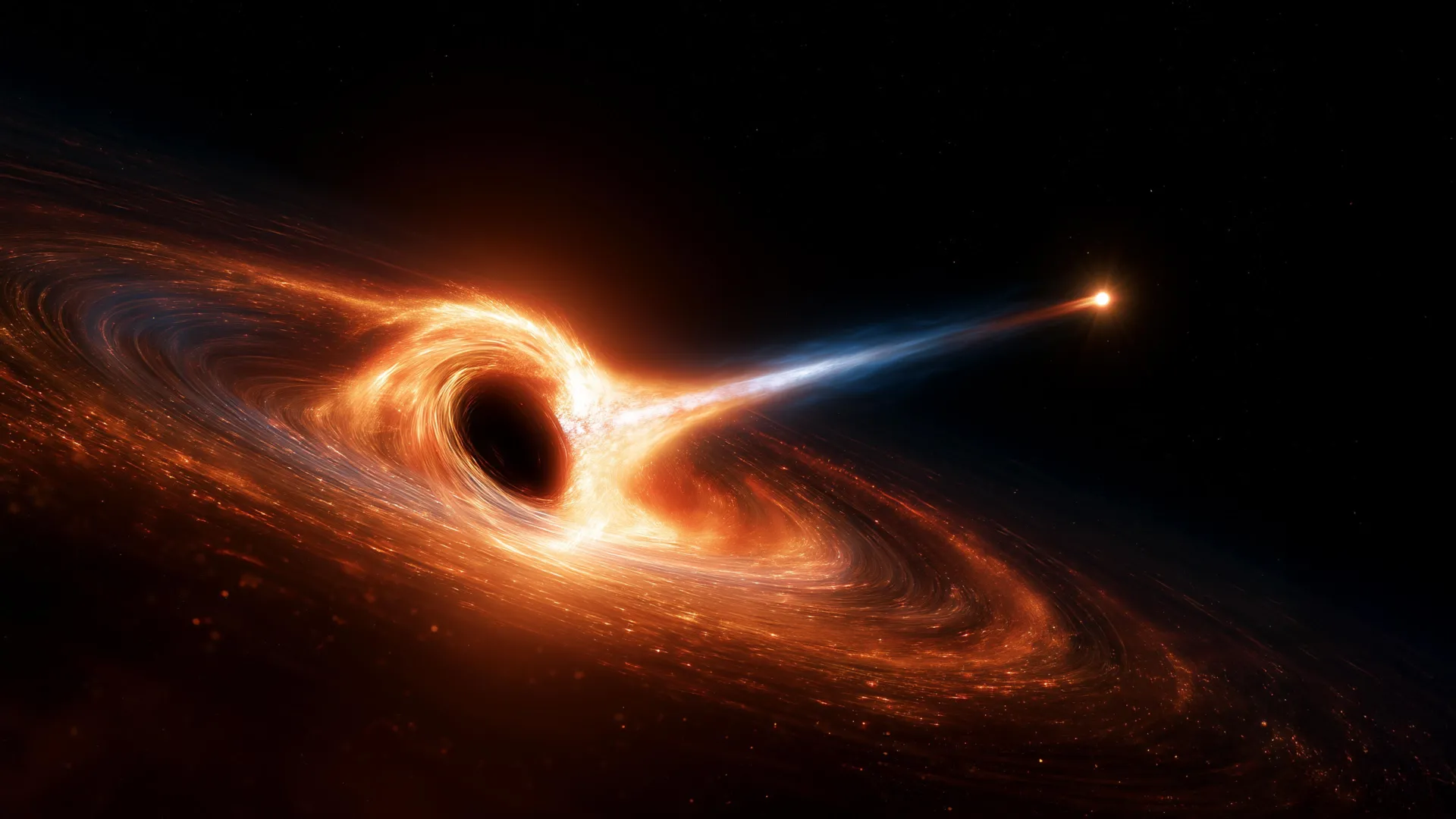
    Astronomers have compared a spectacular tidal disruption event—in which a giant star was torn apart and gradually consumed by a black hole—to “preparing a lunch snack.”

    Astronomers around the world observed this rare black hole encounter, which was announced at the American Astronomical Society conference in Phoenix, Arizona. Researchers explained that the star was ripped apart by the black hole’s immense gravitational force, with its material consumed piece by piece.

    Daniel Perley, an associate professor of astrophysics at Liverpool John Moores University, is the lead author of a study published in Monthly Notices of the Royal Astronomical Society. “We have discovered what we believe to be a black hole merging with a massive companion star and shredding it into a disk that feeds the black hole. This is a rare and awe-inspiring phenomenon,” he told the conference.

    The destruction triggered one of the most powerful cosmic events ever recorded. Although the event was relatively short-lived, it released approximately 400 billion times the energy produced by the Sun, surpassing even the most powerful supernova known to astronomers.

    Black hole swallows giant star

    Astronomers have previously observed black holes apparently consuming stars in events known as tidal disruption events. However, researchers had never witnessed such an encounter occurring on this enormous scale.

    Perley and study co-author Anna Ho, an assistant professor of astronomy at Cornell University, identified the extraordinary event shortly after its light reached Earth. Ho detected the object using the Zwicky Transient Facility at Palomar Observatory in California. The event was officially designated AT2024wpp and nicknamed the Whippet.

    Researchers quickly suspected that the event could be a luminous fast blue optical transient, or LFBOT—a rare and poorly understood type of cosmic explosion associated with the destruction of stars. Within a day, observations from the Liverpool Telescope in the Canary Islands and NASA’s Swift satellite confirmed that the object had the expected characteristics of an LFBOT. It appeared unusually blue and emitted powerful X-rays.

    Distance measurements provided by co-authors R. Michael Rich of UCLA and Yu Jing Qin of the California Institute of Technology showed that the transient released far more energy than a typical supernova. Combined with other observations, including its unusually high temperature, the findings led researchers to conclude that they were witnessing a giant star being torn apart and swallowed by a black hole.

    “We had our suspicions about what it was, but it was still unusual,” Perley added. “This event was many times more energetic than similar events and more powerful than any known explosion caused by the collapse of a star.”

    “These events not only help us identify black holes, but also provide new ways to understand where black holes originate, how they form and grow, and the physics behind these extreme processes,” Perley added.

    A shock wave travels through the surrounding gas

    Additional studies of AT2024wpp revealed that the event generated a powerful shock wave that moved outward through dense surrounding gas at approximately one-fifth the speed of light. After about six months, however, the shock wave appeared to suddenly “disappear.”

    Material stripped from the star formed a disk around the black hole and became extremely hot as it spiraled inward. This process generated X-rays and powerful outflows of gas. The outflow collided with material the star had expelled before its destruction, producing the bright blue and ultraviolet radiation observed during the first few days. It also created radio and millimeter-wave signals detected by astronomers.

    Researchers believe the shock wave appeared to vanish when it reached the outer edge of a bubble formed by gas previously expelled by the doomed star.

    Strange signals emerge from the aftermath

    One puzzling mystery remains. Observations from the Keck Observatory, Magellan Observatory, and the Very Large Telescope revealed no clear chemical signatures during the first month after the explosion. As the event began to fade, however, faint signs of hydrogen and helium emerged.

    The helium signal offered an especially unexpected clue. The gas was moving along our line of sight at more than 6,000 kilometers per second, suggesting that a dense structure may have survived the initial explosion and is now traveling rapidly toward Earth.

    Researchers speculate that the signal may have originated from a stream of material ejected from the star’s core as the black hole’s immense gravity tore it apart. A more speculative possibility is that the material came from a third object in the system and was blown away by a high-velocity wind of particles and X-ray radiation generated by the feeding black hole.

    Source: www.sciencedaily.com

    Share. Facebook Twitter Pinterest LinkedIn WhatsApp
    Previous ArticlePlan Ahead for the Next Two Solar Eclipses
    Next Article COVID-19 Reactivates Dormant Viruses Linked to Long COVID Infections

    Related Posts

    Science

    Coherent Fermion-Parity Oscillations in Coupled Minimal Kitaev Chains

    Technology

    Top 30 Early Black Friday Deals 2026: Best Picks and Ultimate Buying Guide

    Science

    Iowa Explosion Lead Contamination Concerns Persist Despite Official Assurances

    Science

    Einstein’s 120-Year-Old Theory May Be Missing a Major Clue About the Big Bang

    Science

    Physicists Use Gravity to Send Unblockable Messages Through Brick Walls

    Science

    Engineering Signaling Centers for Human Trunk Morphogenesis In Vitro

    Science

    NASA Expands Supplier Program With New Mentor-Protégé Agreements

    Science

    Single-Cell Variant-to-Enhancer-to-Gene Map of Coronary Artery Disease Genetics

    Add A Comment
    Leave A Reply Cancel Reply

    Stay In Touch
    • Facebook
    • Twitter
    • Instagram
    • Pinterest
    Top Picks
    Technology

    Hackers Breach Government Webmail While Running Cryptocurrency Scam

    The Jewelbug hacking group is conducting cyberespionage campaigns against government and military organizations while simultaneously…

    Watch Killer Whales Dismember Giant Sunfish: Stunning Footage Revealed

    China Reaches Solar Energy Milestone: What It Means for the World’s Largest Greenhouse Gas Emitter

    Mysterious Ring of Dead Stars Reveals What Happens When the Sun Dies

    Atlantic Hurricane Season Set to Make History for the First Time in 175 Years

    Most Popular
    Science

    Watch the Hunter’s Moon Rise This Weekend Before Four Consecutive Supermoons Appear

    Technology

    Microsoft Profits Surge After Announcing Thousands of Layoffs

    Categories
    • AI (9)
    • Gadgets (6)
    • Science (3,594)
    • Space (3)
    • Technology (3,237)
    • Wheels (3)
    Our Picks
    Technology

    How This Founder Is Teaching Computer Chips to Recycle Energy

    Science

    Mini Arteries on a Chip May Help Predict Stroke Risk in Humans

    © 2026 Hitechub.
    • Home
    • About Us
    • Privacy Policy
    • Terms & Conditions

    Type above and press Enter to search. Press Esc to cancel.

    GDPR Cookie Banner

    We are using cookies to give you the best experience on our website.

    You can find out more about which cookies we are using or switch them off in .

    Ad Blocker Enabled!
    Ad Blocker Enabled!
    Our website is made possible by displaying online advertisements to our visitors. Please support us by disabling your Ad Blocker.