


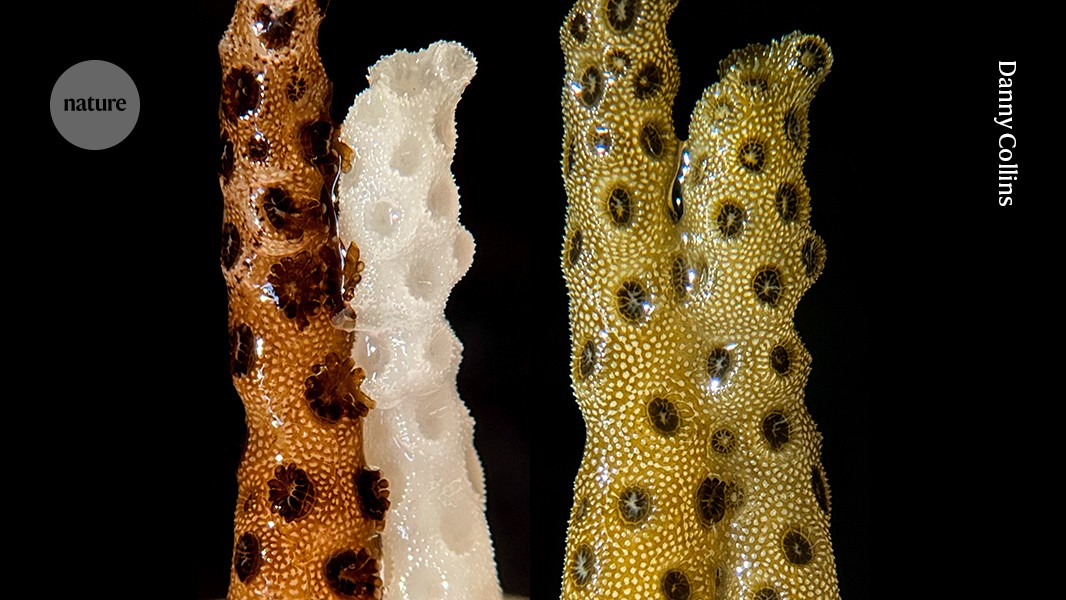
Bleached Corals Recover in Weeks After Fusing with Healthy Fragments
This video shows bleached coral fragments returning to a healthy state within a few weeks by merging with bright coral fragments taken from the same individual.
Credit: Danny Collins
Scientists have rapidly restored bleached corals in the laboratory by exposing them to healthy coral fragments, offering hope for reversing widespread coral decline.
Rising ocean temperatures stress corals, causing them to expel the symbiotic algae that live inside their tissues and give them their color. This process is known as coral bleaching.
Photosynthetic algae from the family Symbiodiniaceae provide most of a coral’s nutrients. Without these algae, corals become severely weakened, putting the marine life that depends on coral ecosystems at risk.
A research team has shown that coral bleaching can be completely reversed within weeks when bleached fragments are placed in contact with healthy fragments from the same individual. The study results were reported in Scientific Reports on October 14.1
“This surprising new finding that bleached corals are capable of rapid and complete recovery may ultimately suggest scalable solutions,” said Fiorenza Micheli, a marine ecologist at Stanford University’s Center for Marine Solutions in California and a co-author of the study.
How healthy coral helped bleached coral recover
In early 2025, Stephen Palumbi, a marine scientist at the Hopkins Marine Station in Pacific Grove, California, was working in his laboratory when he noticed that two coral fragments in his aquarium had accidentally touched. Where the healthy and bleached fragments met, color was beginning to spread into the ghostly branches.
“I had never seen anything like that before,” he recalls.

Symbionts spread from healthy corals to bleached corals.
Credit: Danny Collins
Danny Collins, who was studying how coral diseases spread through contact as part of his doctoral program at Stanford University, investigated whether algae could also be transferred between coral fragments.
He prepared 10 pairs of coral fragments from the same animal, Pocillopora damicornis. Each pair contained one bleached fragment and one healthy fragment. Five pairs were placed in direct contact, while the other five were positioned a few millimeters apart.
In the contact pairs, the bleached corals recovered within eight weeks.
“We were shocked when we saw the color of the symbiotic algae transfer to the bleached coral and saw the coral come back in a very short period of time,” Collins said.
By the second week, the symbiont population was doubling every four days. That recovery was much faster than the recovery times observed in studies of corals recovering naturally in the wild.2,3
Coral recovery depends on genetic matching
After a week of contact with healthy fragments, the bleached branches were able to continue recovering on their own, even when they were no longer touching healthy branches.
By contrast, the bleached fragments in the pairs that were kept slightly apart died after 20 weeks.
Using high-powered microscopy, the researchers found that the coral fragments fused by forming a tissue bridge. This bridge allowed the symbiotic algae to move from the healthy fragment into the bleached one.
The process occurred only when the fragments came from individuals with the same genetic makeup, known as genets. Fragments from different species, or even from different animals of the same species, did not fuse. As a result, those bleached fragments could not be restored to a healthy state.
Source: www.nature.com