


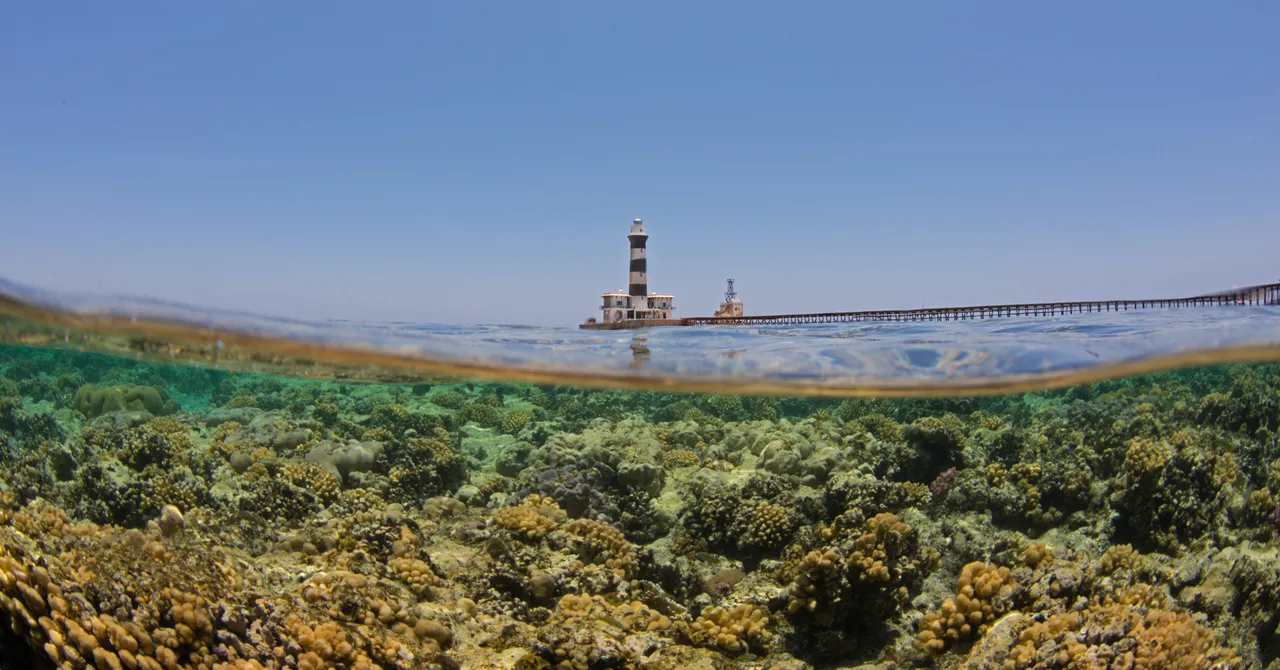
Why Egypt’s Red Sea Coral Reefs Survived the 2024 Heat Wave
Water circulation may protect Egypt’s coral reefs
Resilience varies by region, which is one reason Hanafi is not convinced that evolutionary history is the main explanation for the resilience of Egypt’s coral reefs. He places greater emphasis on the water cycle.
In the northern Red Sea, the direction of water flow changes. This creates vertical mixing, bringing cold water toward the surface from far below, he explains. These conditions may protect corals from heat even when ambient temperatures remain high.
The distinction is important. The survival of these reefs may have little to do with the ecology of the corals or the algae that live with them, which could help explain why Red Sea corals began bleaching in 2024.
Weak circulation contributed to the 2024 coral bleaching
During the 2024 heat wave, the ocean remained unusually calm for about a month and a half. This weakened the circulation that Hanafi believes normally helps protect coral reefs. The HEPCA report identifies weak water circulation as a contributing factor in the bleaching. Unusually low tides in July 2024 may also have increased stress on shallow coral communities.
Osman acknowledges that calmer seas may have made the bleaching more severe, but says more research is needed to explain the circulation. “I don’t rule out that possibility,” he says. “But what I would say is that temperature was the main issue.”
The two explanations are not necessarily mutually exclusive. Understanding their relative importance could help scientists assess how vulnerable Egypt’s Red Sea coral reefs are to future heat waves.
Red Sea coral reefs show signs of recovery
There are signs of recovery. One year after the bleaching event, HEPCA’s preliminary estimates put recovery rates between 75 and 88 percent, depending on the species and location. This is much stronger recovery than has been seen elsewhere around the world, where many coral reefs are only just beginning to recover, even if progress has been limited.
Efforts are also underway to protect the Red Sea’s coral reefs ahead of the next heat wave. The Egyptian government has designated new protected areas and is partnering with the United Nations Development Program and the Global Fund for Coral Reefs on conservation and sustainable management.
Osman believes these efforts are a positive step, but emphasizes that conservation requires continued support. “Nature conservation is not a one-year activity, so there is no doubt that we need more stable funding sources.”
The future of Egypt’s reefs depends on climate action
For Hanafi, the future of Egypt’s coral reefs will likely also depend on whether climate change alters the cycles that help keep them alive.
Whatever explains their extraordinary resilience, local protection alone will not stop ocean warming. “The key, therefore, is to reduce carbon dioxide and greenhouse gases. Other solutions only buy time,” Hanafi added.
This story was originally published by WIRED Middle East.
Source: www.wired.com