


Just three cubic meters of lunar soil could help scientists search for physical evidence of an advanced extraterrestrial civilization that may have existed somewhere in the Milky Way, according to a new study. The research paper is scheduled for publication in the International Journal of Astrobiology.
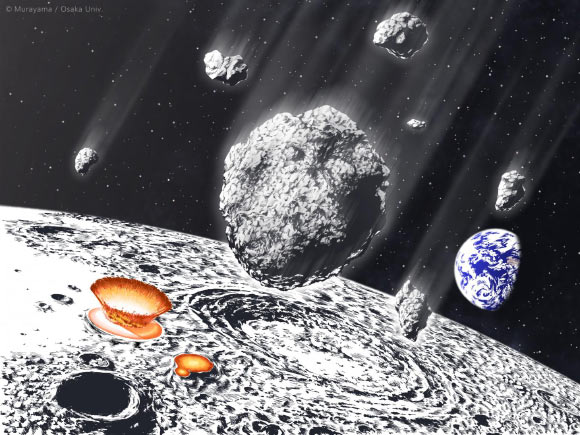
Pinault and colleagues propose searching the Moon for microscopic technosignatures—tiny artificial particles that may have traveled through interstellar space and remained preserved in the lunar soil for billions of years. Image credit: Murayama, Osaka University.
The idea of searching the Moon for alien technology is not new. In the 1990s, Ukrainian astronomer Oleksiy Arkhipov proposed that microscopic debris from extraterrestrial spacecraft, probes, or industrial activity could drift through interstellar space and accumulate on ancient, stable surfaces such as the Moon.
SETI Institute researcher Luis Pineau and his colleagues have now revisited and expanded this concept in a new study focused on microscopic technosignatures in lunar regolith.
“For billions of years, the Moon has been quietly accumulating material from space, much of which may be billions of years older than the Moon itself,” Dr. Pineau said.
“We suspect that this ancient collection may contain microscopic traces of technology created long before humans began observing the sky.”
Unlike Earth, the Moon has no substantial atmosphere, flowing water, or active plate tectonics to destroy or redistribute ancient material. Its surface has been collecting dust from across the Solar System—and potentially from interstellar space—for approximately four billion years.
This makes lunar soil a remarkably stable archive of the Milky Way’s history. If advanced civilizations produce durable microscopic debris, either intentionally or as a byproduct of space exploration and large-scale engineering, some of those particles could eventually become embedded in the lunar regolith.
For the study, the researchers modeled how particles measuring as little as 0.3 microns across—several hundred times thinner than a human hair—could survive a journey through interstellar space.
Their results suggest that sufficiently durable, refractory particles could travel thousands of light-years over hundreds of millions or even billions of years. Some may reach the Earth-Moon system slowly enough to survive impact without completely evaporating.
Solar radiation pressure and the Sun’s magnetic environment, known as the heliosphere, could influence how these particles move through space and enter the Solar System.
The researchers refer to this potential unintentional debris as “Arkhipov particles.” These particles would be comparable to the artificial space debris currently orbiting Earth, although they may have originated from distant civilizations.
The study also discusses a more speculative category called “Bracewell particles,” named after physicist Ronald Bracewell’s proposal for an autonomous interstellar probe. These hypothetical microscale devices could be deliberately engineered to sense their surroundings, record information, or even carry out limited self-replication.
Detecting and confirming such microscopic technosignatures would be extremely challenging. Researchers would need to combine automated machine-vision screening with detailed laboratory analysis, including isotopic, chemical, and structural testing.
These analyses would be essential for distinguishing potential alien artifacts from natural minerals, terrestrial contamination, or debris produced by human spacecraft.
“The concept of searching for microscopic technosignatures in the lunar regolith is both highly original and highly rational,” said Bill Diamond, Director and CEO of the SETI Institute.
“This is a new addition to the search methodology used to investigate evidence of life and technology as potential indicators of intelligence beyond our Solar System, and we are excited about the prospect of making this a reality.”
_____
Luis J. Pineau and colleagues. 2026. Micron-scale technosignatures: How one cubic meter of lunar regolith begins to limit the number of past technological civilizations in the galaxy. International Journal of Astrobiology, in press. arXiv: 2606.24028
Source: www.sci.news