


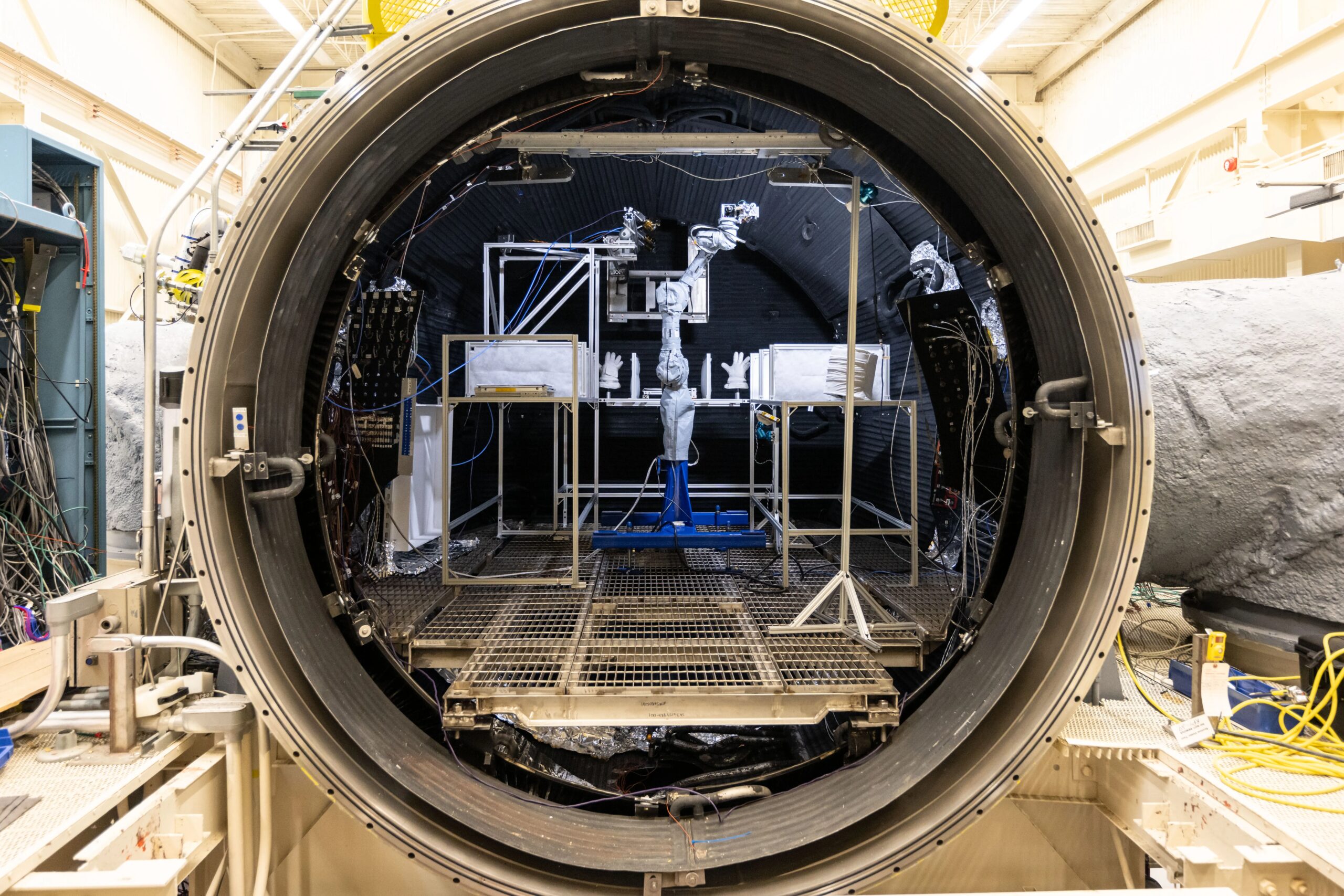
Before astronauts return to the Moon through NASA’s Artemis program, the hardware they rely on must prove it can withstand the extreme lunar environment. At NASA’s Johnson Space Center in Houston, engineers at the Lunar Development and Test Facility are addressing one of the most significant challenges of lunar exploration: Moon dust.
Also known as lunar regolith, Moon dust is sharp, abrasive, and highly clingy—far different from sand on Earth. Without effective dust mitigation, it could damage spacecraft, equipment, spacesuits, and mechanical systems while creating potential health risks for astronauts. Understanding how lunar dust behaves is essential as crews prepare to live and work on the Moon’s surface during future Artemis missions.
Located within NASA Johnson’s Energy Systems Test Area, the Lunar Development and Test Facility supports the development and testing of spaceflight hardware in simulated lunar conditions. Engineers use vacuum chambers and lunar regolith simulant to evaluate spacesuits, spacecraft components, mechanical systems, and moving parts that will need to operate reliably on the Moon.
NASA Johnson’s Propulsion and Power Division developed the specialized systems that make these lunar environment simulations possible. The facility includes a dust containment and preparation laboratory for ambient testing, a 3-foot cube vacuum chamber, and a 15-foot thermal vacuum chamber designed to recreate key conditions found on the lunar surface.
Inside the vacuum chambers, engineers test hardware with lunar regolith simulant while a closed-loop nitrogen system helps reproduce the Moon’s harsh, airless environment. These tests provide valuable data for improving equipment performance, durability, and dust resistance before technologies are deployed on future lunar missions.
“The facility helps develop and test technologies needed for long-duration lunar exploration,” said Mike Salinas, deputy chief of the Propulsion and Power Division branch. “Engineers are advancing techniques to extract resources from lunar regolith, which can be processed into oxygen for astronauts and liquid oxygen for rocket propellant.”
NASA’s spirit of exploration also extends beyond the facility’s walls. Its exterior features a large-scale mural showing astronauts exploring the lunar surface beneath a cosmic landscape. Completed in 2024 by artist Sebastian Boileau, the artwork celebrates the innovation, ingenuity, and discovery taking place inside the building.
Now, anyone can explore the Lunar Development and Test Facility from anywhere. NASA’s new 3D virtual tour offers an inside look at the laboratories and testing chambers where engineers are preparing lunar technologies for Artemis and the next era of Moon exploration.
Source: www.nasa.gov