


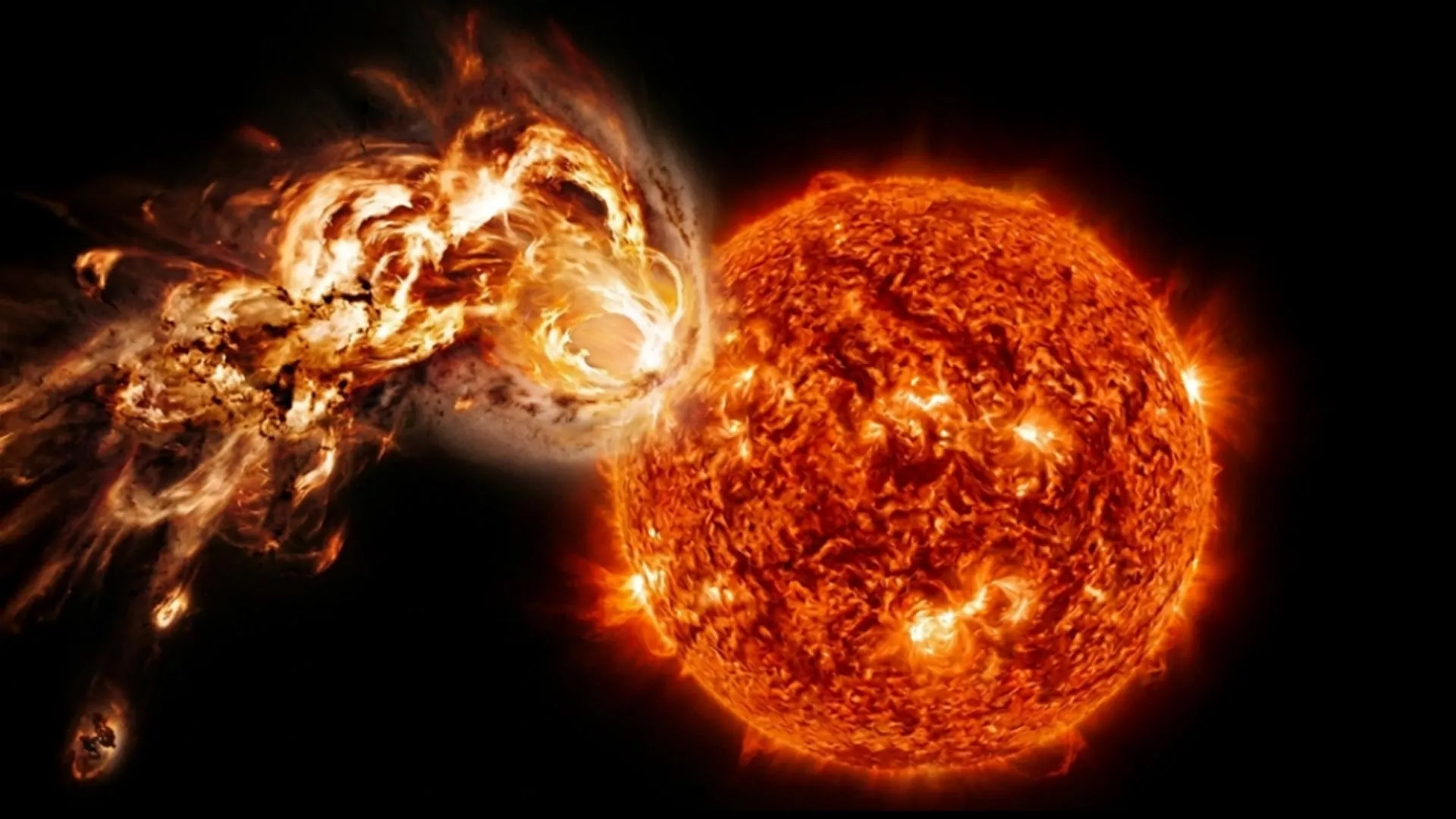
As stars similar to our Sun age, they expand and transform into red giants. During this phase, their outer layers become tumultuous, gradually drifting into space, while the dense cores that are left behind shrink into white dwarfs. This sequence is the ultimate fate of most stars, making white dwarfs one of the most prevalent stellar remnants across the universe.
A groundbreaking model developed by Jim Fuller, a theoretical astrophysicist at the California Institute of Technology, indicates that this stellar transformation may be far less orderly than previously believed. Fuller’s calculations suggest that uneven bursts of ejected material could nudge the dying star in various directions, resulting in thousands of small ‘kicks’ before it completes its transition into a white dwarf.
Chaotic Eruptions Propel Dying Stars
“In this model, clumps of material are randomly expelled from the asymmetrically expanded surface of the star,” Fuller explains. “With each ejection, the star is nudged slightly in the opposite direction, abiding by Newton’s third law: for every action, there is an equal and opposite reaction.”
Fuller presented these revolutionary findings at the 248th Meeting of the American Astronomical Society in Pasadena, with the research submitted to the Pacific Astronomical Society Publications.
His calculations show that a star nearing the white dwarf phase could experience approximately 10,000 small kicks over the course of several hundred thousand years. Each kick would displace the star by only a few meters per second. “That’s slower than a human jogger,” he notes.
Accumulating Small Kicks
The escaping material is ejected in random directions, but the resultant kicks do not fully cancel each other out. Over time, this leads to a net movement in a specific direction, described by a mathematical process known as a random walk.
A simple analogy is tossing a coin repeatedly to decide movement direction: each step is random, but you will ultimately drift away from your starting point. According to Fuller’s model, the cumulative effect of these kicks could result in the dying star traveling around one kilometer per second in a random direction.
Some celestial objects endure more intense forces. For instance, when a massive star detonates in a supernova, it can propel stellar debris in a specific direction at high velocities. While astronomers have long suspected that white dwarfs undergo comparable shocks, the process appears to be much gentler since these stars do not explode.
Understanding Wide Binary Stars’ Breakup
Evidence supporting the theory of white dwarf kicks comes from research led by Kareem El-Badry, an assistant professor of astronomy at the California Institute of Technology. He discovered that widely separated binary star pairs become less common when one star evolves into a white dwarf.
A new model suggests a potential explanation: a net kick of about one kilometer per second could destabilize the orbits of loosely bound binary stars, leading to their eventual separation.
“If the binary star’s orbital velocity is less than its kick velocity, the wide binary star may break free from its gravitational grip,” Fuller clarifies.
Fuller developed this model using El Badry’s data and computer simulations that explore convection within aging red giant stars. These simulations reveal that stirred material near the star’s surface can escape in a non-uniform manner, rather than flowing away evenly.
This model is the first to directly connect the multitude of randomly directed ejections to the motions that astronomers suspect white dwarfs experience.
“I’m excited to see a physical model that explains an observation that has puzzled me for years,” El-Badry comments.
Stellar Kicks and Potential Collisions
This model also introduces new predictions. In some binary systems, the repeated ‘kicks’ delivered to a dying red giant can alter its orbit, possibly resulting in a collision with its companion star. Such an event could lead to a cataclysmic explosion.
Astronomers may be able to observe signs of these dramatic stellar mergers, offering a method to verify whether Fuller’s model accurately depicts the final stages of a Sun-like star’s life cycle.
The research, titled “Kicking of White Dwarfs via Transient Mass Ejection from Red Giant Stars”, received funding from the California Institute of Technology.
Source: www.sciencedaily.com