


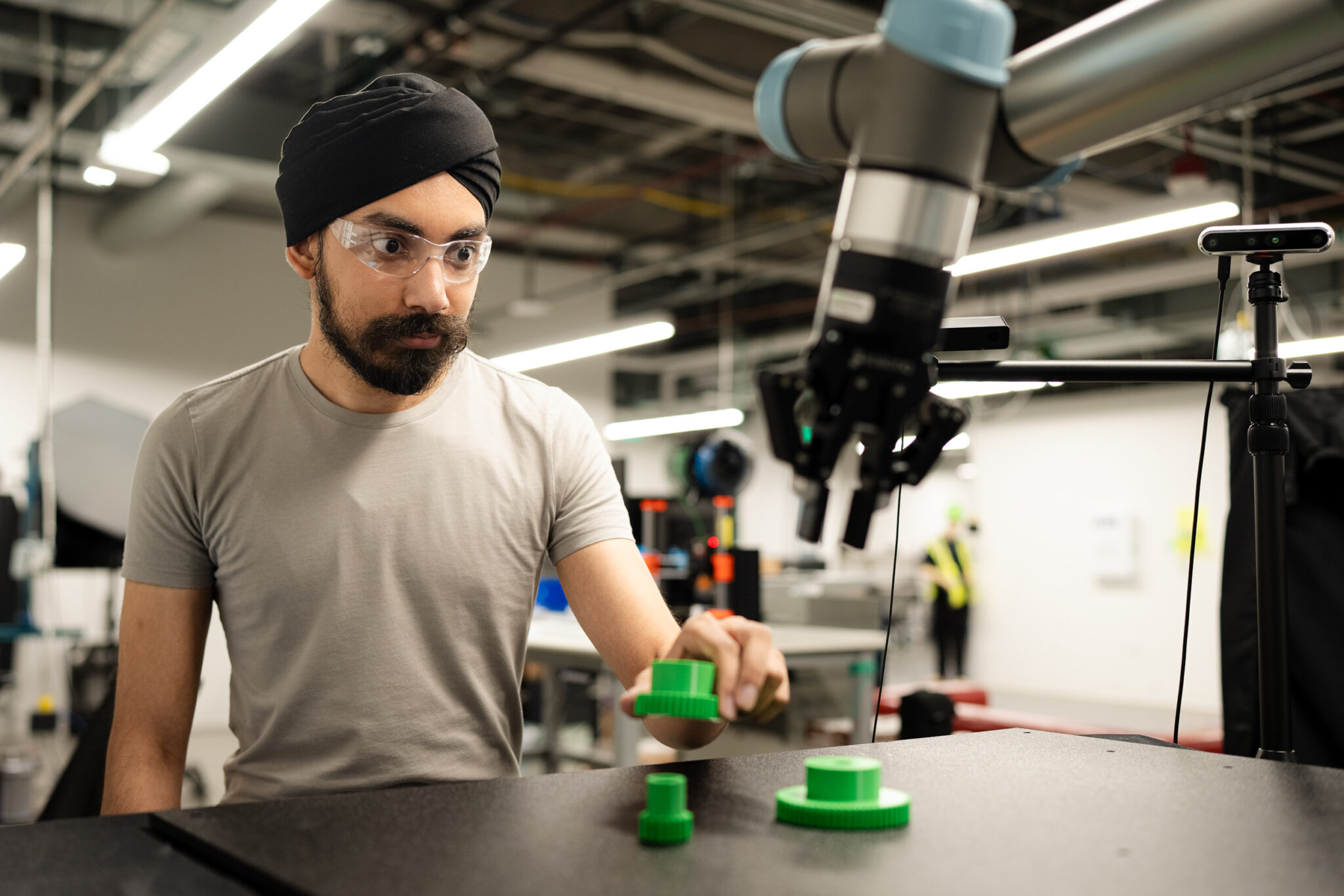
When Jaiveer Singh discusses robotics, he begins not with flashy demos, but with essential infrastructure: the internal components, the software accessible through the robot’s camera, and the engineering necessary for practical applications beyond the demo stage.
As a leading robot software engineer at NVIDIA Isaac ROS (Robot Operating System), Singh is transforming the future of AI in robotics. Built on the open-source ROS 2 framework, Isaac ROS offers CUDA-accelerated libraries and AI models for developers working on autonomous mobile robots, manipulation systems, and humanoid robots.
“My goal is to ensure everyone feels connected to the future of robotics,” Singh stated.
Singh’s journey began in middle school with Lego Mindstorms, a popular programmable robotics kit. He thrived in high school robotics competitions and pursued electrical engineering, computer science, and business at the University of California, Berkeley, where he interned with the robotics team before joining NVIDIA full-time.
Interestingly, the project he now leads started as his internship assignment.
“We were curious about the impact of releasing software utilizing the NVIDIA Jetson platform and CUDA libraries as open source. Would it be valuable?” Singh recounted. “The answer was a resounding yes; developers always want to leverage the GPU’s full capabilities.”
Thus, Isaac ROS was born.
Pillars of the Robotics Revolution
Physics AI blends creativity with the constraints of reality. Viral videos showcase robots performing ballet or intricate dances, but creating systems that consistently operate across various sensors, platforms, factories, and labs can impede progress.
For Singh and the Isaac ROS team, the upcoming robotics era depends on a comprehensive stack encompassing simulation, training, accelerated computing, AI models, middleware, and edge deployment.
Isaac ROS supports a range of applications, including manipulation, mobility, and humanoid robots. It provides developers with essential packages for perception, object detection, mapping, collision detection, and motion planning that can be executed on workstations, including the NVIDIA DGX Spark and the NVIDIA Jetson edge system.
“Unlike the original Isaac SDK, Isaac ROS is fully modular,” Singh explains. “We package our software like Lego blocks, allowing you to customize it as needed and easily integrate your own code with existing ROS code from the global robotics community.”
According to Singh, NVIDIA is accelerating the workflow for many robot manufacturers, facilitating inspection, adaptation, and a robust foundation.
“Open source is valuable because it instills confidence. Developers can build on this foundation early on,” Singh said. “With the fast-paced changes in technology, they need assurance that this platform will provide ongoing support and improvements in the future.”
Such confidence is paramount as the robotics landscape evolves swiftly. Humanoid robots are transitioning from the realm of science fiction to practical engineering.
Singh’s team is dedicated to refining Isaac ROS to cater to the current needs of developers utilizing AI agents and humanoid systems requiring an all-encompassing software stack.
NVIDIA’s longstanding commitment to robotics and its forward-thinking approach initially drew Singh to the company, and his confidence in his work has only deepened since he joined.
“NVIDIA was addressing this issue long before it became crucial,” he noted. “We already recognized its importance.”
To Singh, open source represents a means to share both assurance and accountability. A startup reliant on a closed system must rely on its longevity in the coming years. Open software allows developers to inspect, modify, and improve the code, effectively enabling a community where one company’s fix benefits another.
“The more individuals who can develop robots, the sooner the future will materialize,” Singh declared.
Follow @nvidialife for more insights on NVIDIA Life. Discover NVIDIA’s culture and career opportunities.
Source: blogs.nvidia.com