


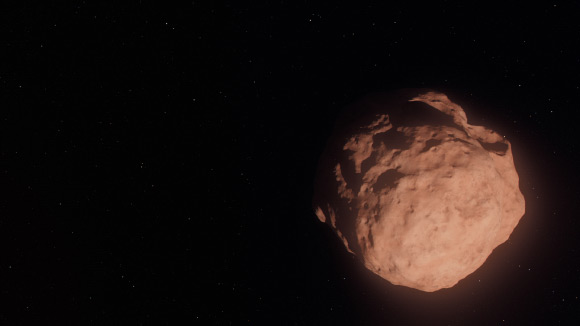
For the first time, astronomers have combined observations from NASA’s Hubble Space Telescope and James Webb Space Telescope to study some of the smallest and faintest objects ever detected beyond Neptune.
Artist’s concept of a trans-Neptunian object beyond Neptune. Image credit: NASA/ESA/Leah Hustak, STScI.
Two teams of astronomers, led by PhD candidates at the University of Victoria and Northern Arizona University, used Hubble’s visible-light observations and Webb’s infrared capabilities to investigate 27 newly identified trans-Neptunian objects (TNOs).
Trans-Neptunian objects are icy remnants from the early stages of solar system formation. They formed before smaller bodies known as planetesimals merged to create the planets.
The smallest objects in the study are only about 5 km (3 miles) across. One is so faint and dark that detecting it from Earth would be comparable to spotting fireflies on the Moon.
The researchers found that the color of one small TNO closely matches that of its much larger relative. This suggests that its surface may not have been substantially altered by impacts, contrary to some scientific expectations.
The team also found that small TNOs are less common than predicted. In addition, the “hot” and “cold” populations of TNOs—classified according to their orbital paths—have surprisingly similar size distributions.
These findings suggest that planetesimal formation may be largely independent of the conditions in the early solar system’s disk.
“It is very interesting that the process of planetesimal formation ultimately generates size distributions that are similar in both cold and hot populations, even though they formed in different regions of the early solar system,” the researchers said.
“This process appears to be independent of disk conditions, producing similar planetesimal sizes whether the disk was hot or cold, dense or fluffy.”
“We can also imagine a scenario in which the surface composition changes during collisions and fragmentation. In that case, the surface color of a small TNO could differ from that of its larger sibling,” added Dr. Anastasia Morgan, a PhD candidate at Northern Arizona University.
“So it is really interesting to see how the smallest objects somehow ‘remember’ and preserve the history of how they formed.”
“The dynamically ‘hot’ TNO retains traces of its birthplace, even though its orbit has since been disrupted,” said Dr. David Trilling, an astronomer at Northern Arizona University.
“Both the ‘hot’ and ‘cold’ populations appear to have changed very little since the birth of the solar system and remain the same color as when they formed.”
The findings are presented in two complementary research papers: We Combined JWST and HST Deep Imaging to Characterize the Smallest Known Trans-Neptunian Object and Luminosity Functions of Ultra-Faint Trans-Neptunian Objects Detected by JWST.
_____
Anastasia N. Morgan et al. 2026. We Combined JWST and HST Deep Imaging to Characterize the Smallest Known Trans-Neptunian Object. The Astronomical Journal 172, 188; doi: 10.3847/1538-3881/ae9084
Mariel R. Eduardo et al. 2026. Luminosity Functions of Ultra-Faint Trans-Neptunian Objects Detected by JWST. The Astronomical Journal 172, 187; doi: 10.3847/1538-3881/ae907f
Source: www.sci.news