


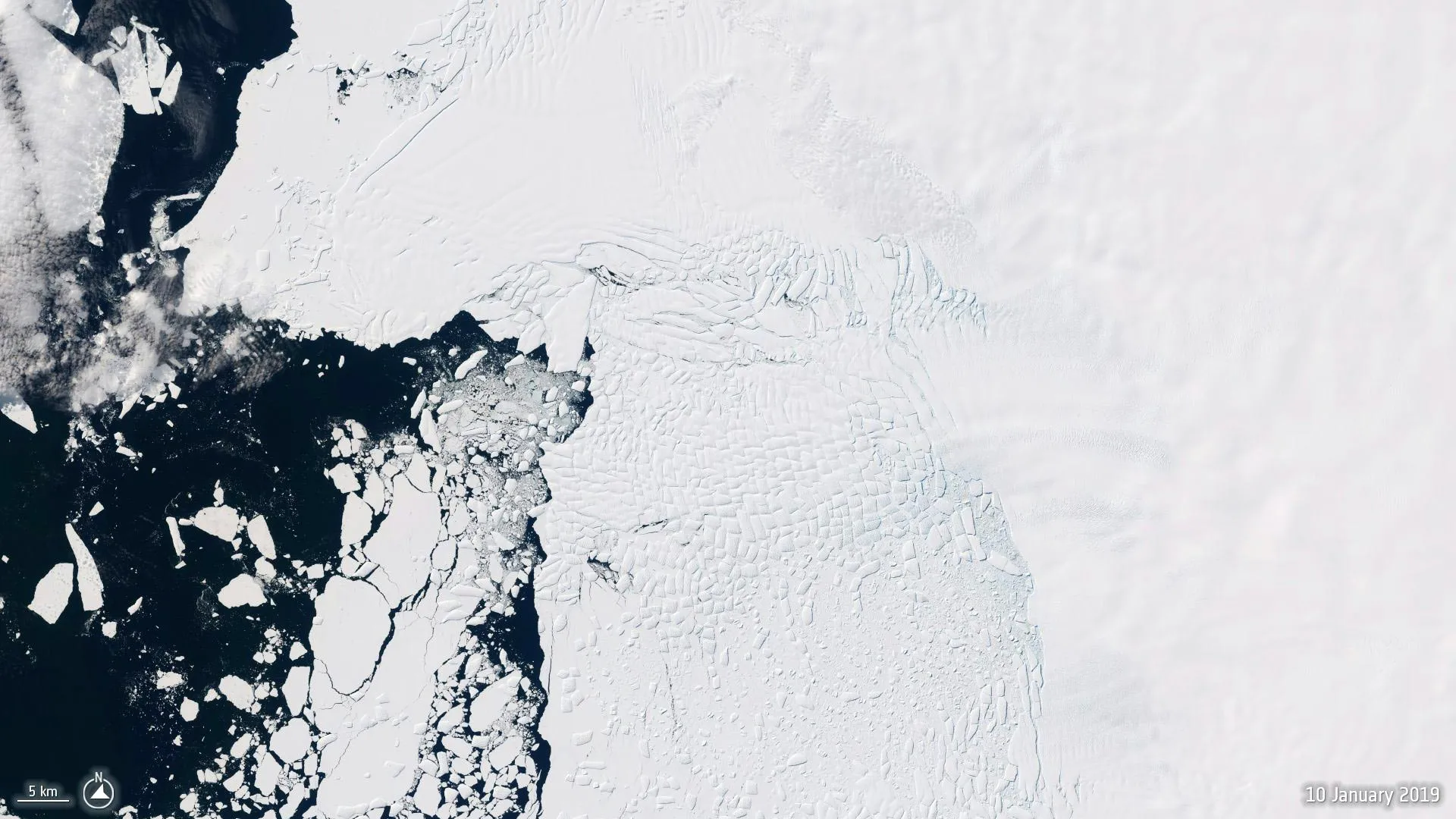
Glacial earthquakes are a rare type of earthquake that occurs in cold, icy regions. First identified in the Northern Hemisphere more than 20 years ago, these events happen when enormous chunks of glacier ice break away, overturn, and fall into the ocean.
Only a small number of glacial earthquakes have been documented in Antarctica. In a new study published in Geophysical Research Letters, I present evidence of more than 360 earthquakes that occurred in Antarctica between 2010 and 2023. Most were detected near the seaward edge, or terminus, of Thwaites Glacier—a vulnerable Antarctic glacier whose collapse could contribute substantially to future sea-level rise.
Recent Discoveries About Glacial Earthquakes
Glacial earthquakes occur when tall, narrow icebergs detach from a glacier’s terminus and fall or overturn into the ocean. When these icebergs form, they can overturn and collide violently with the glacier they broke away from.
These impacts generate powerful mechanical vibrations, known as seismic waves, which can travel thousands of kilometers from the source. Unlike conventional earthquakes, volcanoes, and nuclear explosions, glacial earthquakes produce relatively few high-frequency seismic waves.
This unusual seismic signature made glacial earthquakes difficult to detect. Although conventional earthquakes have been routinely documented for decades, scientists only recently began identifying glacial earthquakes as a distinct type of seismic event.
Glacial Earthquakes Depend on the Season
Most glacial earthquakes detected so far have occurred near the edge of Greenland’s glaciers, which make up the largest ice-covered region in the Northern Hemisphere.
Greenland’s glacial earthquakes can be relatively large. Some have reached magnitudes comparable to seismic signals produced by a nuclear test conducted by North Korea within the past 20 years. Because of their size, they can be detected by high-quality seismic monitoring networks operating around the world.
Glacial earthquake activity in Greenland depends on the season and often peaks in late summer. These events have also become more common in recent decades, possibly reflecting the rapid rate of climate warming in polar regions.
Elusive Evidence of Antarctic Glacial Earthquakes
Antarctica contains the largest ice sheet on Earth, but direct evidence of glacial earthquakes caused by overturning icebergs has been difficult to find. Most previous efforts relied on global earthquake-monitoring networks.
However, if Antarctic glacial earthquakes are smaller than those in Greenland, global networks may not be sensitive enough to detect them. To address this problem, my new research used seismic stations located within Antarctica to search for evidence of these events.
The analysis identified more than 360 glacial earthquake events, most of which do not yet appear in standard earthquake catalogs. The events were concentrated in two clusters near Thwaites Glacier and Pine Island Glacier. Together, these glaciers are among the largest contributors to sea-level rise from Antarctica.
Glacial Earthquakes at Thwaites Glacier
Thwaites Glacier is sometimes called the “Doomsday Glacier” because of its vulnerability and potential impact on global sea levels. If Thwaites Glacier were to collapse completely, it could contribute significantly to sea-level rise, while also destabilizing neighboring parts of the West Antarctic Ice Sheet.
Approximately two-thirds of the detected events—245 of 362—occurred near the ocean-facing terminus of Thwaites Glacier. Most of these events are consistent with glacial earthquakes produced when icebergs break away and overturn into the ocean.
Unlike glacial earthquakes in Greenland, the activity at Thwaites does not appear to be driven primarily by annual changes in air temperature or the seasonal patterns associated with Greenland’s glacial earthquakes.
Instead, the highest level of activity at Thwaites between 2018 and 2020 coincided with an acceleration of the glacier’s floating ice tongue toward the ocean. Satellite observations independently confirmed this increase in ice flow speed.
The acceleration may have been influenced by changing ocean conditions, although the precise causes remain poorly understood. The findings suggest that ocean processes can affect the short-term stability of Antarctic glaciers that end in the sea.
More research is needed to determine how these interactions contribute to glacier loss and future sea-level rise, including the contribution of glaciers to long-term changes in ocean levels.
The second-largest cluster of detected events occurred near Pine Island Glacier. However, these earthquakes were consistently located 60 to 80 kilometers inland from the glacier’s ocean-facing edge, making it unlikely that they were caused by overturning icebergs.
The cause of these events remains uncertain and will require further investigation.
The Next Challenge in Antarctic Glacial Earthquake Research
Detecting glacial earthquakes linked to iceberg calving at Thwaites Glacier could help scientists answer several important questions about the glacier’s future. These include the potential instability created by interactions among the ocean, glacier ice, and solid ground beneath the glacier’s terminus.
A clearer understanding of these processes could help reduce current uncertainty about sea-level rise over the coming centuries. Monitoring Antarctic glacial earthquakes may therefore provide a valuable new way to track changes in vulnerable glaciers and improve projections of future global sea-level rise.
Source: www.sciencedaily.com