


The supplied material is a bibliography of 155 references covering the development of visible and near-infrared photonic integrated circuits, augmented- and virtual-reality displays, laser beam scanning, waveguides, metasurfaces, optical phased arrays, and related sensing and quantum technologies. It spans work published from 1901 to 2026, ranging from early concepts for electrical displays and Ivan Sutherland’s 1965 “ultimate display” to recent demonstrations of flat-panel laser displays, nanophotonic beam scanners and dense integrated optical phased arrays.
From early display concepts to modern extended reality
The references place today’s extended-reality hardware in a longer history of display research. L. F. Baum’s The Master Key, published in 1901, provides an early literary connection to electricity and imagined technologies. In 1965, Ivan E. Sutherland described “The ultimate display” in the Proc. IFIP Congress. Later work established the optical foundations of near-eye displays, including pupil-replication waveguides, diffractive optics and light-field systems.
Research has since focused on making augmented-reality displays thinner, brighter and more capable while preserving a wide field of view. Reviews by J. Xiong, E.-L. Hsiang, Z. He, T. Zhan and S.-T. Wu; Bernard C. Kress; and Y. Ding and colleagues survey the emerging technologies, optical architectures and continuing challenges in AR and VR systems.
Photonic integrated circuits move into the visible spectrum
Silicon photonics was initially developed largely for infrared communications, but the bibliography documents a broad effort to extend integrated photonics into visible wavelengths. Silicon nitride has become an important platform because it can support low-loss waveguides across visible, near-infrared and mid-infrared bands. Reviews and demonstrations by P. Muñoz and colleagues, A. Rahim and colleagues, M. A. Tran and colleagues, and J. K. S. Poon and colleagues describe this expansion.
More recent work addresses the manufacturing infrastructure needed for visible photonics. The cited literature includes visible-light foundry platforms from AIM Photonics, silicon-nitride foundry processes, 200 mm and 300 mm wafer-scale technologies, and low-loss platforms from organizations including IMEC and LIGENTEC. Other approaches use aluminium oxide, silicon carbide, thin-film lithium niobate and hybrid material systems.
Lasers and modulators
Light sources remain a central challenge for compact photonic systems. The references include integrated lasers operating from the near-ultraviolet to the near-infrared, widely tunable chip-scale lasers, visible-light laser engines for AR glasses and quantum-dot lasers grown directly on silicon. A 2024 review by X. Lu and colleagues examines emerging integrated laser technologies in the visible and short near-infrared regimes, while work by M. Corato-Zanarella and colleagues reports widely tunable, narrow-linewidth chip-scale lasers.
The bibliography also covers visible-light modulation using liquid crystals, lithium niobate, silicon-organic hybrids, barium titanate and silicon-ferroelectric nematic liquid crystals. These devices are intended to control optical phase or amplitude at the speeds required by displays, communications and photonic computing.
Architectures for AR displays
The cited display research covers several competing approaches. Liquid-crystal-on-silicon devices, microLEDs, laser projection, laser beam scanning and waveguide displays each offer different trade-offs in brightness, efficiency, size, resolution and manufacturing complexity. Reviews by Y. Huang and colleagues, A. R. Anwar and colleagues, E.-L. Hsiang and colleagues, and K. Behrman and I. Kymissis describe these technologies and their remaining limitations.
Waveguides are a recurring theme because they can route images through thin, see-through optical elements placed in front of the eye. The bibliography includes work on diffractive and geometrical waveguides, pupil steering, holographic retinal projection and synthetic-aperture waveguide holography. A 2025 study by S. Choi, C. Jang, D. Lanman and G. Wetzstein examines synthetic-aperture waveguide holography for compact mixed-reality displays with large étendue. Work by M. Gopakumar and colleagues, published in Nature in 2024, describes full-colour 3D holographic augmented-reality displays with metasurface waveguides.
Beam steering without conventional moving optics
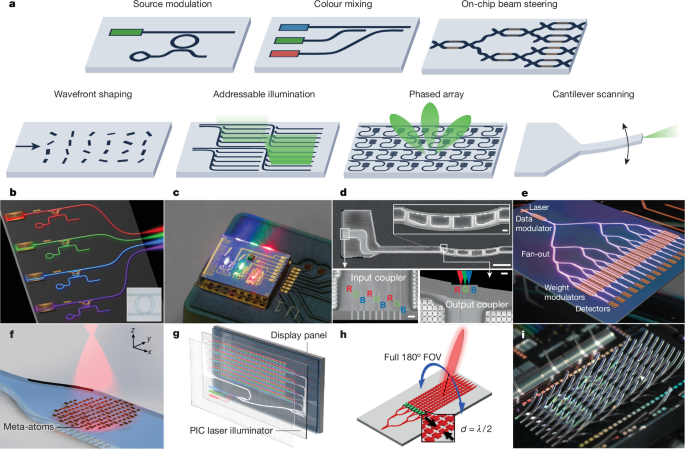
Several references explore ways to steer light electronically or with microscopic mechanical structures. MEMS mirrors can scan laser beams in two dimensions, while optical phased arrays change the phase of light emitted by many closely spaced elements. Integrated photonic circuits can therefore perform beam steering on a chip, potentially reducing the size of display and sensing systems.
The bibliography includes a 2025 Nature paper by Z. Shi and colleagues on flat-panel laser displays made with large-scale photonic integrated circuits. A 2026 Nature paper by M. Saha and colleagues reports nanophotonic waveguide chip-to-world beam scanning. Other cited work covers microcantilever-integrated photonic circuits, active optical phased arrays, programmable photonic circuits and visible-spectrum-spanning integrated optical-phased-array systems.
Optical phased arrays are also being developed for coherent LiDAR, free-space optical communications and underwater communications. The cited examples include a coherent LiDAR system with an 8,192-element optical phased array, photonic-electronic integrated LiDAR engines and integrated arrays designed to avoid grating lobes while providing a wide field of view.
Metasurfaces and holographic projection
Metasurfaces provide another route to controlling light on a compact platform. These engineered layers can shape the phase, amplitude and direction of optical waves using structures smaller than the wavelength of light. The references include foundational work on designer metasurfaces by N. Yu and F. Capasso, as well as studies of leaky-wave metasurfaces, dielectric metasurfaces, metasurface-dressed waveguides and inverse-designed photonic circuits.
Applications described in the bibliography include holographic projection, free-space light-field manipulation, narrow-frequency filters and integrated beam steering. Neural holography and deep-neural-network approaches are also represented, including work by Y. Peng and colleagues and by L. Shi and colleagues.
Perception, image quality and display limitations
The bibliography emphasizes that hardware performance alone does not determine the quality of an AR or VR system. Field of view, eye resolution, retinal image quality, stray light, speckle and pupil position all affect the user’s experience. Research by B. Wheelwright and colleagues argues that field of view should not be treated as a single number, while work by D. M. Hoffman and colleagues examines vergence-accommodation conflicts, which can hinder visual performance and cause visual fatigue.
Other cited studies address the eye’s resolution limit, pupil-steered image quality, foveated rendering and saccade-contingent rendering. These approaches aim to allocate display resources according to where the user is looking, although the references also identify perceptual requirements for keeping virtual content stable relative to the real world.
Beyond displays
The technologies described in the references extend beyond consumer AR glasses. Integrated visible photonics has been applied to fluorescence microscopy, flow cytometry, optogenetics, retinal imaging, optical coherence tomography and wearable optical sensing. Photonic circuits have also been used for laser stabilization, quantum communication, trapped-ion control and spin-photon interfaces.
Examples include a photonic chip that stabilizes a laser to atomic vapour with an instability of 10−11, a chip-integrated visible–telecom entangled-photon-pair source, integrated multi-wavelength control of an ion qubit and photonic engines for programmable atomic control. The bibliography also includes work on routing single photons from trapped ions and on integrated-photonics-based polarization-gradient cooling of trapped ions.
Manufacturing and integration challenges
Across the cited fields, the same engineering constraints recur: low optical loss, efficient light sources, high-speed modulation, thermal management, packaging, alignment, fabrication yield and compatibility with large-scale manufacturing. The references describe processes based on silicon nitride, lithium niobate, aluminium oxide, gallium nitride, polymers, phase-change materials and heterogeneous integration.
The collection therefore presents visible integrated photonics as an enabling technology rather than a single device category. Its potential applications include AR displays, LiDAR, optical communications, biomedical imaging, quantum information processing and scientific instrumentation. The bibliography does not provide a separate narrative conclusion, but its range of publications shows how advances in materials, photonic design, lasers, modulators, beam steering and manufacturing are converging across these applications.
Source: www.nature.com