


Most Distant Fast Radio Burst Ever Detected Reveals a Young Galaxy in the Early Universe
Astronomers have detected the most distant fast radio burst (FRB) ever observed—a powerful burst of radio energy that traveled more than 10 billion light-years to reach Earth.
Known as FRB 20240304B, the event is one of thousands of fast radio bursts detected by astronomers. These brief flashes of radio energy typically last only a few milliseconds, making them difficult to study. Their exact origins also remain unknown.
In this case, however, researchers used the MeerKAT radio telescope array to precisely locate the burst and the James Webb Space Telescope (JWST) to identify its host galaxy. The study, published Thursday, October 8, in the journal Science, provides new evidence that fast radio bursts existed early in the universe’s history. The discovery more than doubles the previous distance record for an FRB.
James Webb Space Telescope identifies the FRB’s host galaxy
JWST played a key role in the discovery and is a co-author of the study. Temiya Nanayakkara, a senior lecturer at the Sydney Institute of Astronomy, told Live Science in an email that the message was written in collaboration with the study’s lead author, Manisha Caleb, a senior lecturer in astrophysics at the same university.
JWST observations showed that the host galaxy is smaller than expected, poor in elements heavier than hydrogen and helium, and forming many stars. These characteristics could offer important clues about the environments where fast radio bursts occur.
The researchers suggest that FRB 20240304B may have been produced by a magnetar—a highly magnetic stellar remnant left behind after a supernova explosion.
MeerKAT precisely located the ancient radio burst
The ancient FRB was first detected by MeerKAT, a network of 64 radio telescopes in South Africa. According to Nanayakkara, MeerKAT revealed both the fast radio burst and its precise location in the sky.
Researchers knew the burst was extremely distant because its radio signals were highly scattered. Initial searches with powerful ground-based telescopes, however, found no visible host galaxy.
“The most likely explanation is that the galaxy was simply too faint to be detected by these observations, which is where JWST made a difference,” the researchers told Live Science.
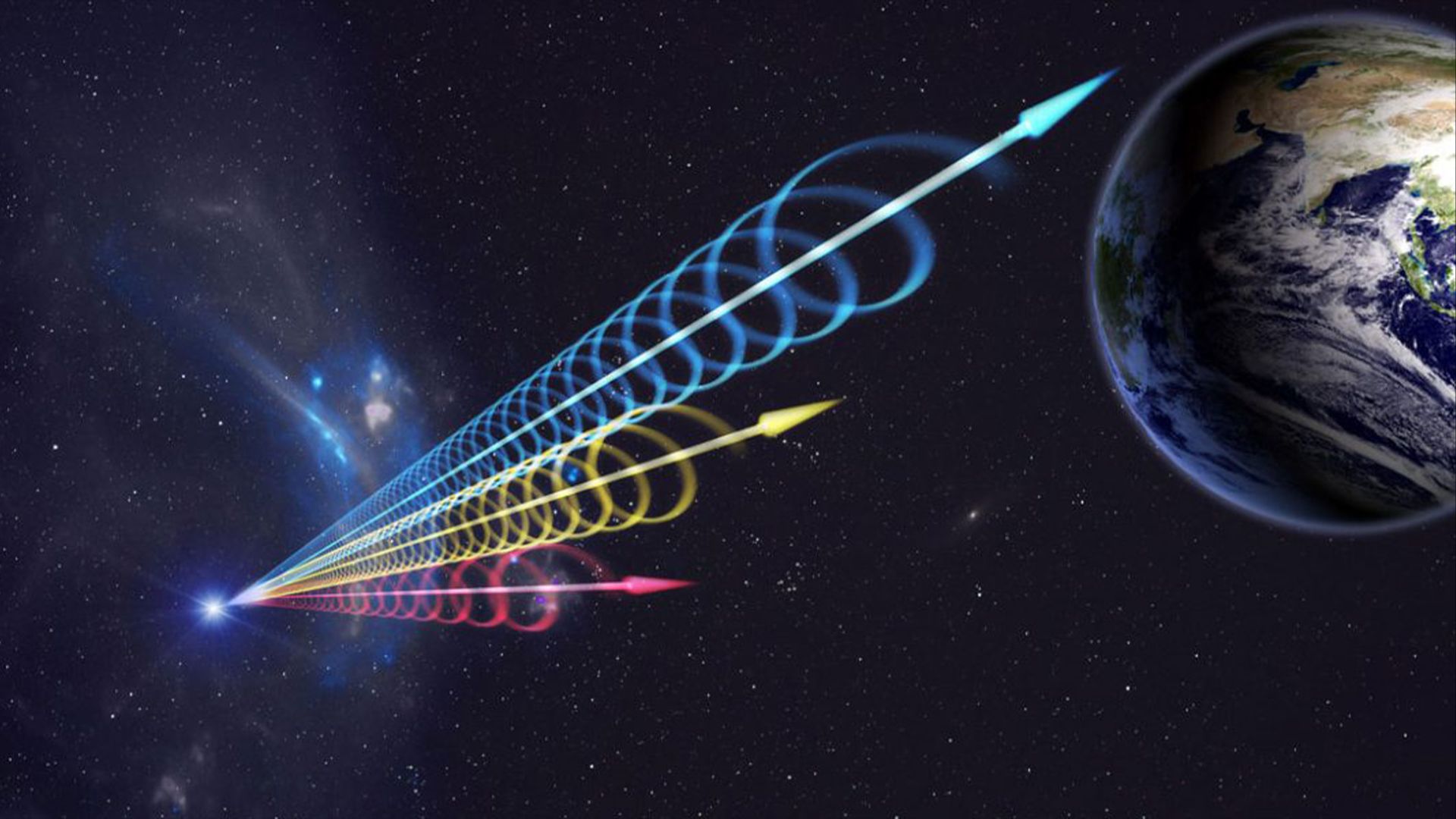
Image credit: Carl Knox/OzGrav, Swinburne University of Technology; background image credit: NASA, ESA, CSA, STScI and Themiya Nanayakkara, University of Sydney; background image processing credit: Joseph DePasquale, STScI.
JWST finds a faint galaxy from when the universe was young
The science team secured time with JWST through a program called Director’s discretionary time, which is intended for time-sensitive observations.
Researchers first used JWST’s near-infrared camera to observe the area surrounding the radio burst and capture very deep images. They then used the telescope’s near-infrared spectrometer to analyze the faint galaxy’s light.
“All of a sudden, there it was: a very faint galaxy in almost the same location where we expected the FRB’s host to be,” Nanayakkara said.
The spectrum revealed hydrogen and oxygen. Because these elements emit light at known wavelengths, researchers could measure how far those wavelengths had shifted as the universe expanded.
“These spectral features act like fingerprints,” Nanayakkara explained. “Since we know the wavelengths at which they are produced in the laboratory, we can measure how much they have shifted due to the expansion of the universe.”
The measurements produced a redshift of approximately 2.15. That means astronomers are observing the galaxy as it appeared when the universe was only about 3 billion years old—roughly one-fifth of its current age.
Could a magnetar have produced the fast radio burst?
Because the host galaxy is so young, the researchers said the discovery supports the idea that at least some fast radio bursts are produced by magnetars. These powerful objects may be especially likely to form in galaxies undergoing intense star formation.
The finding does not yet reveal the definitive source of FRB 20240304B. Astronomers plan to continue searching for additional fast radio bursts with radio telescopes on the ground and then use JWST to study their host galaxies.
“We don’t yet know what the source will be,” Nanayakkara said. “Once our radio telescope finds and locates a suitable new radio source, we can begin JWST observations. That’s really exciting because we never know what we’ll find when we combine the power of these two telescopes.”
Topics:
Source: www.livescience.com