


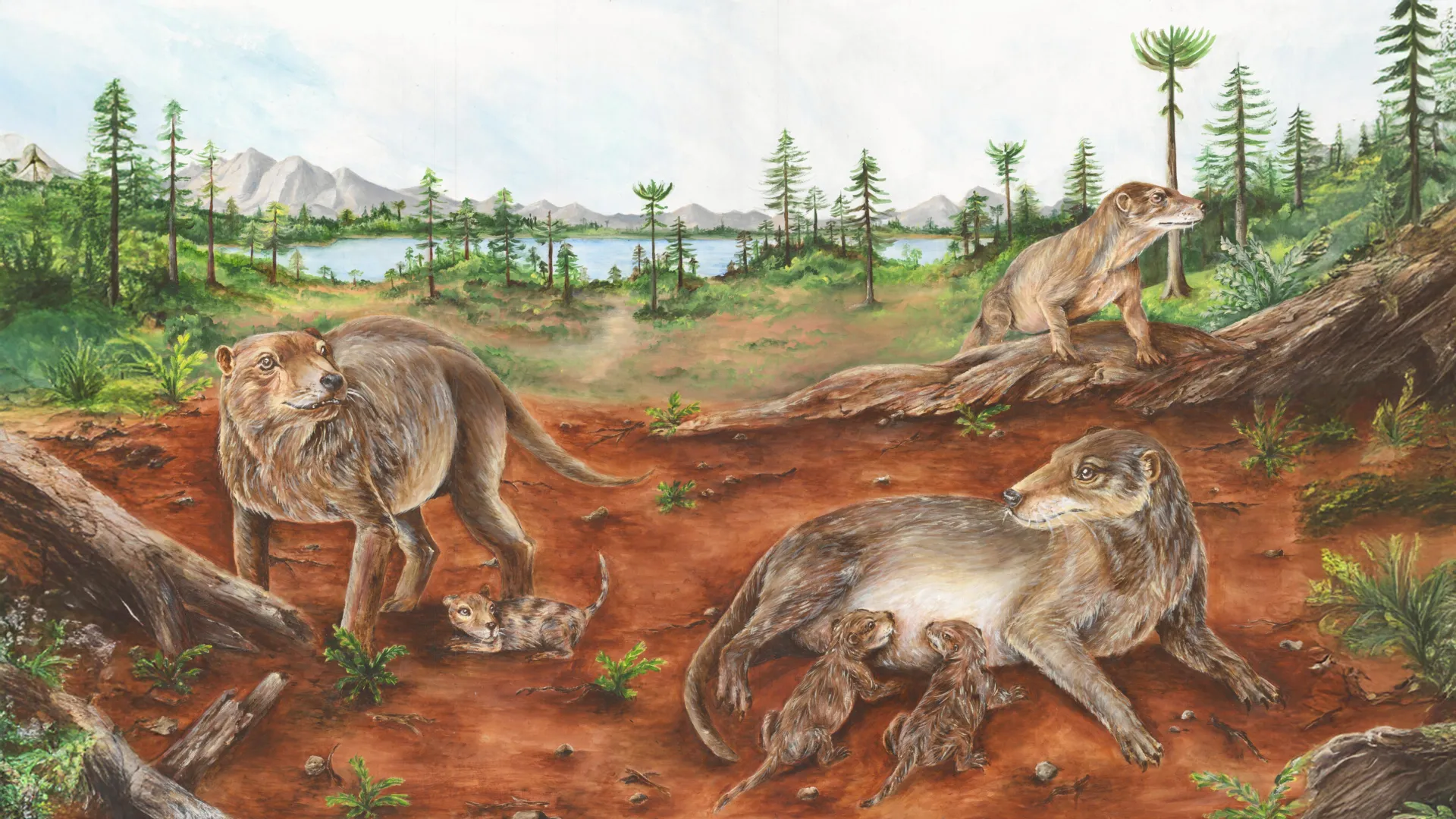
Some cynodonts may have given birth to live young far earlier in evolutionary history than scientists previously believed. New research published in Frontiers of Mammalian Science provides the strongest evidence to date that at least some cynodonts were viviparous, meaning they gave birth to living offspring rather than laying eggs.
“We show for the first time that live birth existed in at least one ancestor of mammals, Chiniquodon theotonicus,” said lead author Dr. Leandro Gaetano, a paleontologist with Argentina’s National Council for Scientific and Technical Research (CONICET). “This suggests that viviparity may have emerged in the mammalian lineage at least 95 to 90 million years earlier than previously thought.”
The long-standing mystery of mammalian reproduction
Cynodonts flourished during the Triassic Period, a time when ecosystems were recovering and rebuilding after one of the most devastating mass extinctions in Earth’s history. Researchers say intense competition for resources, increased predation, arid conditions, and seasonal environmental changes may have favored live birth because embryos developing inside the mother would have been better protected than eggs laid externally.
The study began when researchers identified unusual growth marks in the microscopic structure of fully grown C. theotonicus fossils discovered in northwestern Argentina. Comparisons with living animals suggested that the marks could represent a neonatal line—a distinct growth ring that forms in bones and teeth during the rapid growth that occurs immediately after birth.
To test this interpretation, the researchers estimated the body weight of the animals at birth and at death. They then compared those measurements with data from thousands of living mammals, non-avian reptiles, and birds.
“Whether our mammalian ancestors laid eggs or gave birth to live young has long been considered an unresolved question,” Gaetano said. “We developed an innovative set of methods to investigate a reproductive trait that is extremely difficult to identify in the fossil record.”
Abnormally large newborns
The researchers used measurements from fossilized bones to estimate the size and weight of C. theotonicus at birth and at death. The neonatal line provided an estimate of the animal’s size at birth, while the outer surface of the bones indicated its final size.
According to their calculations, the animal weighed approximately 1.7 kilograms at birth and 12 kilograms at death. This means the newborn C. theotonicus weighed about 14% of its eventual adult body weight.
That proportion is considerably higher than the ratios seen in modern reptiles. Some adult turtles, snakes, and crocodiles weigh between 8 and 14.5 kilograms, while their hatchlings weigh only about 9 to 53 grams. As a result, the neonatal-to-adult body-weight ratio in these reptiles is typically just 0.1% to 0.6%.
Birds also generally produce relatively small offspring. Adult cranes, pelicans, and vultures can weigh between 8 and 21.5 kilograms, while their hatchlings weigh approximately 110 to 357 grams. This corresponds to a neonatal-to-adult weight ratio of roughly 1.3% to 4.5%.
A birth pattern similar to modern mammals
Modern mammals of a similar adult size—between 8 and 15 kilograms—can give birth to relatively large offspring weighing between 35.5 grams and 1.87 kilograms. Their neonatal-to-adult body-weight ratio can reach 18.77%.
For example, bay duiker antelopes give birth to offspring that weigh approximately the same proportion of their adult body weight as the estimated newborn C. theotonicus. The researchers excluded non-placental mammals from this comparison because monotremes lay eggs, while marsupials give birth to extremely small young that continue developing in a pouch.
“We were surprised to find that C. theotonicus grouped with living placental mammals and was clearly separated from other amniotes, including reptiles and birds,” Gaetano said.
Rethinking the evolution of live birth
“Embryonic tissues—and even neonatal lines—had never previously been identified in cynodonts,” said co-author Maria Miceli Barro, a graduate student at the University of Buenos Aires. “Our analysis shows that traits commonly associated with the evolutionary success of mammals were already present long before true mammals appeared.”
Live birth has generally been considered a relatively recent evolutionary development within the mammalian lineage. These findings suggest that viviparity may have evolved much earlier, raising the possibility that other traits previously thought to have appeared later were also present in early cynodonts.
“It is very likely that C. theotonicus was not the only cynodont capable of giving birth to live young,” Gaetano concluded. “This discovery may indicate that the transition from egg-laying to live birth occurred early in the mammalian lineage. More fossil evidence is needed to test this hypothesis, but some cynodonts may have been far more similar to modern mammals than previously recognized.”
Source: www.sciencedaily.com