


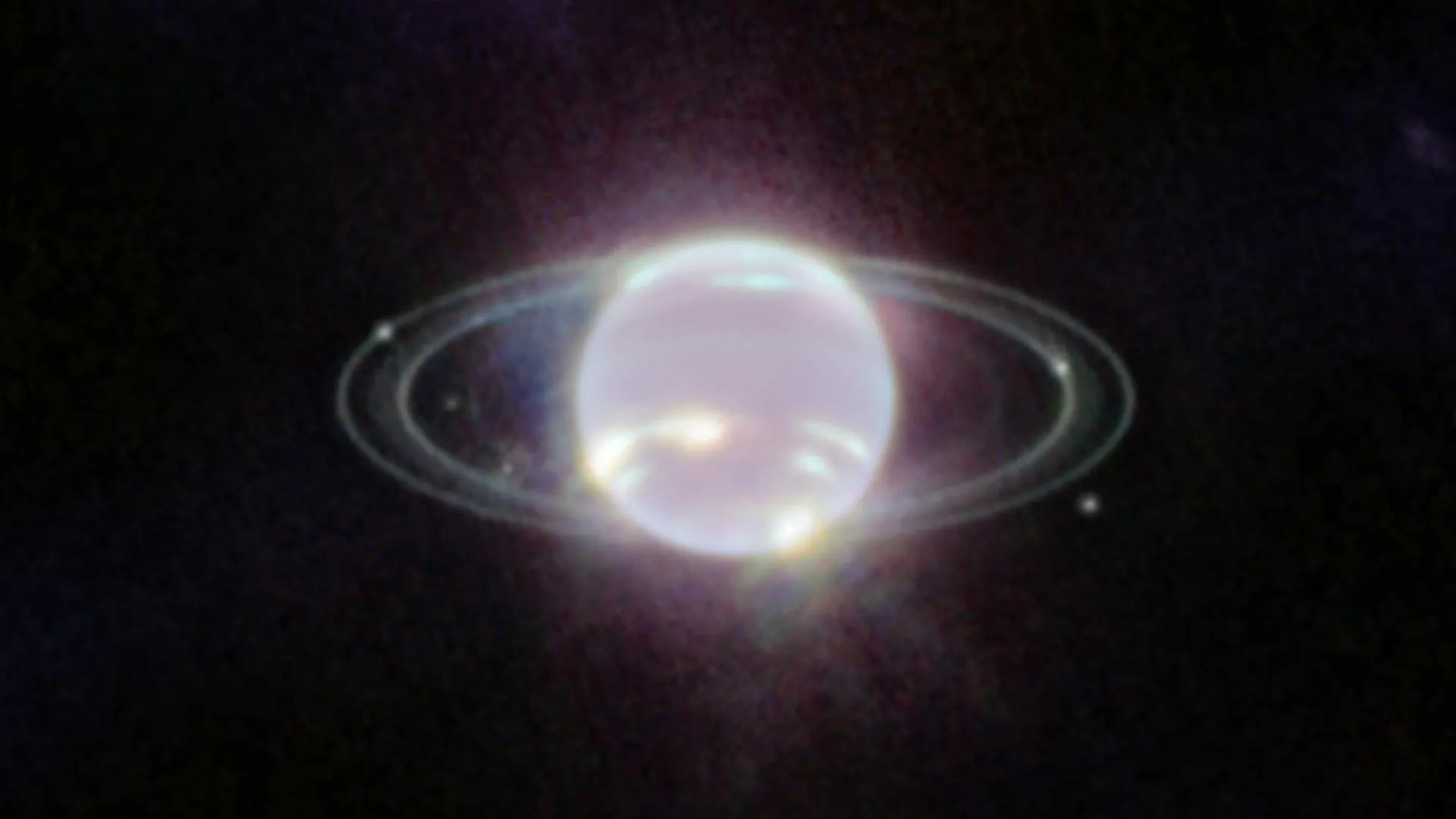
NASA’s James Webb Space Telescope has revealed unexpected clay minerals in Neptune’s inner moons and rings, offering new evidence that the planet’s original moon system was destroyed when Triton was captured by Neptune’s gravity.
A Caltech-led research team used JWST observations to study Neptune’s rings and three of its small inner moons: Larissa, Galatea, and Proteus. The findings show that these satellites contain a chemical composition unlike any previously identified among known bodies in the outer solar system.
The discovery may help explain how Neptune developed its unusual moon system. Unlike the other giant planets, Neptune does not have a large, orderly collection of major satellites. Scientists believe its original moons may have been shattered after Triton, Neptune’s largest moon, was captured from elsewhere in the solar system.
Some of the debris from that catastrophic event may have later gathered to form the small inner moons that orbit Neptune today.
“If Neptune once had a system of moons that looked something like what we see at Uranus today, we expect it would’ve been completely destroyed by the process of Triton getting captured,” says former Caltech graduate student Ryleigh Davis (PhD ’26), lead author of the study published in Science Advances. “This is exciting new evidence that something catastrophic happened at Neptune that completely destroyed its original satellites, and we’re getting to see the fingerprints left behind by that process.”
JWST Investigates Neptune’s Mysterious Inner Moons
Neptune’s small inner satellites have been difficult to study because of their size and location near the planet’s bright rings. Voyager 2 discovered six previously unknown moons around Neptune in 1989, including five tiny satellites orbiting just beyond the planet’s main rings.
Until recently, scientists had no spectroscopy measurements for these moons. Instruments such as JWST’s near-infrared spectrograph separate light into different wavelengths, allowing researchers to identify chemical compounds and minerals on the surfaces of distant objects.
Davis, who conducted her graduate research in the laboratory of Mike Brown, Caltech’s Richard and Barbara Rosenberg Professor of Planetary Astronomy, worked with Caltech postdoctoral scholar Matthew Belyakov to design and co-lead a JWST program focused on Neptune’s rings and inner moons.
The goal was to determine what the satellites are made of and use their composition to uncover clues about their origins.
Neptune’s Moons Contain Unexpected Clay Minerals
The observations produced a surprising result. Spectral signatures from Larissa, Galatea, and Neptune’s rings revealed magnesium-rich phyllosilicates, a group of clay minerals that form in the presence of liquid water.
“Phyllosilicates had never been detected anywhere in the outer solar system beyond Jupiter, so that was not on our list of things to look for,” says Davis, now a postdoctoral researcher at UC San Diego. “We were shocked to find the observed clays, which had to come from objects that were much, much bigger than Neptune’s small inner ring moons.”
The finding is puzzling because the researchers did not detect water ice on any of the three moons or in Neptune’s rings. Icy material is expected to be abundant in the distant region of the solar system where Neptune formed.
“That’s really surprising because everything out in this part of the solar system is really icy,” Davis says. “We’re fairly confident that they had to come from deep inside something that was big enough to generate enough heat that it melted its water ice.”
The team believes the minerals may have originated in an earlier system of large icy moons. Heat generated inside those bodies could have melted water ice and allowed clay minerals to form. However, researchers are still uncertain where the original ice went.
Mike Brown says the unusual spectra immediately raised the same question among members of the research team: “What is that?”
“It took diligent detective work from Ryleigh before we understood what we were seeing,” Brown says. “Sometimes in science you are trying to find evidence to evaluate a specific hypothesis, and, sometimes, something that you had not been thinking about just hits you in the face.”
Proteus Presents a Different Chemical Signature
Proteus, the largest of the three moons studied, did not display the same phyllosilicate signature. This difference may indicate that Proteus formed from material in another part of the debris disk created after Neptune’s original moons were destroyed.
Another possibility is that Proteus experienced additional heating that altered or destroyed the clay minerals once present on its surface.
The researchers also identified the same hydrated mineral on Larissa, Galatea, and Proteus. Its exact composition remains unknown because it does not match any material in the team’s existing spectral libraries.
“We see something that doesn’t really look like anything else we’ve identified in the solar system; it doesn’t match anything we have in our spectral libraries,” Davis says. “We assume it’s some form of hydrated rock from the moons as well, but there’s still a lot of mystery.”
Evidence of a Catastrophic Event at Neptune
The research team favors the theory that Triton’s capture destroyed Neptune’s original satellite system. Triton is believed to have formed elsewhere before being captured by Neptune’s gravity. Its arrival could have destabilized the planet’s existing moons, sending them into collisions or breaking them apart.
A separate JWST study led by Belyakov provides additional support for the existence of an earlier Neptunian moon system. That research suggests Nereid may be the only original moon to have survived intact.
However, scientists have not ruled out another explanation. The minerals may have come from a large, differentiated Kuiper Belt object roughly comparable in size to Pluto. If such an object passed close to Neptune, the planet’s powerful gravity could have torn it apart through tidal forces.
Both possibilities imply that the material now exposed on Neptune’s inner moons originated deep inside a much larger icy world.
“Either way, what we’re seeing on these moons had to come from deep inside something much larger,” Davis says. “That material is normally permanently buried—we can only infer what’s there. Here, a catastrophic event essentially turned these ancient moons inside out, and we get to see what was hidden inside.”
As a result, Neptune’s small moons provide scientists with an unusual opportunity to study material from the interior of a large icy body. Elsewhere in the solar system, such material is typically buried beneath many layers of ice and rock.
Reconstructing Neptune’s Lost Moon System
The findings raise important questions about how Triton’s capture affected Neptune’s moons, how the resulting debris evolved, and how some of that material eventually formed new satellites.
“If you bring Triton in, and you smash up your large moons, we think only 1 percent or so of that material stayed around in the system,” Davis says. “But the actual behavior of that material might be really different if Triton is still there shaking things up for a long time.”
Future studies could help determine how large Neptune’s original moons were, how much material survived Triton’s capture, and how long it took the remaining debris to assemble into the moons seen today.
The study is titled “Neptune’s Inner Moons and Rings Are Exposed Icy Body Interiors.” In addition to Belyakov, Brown, and Davis, the co-authors include Caltech postdoctoral scholar Zachariah Milby (PhD ’26) and former Caltech graduate student Ian Wong (PhD ’18), now with the Space Telescope Science Institute in Baltimore, Maryland.
The research was funded by NASA through a grant to the Space Telescope Science Institute, which is operated by the Association of Universities for Research in Astronomy.
Source: www.sciencedaily.com