


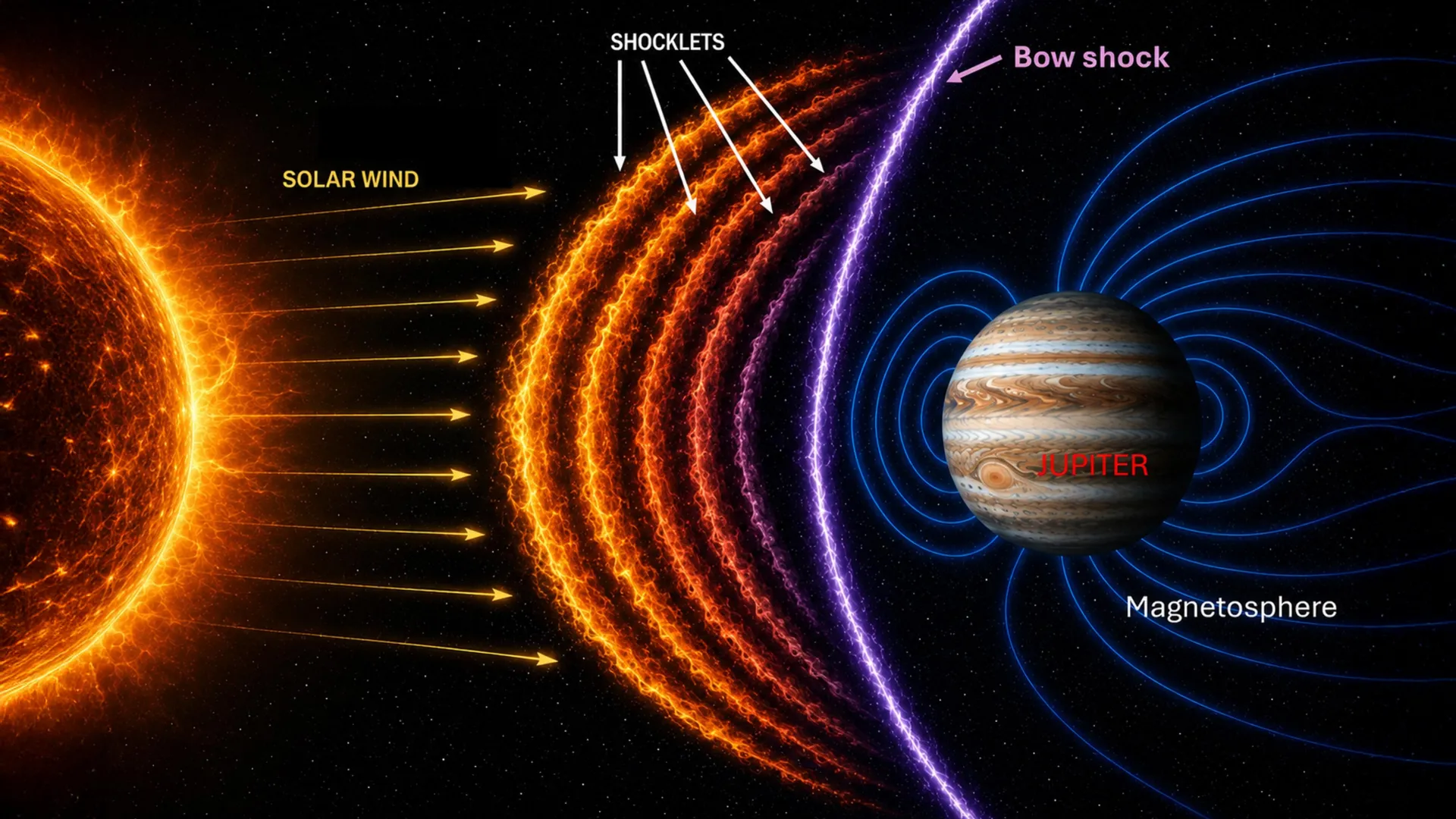
NASA’s Juno spacecraft has provided the most detailed view yet of Jupiter’s bow shock, the boundary where the solar wind meets the planet’s magnetic environment. The observations show that Jupiter uses plasma waves across multiple frequencies, along with additional shock structures, to slow and heat incoming solar particles. The findings, led by scientists at the University of Iowa, could also help researchers understand how much more powerful shock waves transfer energy in phenomena such as supernova remnants.
How Jupiter responds to the solar wind
The Sun continuously emits a stream of charged particles known as the solar wind. These particles travel through space at speeds greater than the speed of sound in the surrounding plasma. When the solar wind approaches a planet with a magnetic field, it encounters a boundary called a bow shock.
At Earth, the bow shock slows and heats incoming particles, helping redirect much of the solar wind around the planet. Without this process, more energetic particles could reach Earth’s atmosphere, creating a less favorable environment for life.
Jupiter also has bow shocks, but its enormous size, powerful magnetic field and gaseous composition make it an especially useful place to study how these boundaries behave. Scientists have long sought to understand why Jupiter responds to the solar wind differently from Earth and what those differences might reveal about other objects in the universe.
A more complex system of plasma waves
Using measurements from Juno, researchers found that Jupiter uses plasma waves at multiple frequencies to slow and heat incoming solar particles. These frequencies, known as “harmonics,” produce waveforms that are more complex than those typically observed at Earth.
The process can be compared with music: several notes played together create a richer sound than a single note. Similarly, plasma waves containing multiple frequencies can interact with incoming particles in more complicated ways. This enables Jupiter’s bow shock to transfer energy to more particles, heating them and slowing them down.
By comparison, Earth’s bow shock primarily uses plasma waves concentrated around a single frequency. That simpler arrangement is generally sufficient for the conditions near Earth.
“Jupiter has found a unique way to cope with the solar wind through plasma waves that exhibit stronger and richer harmonic structures,” said Jayasri Joseph, a postdoctoral fellow in the University of Iowa’s Department of Physics and Astronomy and corresponding author of the study. “This is important because multiple frequencies allow us to heat more particles in the solar wind and slow them down.”
Jupiter’s additional line of defense
The researchers identified another important difference between how Jupiter and Earth interact with the solar wind. Incoming particles may encounter smaller shock structures called shocklets before reaching Jupiter’s main bow shock. These regions begin slowing the solar wind before it reaches the primary impact boundary.
At Earth, the bow shock generally serves as the main region where the solar wind is slowed and redirected. Jupiter’s additional shock structures point to a more complex process for managing the energy carried by solar particles.
“The effect of the solar wind is not very strong, so Earth doesn’t need to take these special measures to deal with it,” said Bill Kurth, a researcher in the University of Iowa’s Department of Physics and Astronomy and a co-author of the study.
Kurth has been involved with NASA’s Juno mission since the spacecraft launched in 2011.
What Jupiter can reveal about exploding stars
Although the observations focus on Jupiter, their significance may extend beyond the solar system. Shock waves occur throughout the universe, particularly in environments where enormous amounts of energy are released. Some of the most extreme examples are found in supernova remnants, expanding clouds of material left behind when certain dying stars explode.
Those cosmic shock waves are far more powerful than the shocks near Jupiter, but the physical processes that govern how energy moves through plasma share important similarities. Studying Jupiter’s bow shock in unprecedented detail gives scientists a nearby way to investigate mechanisms that are much more difficult to measure directly around distant stars.
“Because even more powerful shocks occur around astrophysical objects such as supernova remnants, Jupiter’s bow shock provides a nearby natural laboratory to investigate and understand how nature converts vast amounts of flowing energy into heat and energetic particles,” Joseph said.
Understanding these processes could improve scientific models of how shock waves transfer energy, heat particles and shape environments throughout the universe.
Juno’s measurements
The discovery was based on observations Juno collected in December 2024. NASA’s spacecraft has been orbiting Jupiter since July 2016, giving researchers an opportunity to study the giant planet and the environment around it.
A key contribution came from Juno Waves, an instrument designed and built by physicists at the University of Iowa. It measures radio and magnetic wave activity, allowing scientists to examine plasma behavior around Jupiter.
Previous spacecraft had detected bow shocks at exoplanets, but they lacked the measurements needed to reveal the detailed structure of the associated plasma waves. Juno’s observations provided a clearer view of how those waves behave at Jupiter.
The findings were published online on July 31 in Nature Communications in a study titled “Plasma wave observations from the Juno spacecraft during Jupiter’s bow impact.”
Research team and support
Additional contributors from the University of Iowa included Alison Jaynes, an associate professor in the Department of Physics and Astronomy, and research assistants Jeremy Faden and Chris Piker.
The international research team also included Lynn Wilson III of NASA’s Goddard Space Flight Center; John Conany of NASA Goddard Space Flight Center and Space Research Corporation; Frederick Allegrini of the Southwest Research Institute and the University of Texas at San Antonio; Rob Wilson of the University of Colorado Boulder; Ali Sulaiman of the University of Minnesota; Scott Bolchon and Robert Ebert of the Southwest Research Institute; and Barry Moak of the Johns Hopkins University Applied Physics Laboratory.
NASA funded the research.
Source: www.sciencedaily.com