


Other Monitor Arms We Tested

Photo: Jacob Roach
Wali Heavy-Duty Monitor Arm, $75
:
Large screens need more support than a standard monitor stand can provide. I tested this Wali monitor arm with a 42-inch KTC G42P5 display, and it has remained stable for more than a year without noticeable sagging. It is also strong enough for oversized monitors such as the 42-inch LG C4 and Samsung Odyssey OLED G9, provided the display stays within the arm’s weight rating. —Jacob Roach

Photo: Luke Larsen
Branch Monitor Arm, $129
:
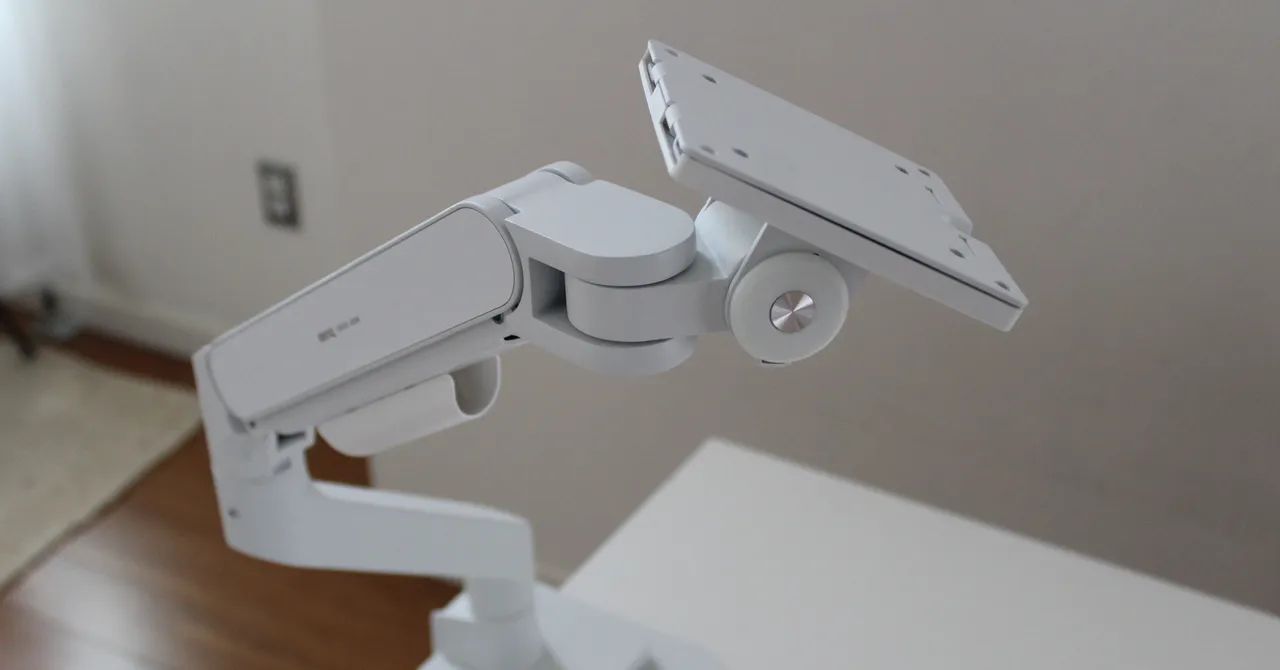
The Branch Monitor Arm is a polished, dependable option with a design that closely resembles the BenQ Ergo Arm. It is slightly less expensive and provides smooth, reliable movement. However, it does not include a desk-reinforcement plate, which may be important for thinner desktops. The dual-monitor version is also less flexible than some competing monitor arms, particularly for vertical-monitor setups.
Monoprice Workstream Single Monitor Arm, $83
:
I have used the dual-monitor version of this arm with a 32-inch ultrawide display and a vertically oriented monitor. Both arms moved smoothly and held their positions without sinking. The large clamp is another advantage: it can accommodate desks up to 5 inches thick, making this one of the most versatile monitor arms for extra-thick desktops. —Julian Chokkatu
Pout Eyes 12 Monitor Arm, $55
:
This budget monitor arm was previously one of my favorite inexpensive options. Although shoppers should be cautious when buying low-cost monitor arms, this model offered a clean appearance and solid value during testing. Its gray-and-black design looks more distinctive than the typical all-black arm. The spring-assisted mechanism is less fluid than a gas-spring system, but it works well for users who do not frequently reposition their monitor. The product now appears to be sold mainly to businesses rather than directly to consumers.

AmazonBasics Adjustable Desk Mount Arm, $29
:
This low-cost monitor arm was less impressive than the alternatives we tested. The first unit arrived damaged, and the replacement packaging was also in poor condition. Although the arm is sturdier than some plastic budget models, its traditional pole design makes height adjustments less convenient. It was also more unstable and difficult to secure than other monitor arms in this guide. For better ergonomics and long-term stability, spending more on a stronger model is worthwhile.
Mount-It! Durable Dual Monitor Arm, $322
:
This dual-monitor mount has supported a 34-inch ultrawide monitor for several years. It accommodates displays from 15 to 34 inches and supports up to 20 pounds per screen. The arms offer useful adjustment, integrated cable management, and a relatively clean appearance. Because it uses the VESA mounting standard, confirm that your monitors have compatible mounting holes before purchasing. —Julian Chokkatu
Why use a monitor arm?
Replacing your monitor stand with a desk-mounted monitor arm can improve ergonomics and free up valuable workspace. A monitor arm lets you position the screen at eye level, helping reduce neck strain and slouching. You can also pull the display closer when needed or move it out of the way to create more desk space.
Monitor arms are especially useful for ultrawide and large-format displays, which often come with bulky stands. Removing the original base creates a cleaner, more flexible workspace and leaves additional room for accessories, notebooks, and other equipment.
What to look for in a monitor arm
Monitor arms vary widely in design, adjustability, materials, and weight capacity. Consider the following features before buying.
Arm type: Fully articulated arms provide the greatest flexibility, allowing you to adjust height, depth, tilt, and rotation. Basic pole-style arms usually offer limited height adjustment. A pole with articulated extensions can be a useful middle ground for some dual-monitor setups.
Brand: Established brands such as Ergotron, BenQ, Asus, MSI, Acer, Humanscale, and Herman Miller are good places to start. Lesser-known brands can also offer strong value, but check independent reviews, warranty coverage, and user feedback before purchasing.
Materials and design: Steel and aluminum monitor arms generally provide better durability than thick, inexpensive plastic. A well-designed arm should also include smooth adjustment points and effective cable management.
Weight capacity: Check your monitor’s weight without its original stand and compare it with the arm’s rated limit. Curved and ultrawide monitors may require additional capacity because their weight places more leverage on the arm. An arm that is too strong for a very lightweight display may also be difficult to balance.
Clamps, grommets, and stands: Most monitor arms attach to a desk with a clamp. Grommet mounts are installed through a hole in the desktop and generally provide greater stability, although they require drilling. Wall-mounted monitor arms are another option when a desk clamp is unsuitable.
What is a gas-spring monitor arm?
A gas-spring monitor arm uses a nitrogen-filled cylinder to counterbalance the weight of the display. This design typically provides smoother, easier adjustments than a conventional mechanical spring. Gas-spring arms often cost more, while mechanical-spring arms are usually less expensive and may be suitable if you rarely reposition your monitor.
Should I buy one dual-monitor arm or two single-monitor arms?
A dual-monitor arm uses one desk mount and can simplify installation. It also makes it easier to align two screens side by side without a gap. This is a good choice for productivity-focused setups where both displays are used together.
Two single-monitor arms offer more positioning flexibility. They are often better for gaming setups, especially when one display is the primary screen and needs to be centered directly in front of you. Separate arms are also useful when one monitor is used vertically.
Can my monitor and desk support a monitor arm?
Not every desk is suitable for a monitor arm. Thin desktops, rounded edges, glass surfaces, and hollow-core furniture may not provide enough support for a clamp. Always verify the manufacturer’s requirements before installation.
Your monitor must also support VESA mounting. Most displays use a 100-by-100-millimeter VESA pattern, while some compact or older monitors use 75-by-75-millimeter mounting holes.
Budget monitors may not include VESA compatibility, so check the specifications carefully before buying a monitor arm—especially when shopping for displays priced below $200.
How we test monitor arms
To test each monitor arm, we assemble it, attach a VESA-compatible monitor, and secure it to a desk using the included mounting hardware. We evaluate installation, stability, range of motion, cable management, and how well the arm maintains its position over time.
Heavy-duty monitor arms are also tested with large-format and ultrawide displays to determine whether they can support their advertised weight without sagging. Our testing includes products from established manufacturers as well as affordable models from smaller brands.
Many monitor arms share similar components, so we focus on the features that genuinely distinguish one product from another, including build quality, ease of adjustment, desk compatibility, and long-term reliability.
Power up with unlimited access WIRED.
Get expert product reviews, in-depth reporting, and subscriber-only content with unlimited access. Subscribe now.
Source: www.wired.com