


NASA Tests ASCENT Dual-Mode Propulsion System for Safer, More Efficient Spaceflight
NASA engineers have completed environmental and physical tests on a small satellite designed to make spacecraft propulsion safer, more efficient, and less complex. The ASCENT (Advanced Spacecraft Energetic Non-Toxic) propulsion dual-mode mission will demonstrate an integrated system that uses one non-toxic propellant tank to power two different types of space engines.
One Propellant Tank for Two Types of Thrusters
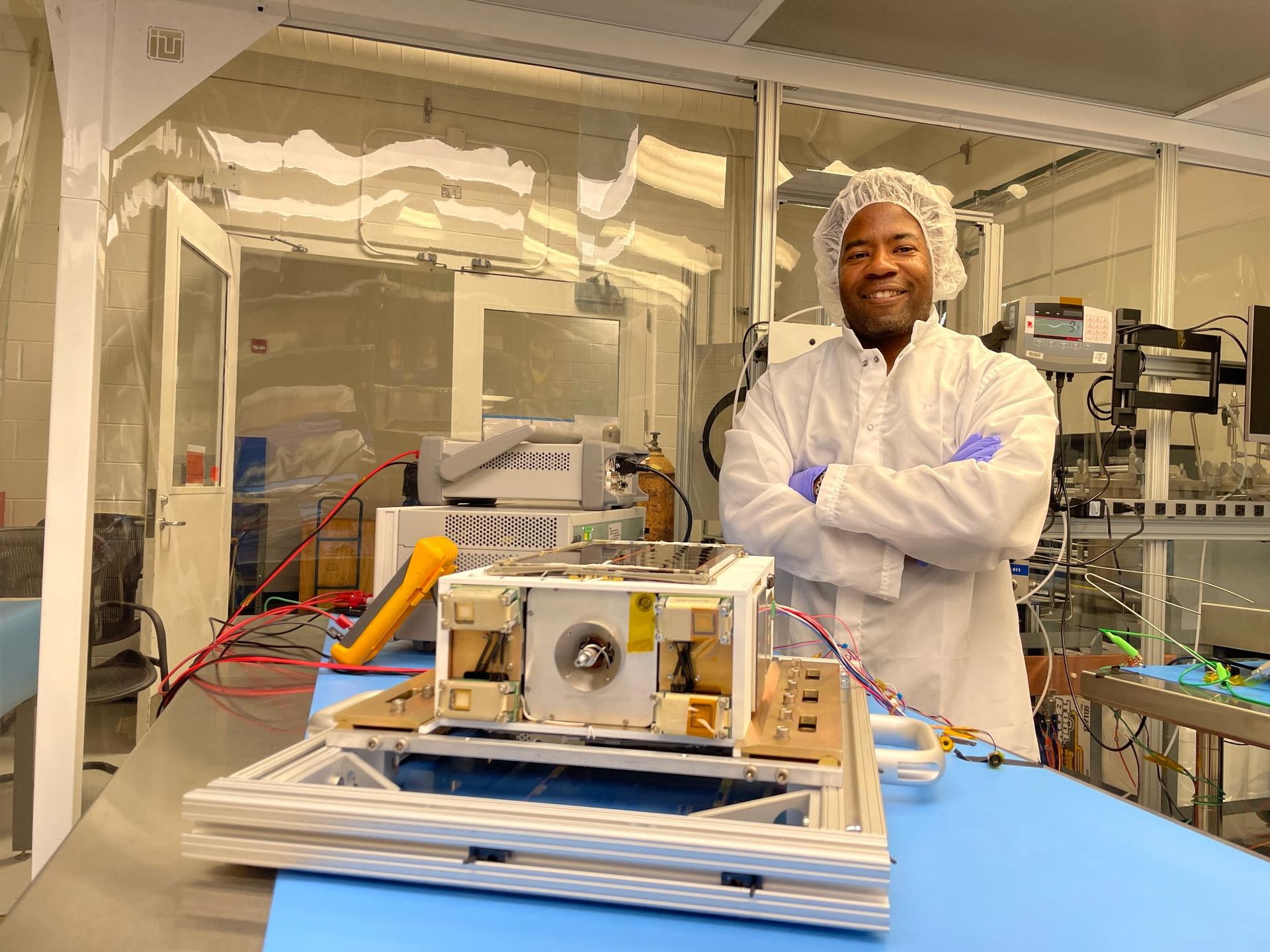
The spacecraft, roughly the size of a large shoebox, is being developed as a flight demonstration. Unlike conventional spacecraft that use separate propulsion systems for different maneuvers, the ASCENT mission will supply both a high-thrust chemical engine and a low-thrust electrospray thruster from a single central tank.
Spacecraft typically rely on a high-thrust chemical system for rapid maneuvers, such as entering orbit, and a low-thrust electrical system for efficient, gradual operations, including maintaining position. These separate systems require multiple fuel tanks, pipes, and other hardware that add weight and consume valuable space.
Using a single tank of ASCENT propellant could reduce the spacecraft’s mass and volume. For future missions, that could create more room for scientific instruments and make it possible to launch spacecraft on smaller, less expensive rockets.
NASA, MIT and Georgia Tech Support the Mission
NASA’s Marshall Space Flight Center in Huntsville, Alabama, manages the mission through a collaboration involving several organizations. The electrospray thruster was developed by the Massachusetts Institute of Technology, the chemical propulsion module was manufactured by Plasma Process Corp., and Georgia Tech integrated the spacecraft bus.
“There are many challenges, some small challenges and some major challenges,” said Nehemiah Williams, project manager for the NASA Marshall demonstration. “But ensuring propulsion system functionality across all these different teams is what makes the mission successful.”
NASA Completes Leak, Thermal Vacuum and Spin Testing
Before the spacecraft can operate safely in the harsh environment of low Earth orbit, it must pass a series of ground tests. Over the past several months, Marshall’s engineering team tested the flight hardware inside the center’s Small Spacecraft Services and Integration Lab.
Engineers conducted extensive leak testing to verify the integrity of the integrated propulsion system. During a pressurized helium leak test, the spacecraft was placed inside a vacuum chamber to confirm that its seals were working as intended. Because a single ASCENT propellant tank supplies two different thruster types, sealed fuel lines and valves are essential to mission safety and performance.
The spacecraft also completed thermal vacuum testing. By placing it in a vacuum chamber that simulates the lack of air and extreme temperature changes of space, engineers can verify that the electronics, thrusters, and mechanical systems will operate properly in orbit.
A spin test measured the spacecraft’s mass properties and center of gravity. Like balancing a car’s tires, this process helps confirm that the spacecraft can fly stably and maintain the correct attitude. Proper attitude control allows its antenna to communicate with Earth and its solar panels to capture sunlight accurately.
ASCENT Mission to Launch on a SpaceX Falcon 9
With environmental and physical testing complete, the mission has entered its final preparation phase. The team will conduct final system checkout, integrate the spacecraft’s solar array, and ship the flight hardware to its launch destination.
The ASCENT-propelled dual-mode mission is scheduled to launch by October 1 as a payload aboard a SpaceX Falcon 9 rocket from Vandenberg Space Force Base in California.
After deployment approximately 325 miles above Earth, the spacecraft will begin a nine-month mission. Following an initial checkout period, the operations team will perform short chemical and electrical propulsion operations. If successful, the spacecraft will spend several months carrying out multiple orbital ascent and descent maneuvers while alternating between its high-thrust and low-thrust engines.
These operations will demonstrate whether the dual-mode propulsion concept can function effectively in space and help establish a more compact approach to future small-spacecraft missions.
Who Manages the ASCENT Propulsion Mission?
The ASCENT propulsion dual-mode mission is managed and funded by NASA’s Small Spacecraft and Distributed Systems (SSDS) program within the NASA Research and Technology Mission Directorate at NASA Headquarters in Washington. SSDS is based at NASA’s Ames Research Center in California’s Silicon Valley.
Source: www.nasa.gov