


Close Menu
HitechubHitechub
    What's Hot
    Science

    NASA Unveils Three Unmanned Moon Exploration Missions in 2023 to Support Lunar Base Construction

    Science

    Revolutionary Mathematics AI Solves Decades-Old Research Problems in Just Weeks

    Science

    21 Gray Whales Found Dead in 3 Months: Understanding the Surge of Carcasses on Pacific Beaches

    Important Pages:
    • About Us
    • Privacy Policy
    • Terms & Conditions
    Facebook X (Twitter) Instagram Pinterest
    Facebook X (Twitter) Instagram
    HitechubHitechub
    Saturday, June 13
    • Technology
      1. AI
      2. Gadgets
      3. View All

      This is the most popular CEO in the world

      Sectors in which “Chat-GPT” is most often used

      AI Pioneer Expresses Concern About Potential for AI to Surpass Humanity

      Artificial intelligence has begun to “swallow” professions

      What’s new in Android 14

      Europeans have about 700 million old mobile phones in their drawers

      Here’s how you can tell if your phone is being tapped

      “Sneaker X” – computer case in the shape of a sneaker

      Russian Gamers Unite to Prevent Nuclear War: Join the Fight Online

      Challenges of Space Travel: Why Journeying to Space is So Difficult

      NASA Astronaut Casts Historic Vote from Space

      Discover the Future of Comfort: What If You Could Wear a Chair?

    • Science
      1. Space
      2. Wheels
      3. View All

      Galaxies in the universe are growing more slowly than they should

      “Espace” presented the new lander “Apex 1.0”

      The largest asteroid sample ever collected has arrived on Earth

      (VIDEO) Incredible flight of the Parker Solar Probe

      Toyota wants to make a new generation battery with a range of up to 1,200 km

      Meet Toyota’s lunar “baby” that could make exploring the Moon easier

      Microlino – Is this the perfect city car?

      Alfa Romeo 4C gets an electric successor

      Space Storm Threatens Train Signals, Potentially Leading to Serious Accidents

      First Quantum Grandfather Clock: Exploring the Origins of Gravity

      Nasa’s Ambitious Lunar Base Project: A Massive Facility Covering Hundreds of Square Kilometers

      Why Wealthy Individuals with Environmental Values Contribute Most to Carbon Emissions

    HitechubHitechub
    Home » Nasa’s Ambitious Lunar Base Project: A Massive Facility Covering Hundreds of Square Kilometers
    Science

    Nasa’s Ambitious Lunar Base Project: A Massive Facility Covering Hundreds of Square Kilometers

    Share Facebook Twitter Pinterest WhatsApp
    Share
    Facebook Twitter LinkedIn Pinterest WhatsApp
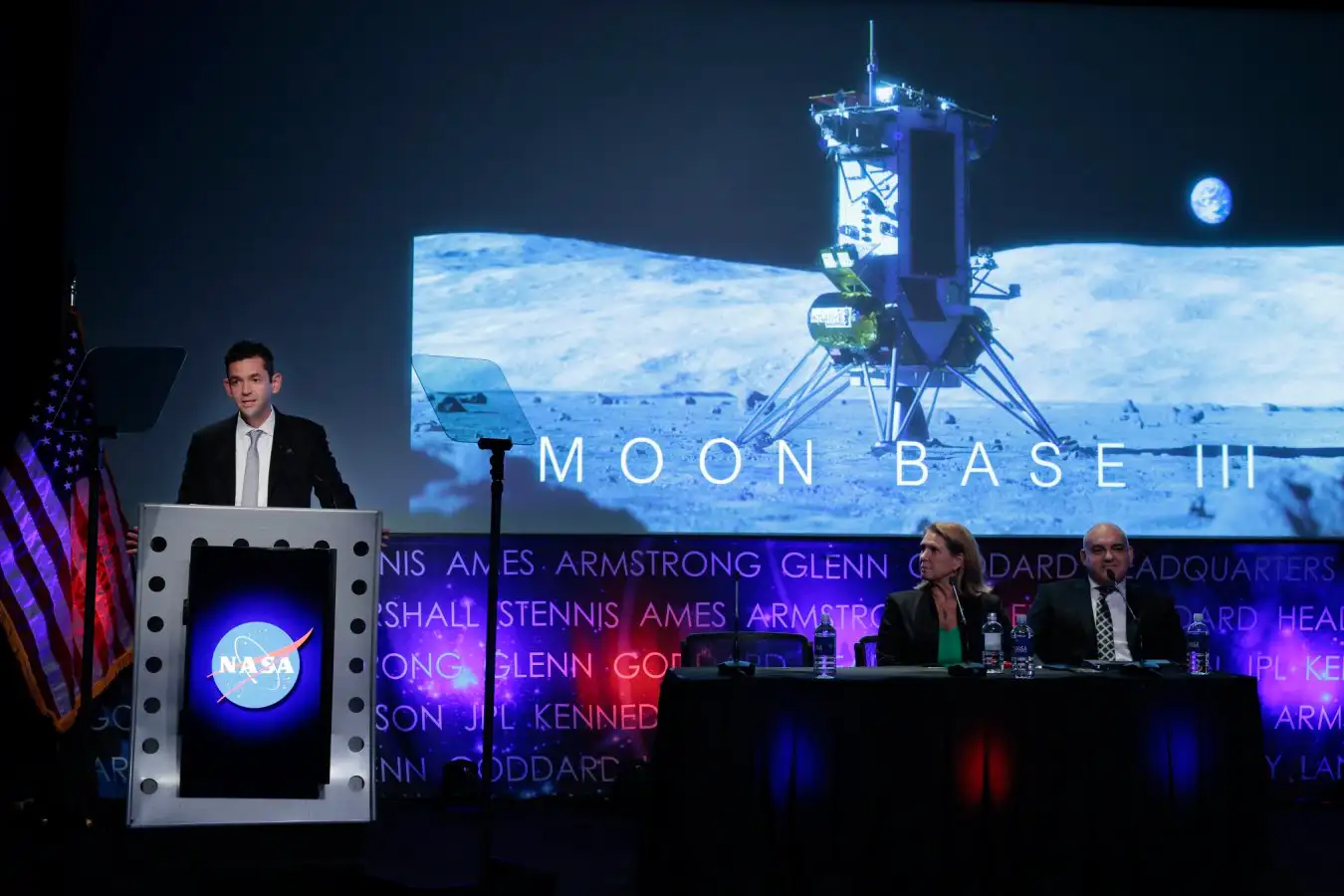
    NASA Administrator Jared Isaacman announcing moon base plans

    NASA Administrator Jared Isaacman (left) discusses plans for a permanent lunar presence at NASA Headquarters on May 26.

    Chip Somodevilla/Getty Images

    NASA has unveiled ambitious plans to establish a permanent base on the moon, focusing first on utilizing autonomous rovers and drones to explore the lunar terrain. Eventually, astronauts will construct a lunar habitat spanning several hundred square kilometers.

    The concept of a lunar base has been integral to NASA’s Artemis program for several years, primarily aimed at landing astronauts on the moon for the first time since the 1970s. The human spaceflight segment of the program has progressed well, with the successful Artemis II mission returning four astronauts to Earth after orbiting the moon in April. However, concrete timelines for building a lunar base have only recently begun to emerge.

    On May 26th, NASA announced the schedule for the first three missions to establish a lunar base, targeting launches this year, with at least nine more missions anticipated by 2027. The program will be conducted in three phases: the initial phase will continue until 2029 to ensure reliable lunar access, followed by initial base operations until 2032, and the actual construction of the base, located near the moon’s south pole, projected to occur by 2036.

    The upcoming missions will be unmanned and will focus on detailed lunar surface studies to mitigate risks for future landing operations while testing an autonomous rover for subsequent design enhancements. The inaugural mission, Lunar Base I, is set to launch later this year and will feature a lander constructed by Jeff Bezos’ Blue Origin.

    Moonbase II and III missions are also planned for this year, although specific launch windows are still pending. Each mission will involve different private companies’ landers; Astrobotic will launch the Griffin lander alongside an autonomous rover, and Intuitive Machines has previously attempted two lunar landings, neither of which were fully successful.

    Additionally, NASA announced two companies—Astrolab and Lunar Outpost—will receive over $200 million each to develop future lunar probes as part of the Commercial Lunar Payload Services Program. Astrolab will design a larger human-operated rover capable of carrying around 1000 kilograms at a speed of about 10 kilometers per hour, while Lunar Outpost will focus on a more agile robot, traveling faster than 14 km/h and capable of autonomous navigation.

    NASA also outlined its Moonfall mission for 2028, involving four unmanned vehicles that will conduct brief flights over the moon’s surface to capture high-resolution images for identifying suitable landing spots for future Artemis missions. The drones will be built at NASA’s Jet Propulsion Laboratory in California, with Firefly Aerospace developing the spacecraft to transport them from Earth to the moon.

    However, key elements regarding the construction and operationalizing of the future moon base—specifically its energy supply, building methods, and protection against space radiation—remain largely unspecified. Former NASA administrator Sean Duffy previously mentioned that a nuclear fission reactor could be established on the moon by 2030, yet the latest updates from NASA, led by Jared Isaacman, provided no further information on this matter.

    New Scientist: Your source for science news and in-depth reporting

    History and Future of Space Exploration: United States

    Embark on an extraordinary journey through America’s groundbreaking achievements in space exploration, tailored for curious minds and lifelong learners.

    Topic:
    Source: www.newscientist.com

    Share. Facebook Twitter Pinterest LinkedIn WhatsApp
    Previous ArticleWhy Wealthy Individuals with Environmental Values Contribute Most to Carbon Emissions
    Next Article First Quantum Grandfather Clock: Exploring the Origins of Gravity

    Related Posts

    Science

    Space Storm Threatens Train Signals, Potentially Leading to Serious Accidents

    Science

    First Quantum Grandfather Clock: Exploring the Origins of Gravity

    Science

    Why Wealthy Individuals with Environmental Values Contribute Most to Carbon Emissions

    Science

    Stunning Images Reveal Sand’s Advance on Sahara Desert Oasis

    Science

    Exploring Ian Watson’s Sci-Fi Classic ‘The Embedding’: A Fascinating Yet Outdated Read

    Science

    Exploring Henry Moore: A Stunning Exhibition Merging Art and Nature

    Science

    The Arrival of Killer Robots: Time to Decide Our Acceptance

    Science

    Understanding the Relationship Recession: Why It’s a Major Concern for Gen Z

    Add A Comment
    Leave A Reply Cancel Reply

    Stay In Touch
    • Facebook
    • Twitter
    • Instagram
    • Pinterest
    Top Picks
    Science

    21 Gray Whales Found Dead in 3 Months: Understanding the Surge of Carcasses on Pacific Beaches

    Whales typically feed for four to six months in the Arctic, as noted by Stewart.…

    The largest asteroid sample ever collected has arrived on Earth

    Exploring Henry Moore: A Stunning Exhibition Merging Art and Nature

    Unlock the Benefits of Sleep Without Actually Sleeping

    The unusual robot conductor of a concert in Seoul

    Most Popular
    Science

    Scientists Warn of ‘Unprecedented’ Changes in Earth’s Rotation

    Science

    How Hidden Manganese Stores Contributed to Earth’s Oxygen Formation

    Categories
    • AI (13)
    • Gadgets (10)
    • Science (223)
    • Space (9)
    • Technology (37)
    • Wheels (9)
    Our Picks
    Science

    Revolutionary Nuclear Clock: A New Era in Accurate Timekeeping

    Technology

    Roborace Car Makes Historic Street Circuit Debut in Marrakech

    © 2026 Hitechub.
    • Home
    • About Us
    • Privacy Policy
    • Terms & Conditions

    Type above and press Enter to search. Press Esc to cancel.

    We are using cookies to give you the best experience on our website.

    You can find out more about which cookies we are using or switch them off in .

    Ad Blocker Enabled!
    Ad Blocker Enabled!
    Our website is made possible by displaying online advertisements to our visitors. Please support us by disabling your Ad Blocker.
    Hitechub
    Powered by  GDPR Cookie Compliance
    Privacy Overview

    This website uses cookies so that we can provide you with the best user experience possible. Cookie information is stored in your browser and performs functions such as recognising you when you return to our website and helping our team to understand which sections of the website you find most interesting and useful.

    Strictly Necessary Cookies

    Strictly Necessary Cookie should be enabled at all times so that we can save your preferences for cookie settings.