


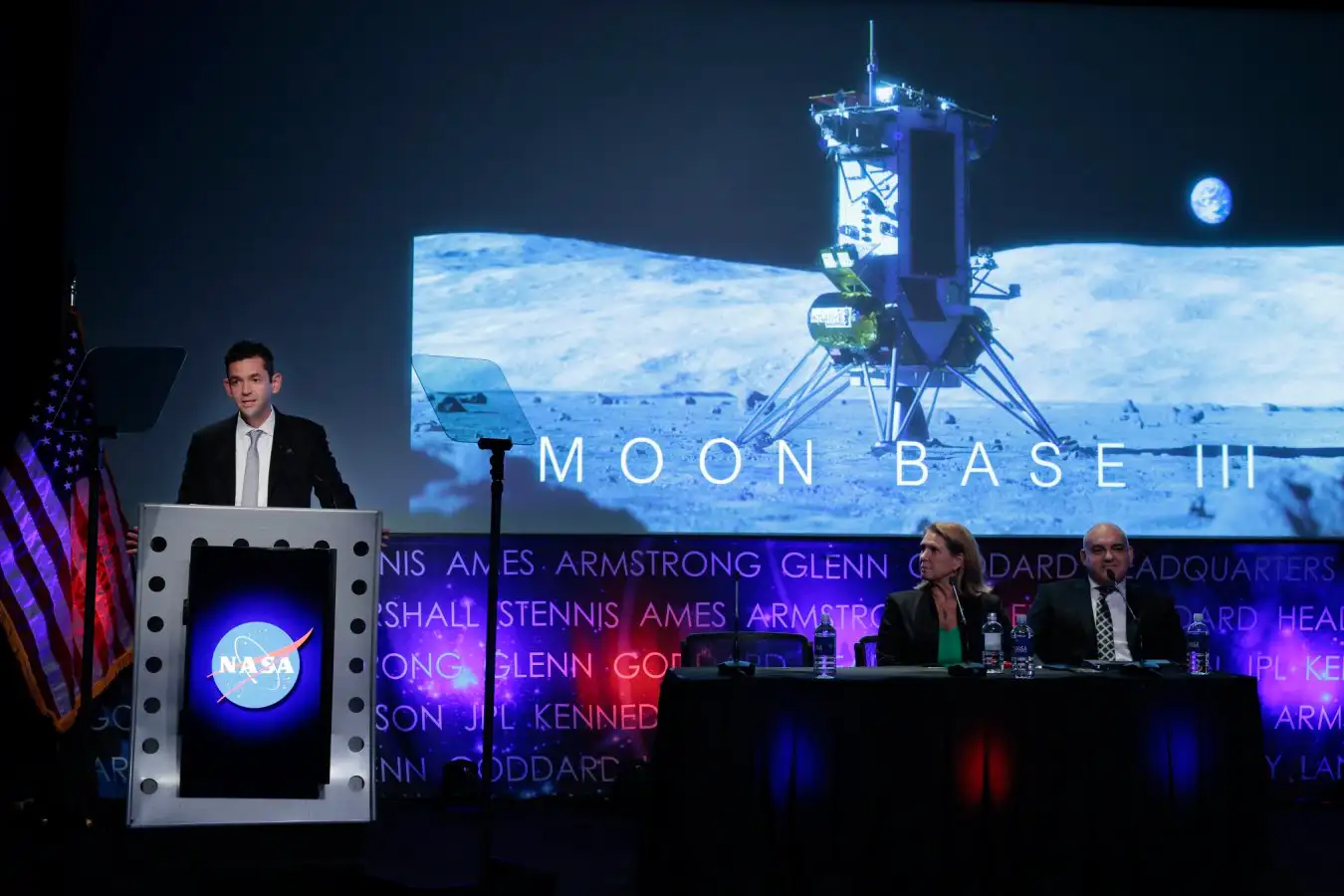

NASA Administrator Jared Isaacman (left) discusses plans for a permanent lunar presence at NASA Headquarters on May 26.
Chip Somodevilla/Getty Images
NASA has unveiled ambitious plans to establish a permanent base on the moon, focusing first on utilizing autonomous rovers and drones to explore the lunar terrain. Eventually, astronauts will construct a lunar habitat spanning several hundred square kilometers.
The concept of a lunar base has been integral to NASA’s Artemis program for several years, primarily aimed at landing astronauts on the moon for the first time since the 1970s. The human spaceflight segment of the program has progressed well, with the successful Artemis II mission returning four astronauts to Earth after orbiting the moon in April. However, concrete timelines for building a lunar base have only recently begun to emerge.
On May 26th, NASA announced the schedule for the first three missions to establish a lunar base, targeting launches this year, with at least nine more missions anticipated by 2027. The program will be conducted in three phases: the initial phase will continue until 2029 to ensure reliable lunar access, followed by initial base operations until 2032, and the actual construction of the base, located near the moon’s south pole, projected to occur by 2036.
The upcoming missions will be unmanned and will focus on detailed lunar surface studies to mitigate risks for future landing operations while testing an autonomous rover for subsequent design enhancements. The inaugural mission, Lunar Base I, is set to launch later this year and will feature a lander constructed by Jeff Bezos’ Blue Origin.
Moonbase II and III missions are also planned for this year, although specific launch windows are still pending. Each mission will involve different private companies’ landers; Astrobotic will launch the Griffin lander alongside an autonomous rover, and Intuitive Machines has previously attempted two lunar landings, neither of which were fully successful.
Additionally, NASA announced two companies—Astrolab and Lunar Outpost—will receive over $200 million each to develop future lunar probes as part of the Commercial Lunar Payload Services Program. Astrolab will design a larger human-operated rover capable of carrying around 1000 kilograms at a speed of about 10 kilometers per hour, while Lunar Outpost will focus on a more agile robot, traveling faster than 14 km/h and capable of autonomous navigation.
NASA also outlined its Moonfall mission for 2028, involving four unmanned vehicles that will conduct brief flights over the moon’s surface to capture high-resolution images for identifying suitable landing spots for future Artemis missions. The drones will be built at NASA’s Jet Propulsion Laboratory in California, with Firefly Aerospace developing the spacecraft to transport them from Earth to the moon.
However, key elements regarding the construction and operationalizing of the future moon base—specifically its energy supply, building methods, and protection against space radiation—remain largely unspecified. Former NASA administrator Sean Duffy previously mentioned that a nuclear fission reactor could be established on the moon by 2030, yet the latest updates from NASA, led by Jared Isaacman, provided no further information on this matter.
Embark on an extraordinary journey through America’s groundbreaking achievements in space exploration, tailored for curious minds and lifelong learners. Topic:
History and Future of Space Exploration: United States
Source: www.newscientist.com