


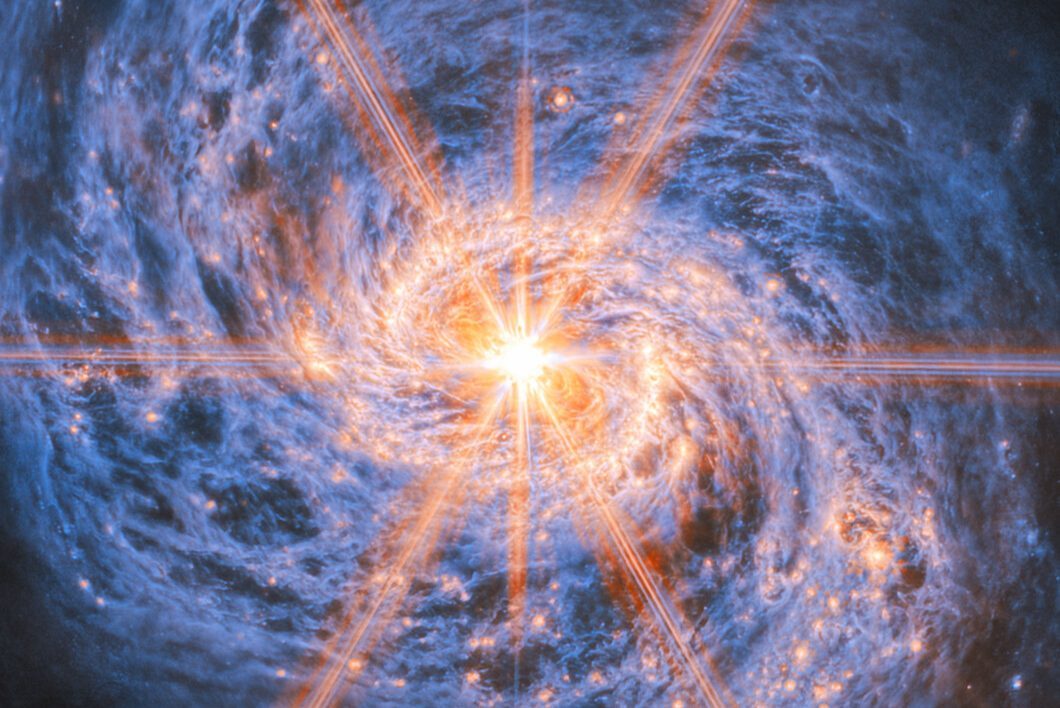
Recent stunning images from the James Webb Space Telescope have unveiled new insights into one of the universe’s brightest spectacles.
Messier 77 (M77), commonly referred to as the Squid Galaxy, features magnificent swirling tentacles of dust and gas that stretch deep into intergalactic space.
What sets this galaxy apart, located 47 million light-years from Earth, are the brilliant rays of light emanating from its core.
Recent observations highlight the extreme activity of this galactic nucleus. According to Dr. Darren Baskill, an astronomy lecturer at the University of Sussex, “Look how exceptionally bright the center of this galaxy is in comparison to the trillions of stars surrounding it,” as reported by BBC Science Focus.
“For years, the reason behind the overwhelming brightness of galactic centers was a mystery. However, calculations and observations now suggest that significant amounts of gas are falling into the supermassive black hole at the center,” Baskill elaborates.
Describing the sheer scale, M77 boasts a mass of approximately 8 million solar masses, making it twice as massive as Sagittarius A*, the supermassive black hole at the core of our Milky Way galaxy.
Furthermore, there’s a crucial distinction, Baskill explains: “A vast quantity of gas is spiraling into a disk around the supermassive black hole at M77’s center. In contrast, our Milky Way’s center remains relatively tranquil, with only sporadic stars falling into its black hole.”
“This disparity elucidates the striking brightness difference between M77 and our galaxy.”
Read More:
Source: www.sciencefocus.com