


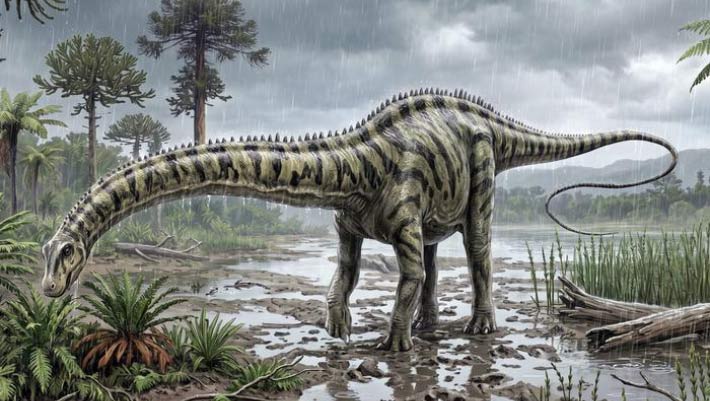
First Diplodocus Fossil Found Outside North America Identified in Spain
Paleontologists from the Dinópolis Foundation have identified the first known fossil of the iconic sauropod genus Diplodocus outside North America.
A giant sauropod from Jurassic Spain
The Spanish Diplodocus lived approximately 150 million years ago, near the end of the Jurassic Period. Researchers estimate that the dinosaur was about 25 meters (82 feet) long, making it comparable in size to its American relatives.
Its fossilized remains were excavated at the La Tejeria archaeological site near El Castellar in Teruel province, Spain. The material includes 14 well-preserved caudal vertebrae and several chevron-shaped bones.
“We are delighted with this discovery,” said Sergio Sánchez Fenollosa, a student associated with the Dinópolis Foundation. “This will allow us to better understand the diversity of sauropod dinosaurs that lived in the Iberian Mesozoic ecosystem and during the Jurassic Period of Europe.”
Fossil anatomy points to Diplodocus
According to Alberto Cobos, Managing Director of the Dinópolis Foundation, the dinosaur from El Castellar was approximately 25 meters long. Along with other sauropods from Teruel, it represents one of the giant sauropods known from Jurassic Spain.
However, its characteristics differ significantly from other diplodocid dinosaurs, including Turiasaurus and Losillasaurus.
“It was an exciting and ongoing process to watch the pieces of the puzzle gradually fall into place,” Cobos said.
During the early stages of the osteological study, researchers noticed strong similarities between the fossils and certain diplodocine sauropods. As they examined the anatomy in greater detail, they identified a combination of features characteristic of the Diplodocus lineage.
Multiple evolutionary analyses supported the same conclusion, strengthening the identification of the Spanish fossils as Diplodocus.
Evidence of dinosaur migration between Europe and North America
The discovery also provides evidence that dinosaurs migrated between North America and Europe during the Late Jurassic. The researchers suggest that the animals may have crossed temporary land bridges that appeared as the proto-North Atlantic periodically retreated.
“The results of this excavation constitute some of the strongest paleontological evidence for an episode of dispersal and faunal exchange between the two proto-Atlantic continents during the Late Jurassic,” Sánchez Fenollosa said.
The team said that dinosaur fossils, including new species, make Teruel an important reference point for understanding the remarkable diversity of Jurassic dinosaurs.
Study publication
The team’s study is scheduled for publication in the Journal of Vertebrate Paleontology.
Sergio Sánchez Fenollosa et al. 2026. Intercontinental evidence for an iconic genus, Diplodocus Marsh, 1878 (Dinosauria, Sauropoda). Journal of Vertebrate Paleontology, in press. DOI: 10.1080/02724634.2026.2718423.
Source: www.sci.news