


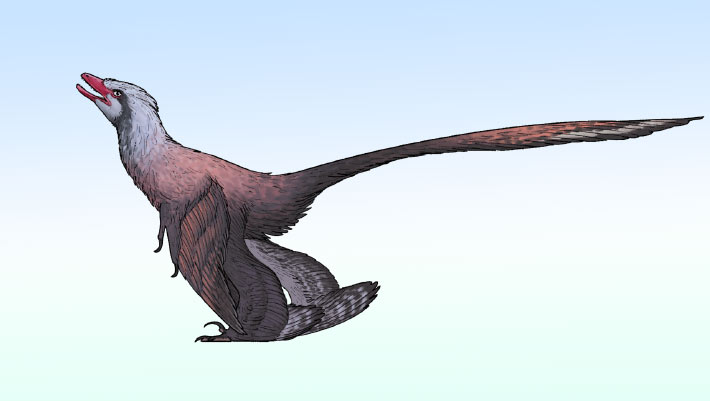
Discover the newly identified genus and species of the four-winged Penaraptor dinosaur, Changzhou Saurus sinensis, from the Early Cretaceous period in northern China. This groundbreaking finding sheds light on the evolution of birds from their dinosaur ancestors, according to paleontologist Dr. Xin Shu of the Institute of Vertebrate Paleontology and Paleoanthropology at the Chinese Academy of Sciences.
Changzhou Saurus sinensis lived approximately 120 million years ago during the early Cretaceous period in present-day China.
This dinosaur species is about 34 cm (13 inches) in length, ranking among the smallest known non-avian theropods.
Despite its diminutive size, Changzhou Saurus sinensis exhibited anatomical features characteristic of various branches of the bird-like dinosaur family tree.
It is believed to be a member that diverged early within the Deinonychosaurus lineage, a group of pennaraptor dinosaurs that include dromaeosaurs and troodontids.
Dr. Xu elaborated in the research paper, “Penaraptoridae comprises several smaller clades (e.g., Unenlaginae, Microraptoridae, Scansoliopteridae, Anchiornitidae, Halskaraptrinae) and four major groups (Oviraptorosauridae, Dromaeosauridae, Troodontidae, and Ornithidae).”
“In the last 30 years, remarkable fossils from both newly recognized minor clades and well-established major Pennaraptorian groups have significantly bridged the morphological gap between major Pennaraptorian lineages and provided the earliest fossil record of feathers, documented the initial instances of theropod flight, and showcased unexpected morphological adaptions.”
“Crucially, these fossils enhance our understanding of bird origins, indicating that complex plumage, aerodynamic features, and other characteristics once believed exclusive to birds also appeared in various Pennaraptoran groups.”
Nevertheless, many pivotal questions remain, particularly concerning the phylogeny reconstruction, behavior, and ecology of Pennaraptors and the interpretation of individual morphological traits.
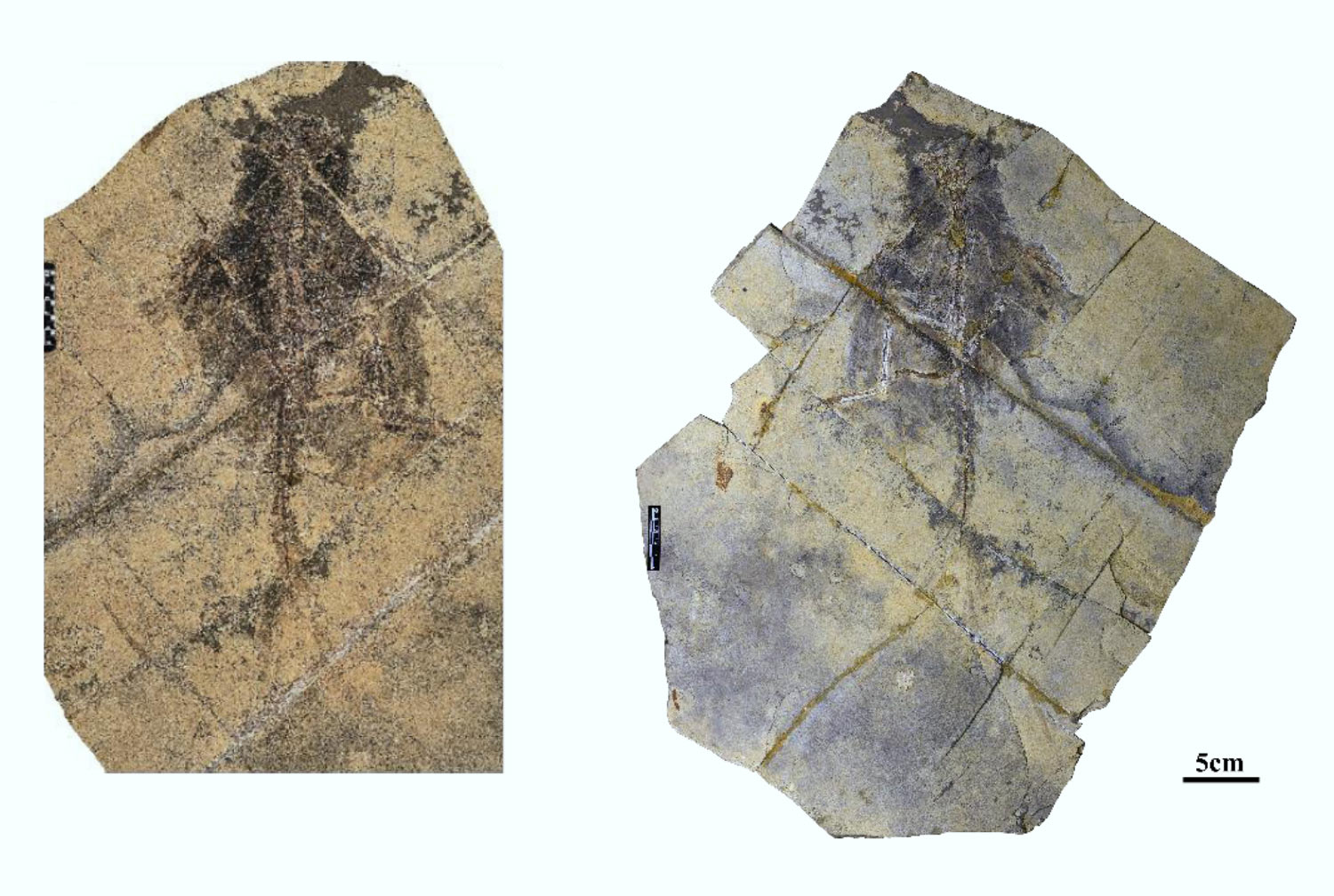
Holotype specimen of Changzhou Saurus sinensis. Image credit: Xing Xu, doi: 10.19615/j.cnki.2096-9899.260616.
The fossilized remains of Changzhou Saurus sinensis were discovered in the Jiufodang Formation in western Liaoning Province, a region famed for its rich fossil deposits.
This specimen is well-preserved in slabs and counterslabs, representing nearly a complete skeletal structure, adorned with extensive feathers.
Changzhou Saurus sinensis featured approximately 16 significantly elongated tail feathers, reaching nearly four times the length of its femur, reminiscent of the long decorative tail feathers of peacocks.
Its unusually large wings boasted primary flight feathers measuring around 12 cm (4.7 inches), which proportionately surpassed the flight feathers of other known non-avian Penaraptornids.
This finding challenges conventional views, suggesting that features related to feathered wings and arm length did not develop simultaneously in the evolution of flight.
The legs also displayed large feathers, bolstering the idea that some bird-like dinosaurs exhibited a four-winged morphology.
“This discovery adds significant complexity to the early evolution of Pennaraptors and raises several methodological questions in the field of Penaraptor research,” Dr. Xu concluded in the study.
“We must address how to derive a robust phylogeny of Pennaraptors, as well as how to deduce their aerial behavior and ecological habitats, in addition to defining plumage and the concept of birds themselves.”
This groundbreaking research paper has been published online in the journal Asian Vertebrates.
_____
Shin Shu. 2026. A new feathered dinosaur from northern China from the Early Cretaceous. We highlight the complexity of early Penaraptornian evolution and comment on several related conceptual and methodological issues. Spinal Paralysis, in press. doi: 10.19615/j.cnki.2096-9899.260616
Source: www.sci.news