


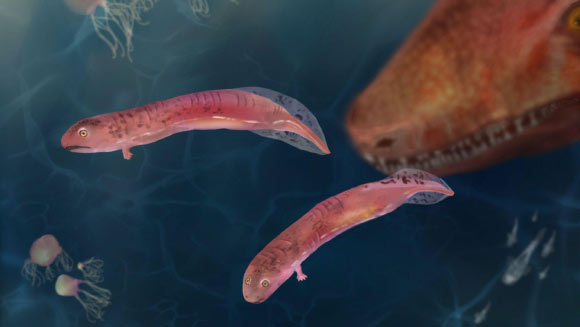
A paleontologist from the Field Museum of Natural History has described the fossilized remains of a baby embolomere, a crocodile-like predator that inhabited ancient rivers and swamps between 350 million and 280 million years ago. These remarkable creatures were some of the earliest vertebrates to venture onto land, challenging previous assumptions that their young resembled tadpoles.
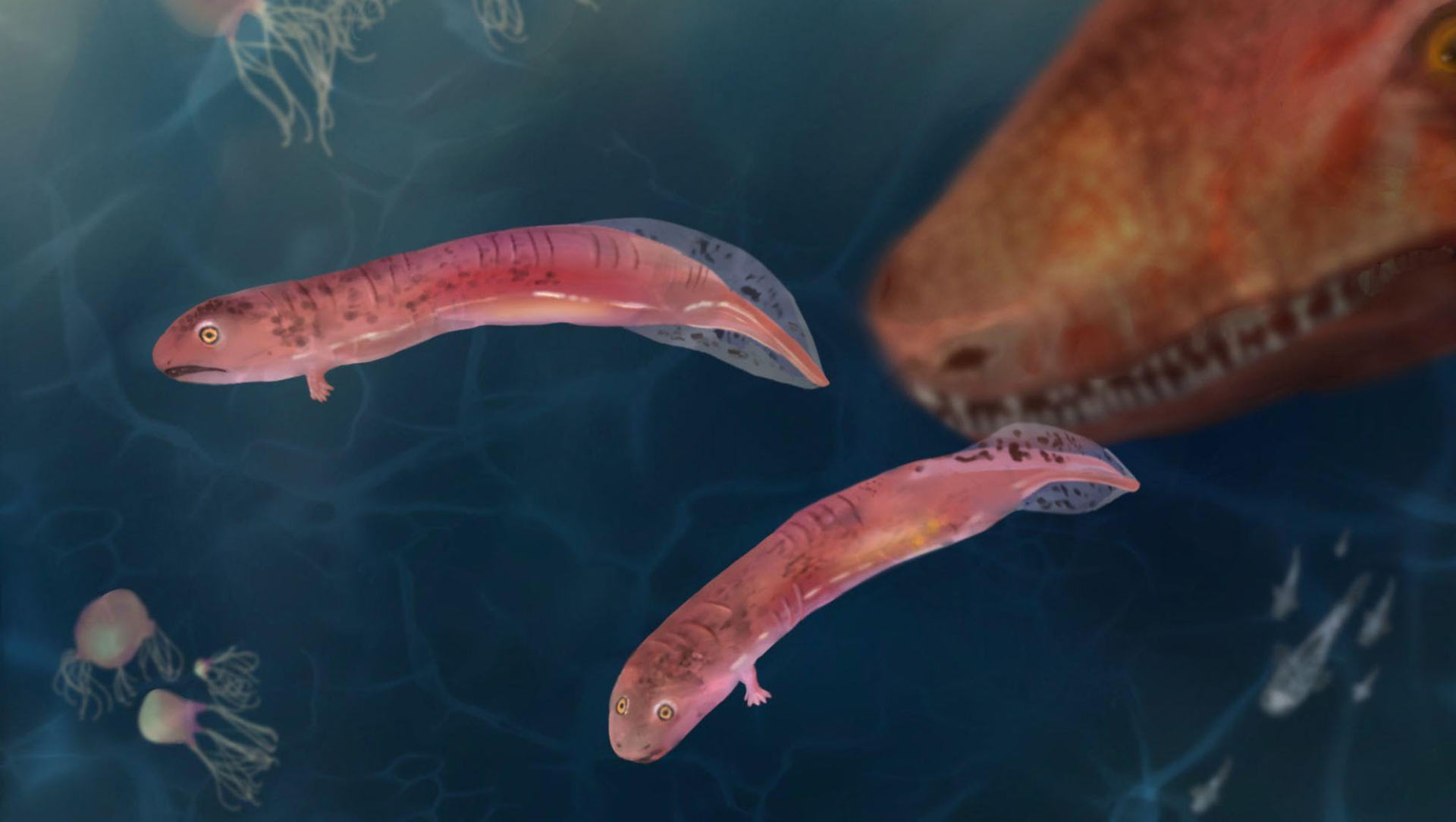
New fossil evidence indicates that embolomeres did not experience the same metamorphosis that modern amphibians undergo, challenging the conventional scientific narrative that amphibians, reptiles, and mammals descended from tadpole-like ancestors. Image credit: Berit Godling.
“We were often taught a simplified version of evolution in high school, where fish evolved into amphibians, amphibians turned into reptiles, and some reptiles transitioned into mammals,” stated Jason Pardo, a paleontologist at the Field Museum.
“Our research reveals that this foundational idea—that the first four-legged vertebrates developed like amphibians—is fundamentally flawed.”
In their recent study, Dr. Pardo and colleague Dr. Arjan Mann analyzed fossilized quadrupeds from the Mason Creek Lagerstätte in Illinois. Many of these fossils featured well-preserved soft tissue.
“This site is one of the world’s best for soft tissue and delicate small fossils,” added Dr. Mann.
“The Mason Creek fossils act as a time capsule, allowing us to explore previously impossible theories.”
Embolomeres reached over 3 meters (10 feet) as adults and were fierce apex predators that thrived in rivers, lakes, and swamps from 350 million years ago (Carboniferous period) to 280 million years ago (Permian period).
The Mason Creek specimen provides a striking contrast. Despite being only a few centimeters long, it holds critical information that could overturn a century’s worth of scientific assumptions.
According to the study’s authors, baby embolomeres did not exhibit essential characteristics of amphibian tadpoles, such as external gills.
There were no indications of true metamorphosis in these early tetrapods, despite significant changes occurring in their life cycle as they matured.
Instead, the developmental stages of these ancient tetrapods appear to be more comparable to those of humans or fish than to modern amphibians.
“We examined various species that represent different fish-to-tetrapod transitions and found no evidence of anything resembling a tadpole,” said Pardo.
“Without tadpoles, there can be no metamorphosis.”
“If animals like embolomeres never had tadpole-like features or true amphibian metamorphosis, this challenges the widely accepted hypothesis that reptiles and mammals evolved from amphibian-like ancestors.”
“The earlier belief was that metamorphosis facilitated the transition from aquatic to terrestrial life. That narrative no longer stands. It’s now just dust in the wind.”
The findings are published in the journal Science.
_____
Jason D. Pardo & Arjan Mann. 2026. Direct development of stalk tetrapods through the fin-to-limb transition. Science 392 (6804): 1292-1296; doi: 10.1126/science.aeb7635
Source: www.sci.news