


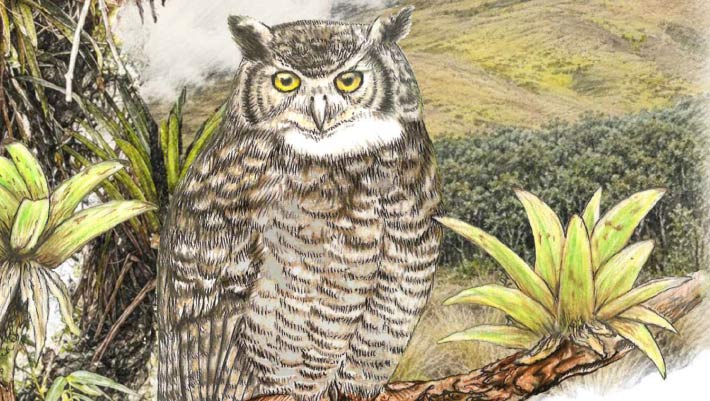
A new species of long-eared owl has been identified in the high Andes of northern Peru. Described in a paper published in July 2026, the Jalca-eared Owl (Bubo jalca) is known from narrow grassland and cloud forest habitats in the Huancabamba Depression. The discovery was reported in the journal Audio Lunis.
The newly described Jalca-eared Owl belongs to the genus Bubo, a group that includes more than 10 species of horned owls and eagle-owls found across the Americas and the Old World.
Named Bubo jalca, the Jalca-eared Owl is restricted to cold, high-altitude grasslands and adjacent cloud forests in the Huancabamba Depression. This geographic depression in the Peruvian Andes separates the páramo ecosystem to the north from the puna ecosystem to the south.
“Bubo jalca is a particularly rare taxon, or at least a very rare taxon, within its known range, including the cloud forest adjoining the jalca,” said ornithologist Armando Ugas Scheele of the National University of Piura and colleagues from Argentina and Peru.
“To date, no photographs of this species are known, which indirectly reflects its uniqueness.”
In terms of plumage and body measurements, Bubo jalca is largely indistinguishable from its closest relatives, including the Black-and-chestnut Eagle-Owl, which inhabits páramo environments in Ecuador and Colombia.
According to the researchers, the most distinctive feature of the new owl species is its vocalization.
“Its calls can be distinguished acoustically and by their phrase structure on spectrograms and oscillograms, which may be useful for identification,” the researchers said.
The Jalca-eared Owl produces a rapid “jecu” call, with emphasis on the first syllable. This differs from the long, three-syllable “cus-cún-go” call of Bubo virginianus, which has emphasis on the middle syllable, and the shorter, two-syllable “tu-cú” call of Bubo magellanicus.
The formal description of Bubo jalca is based on a female specimen collected in July 1980 near Cruz Blanca, approximately 33 km by road southwest of Huancabamba at an elevation of about 3,050 m.
The specimen is housed at the Louisiana State University Museum of Natural Science. Matching audio recordings of the same individual are archived in the Cornell Lab of Ornithology’s Macaulay Library.
Because of its extremely limited distribution, Bubo jalca is believed to face serious conservation threats.
The researchers point to the expansion of pine plantations into the jalca grasslands and the continuing loss of adjacent cloud forest as major risks to the species.
“Bubo jalca, as a species with a highly restricted range, is considered to face serious conservation threats. Its survival depends not only on the jalca, which has recently been increasingly invaded by pine forests, but also on the adjacent cloud forest, which is under imminent threat of deforestation,” the researchers concluded.
_____
Bernabé López-Lanús et al. 2026. Confirmation of a new species of owl (Strigidae: Bubo) endemic to the Jalca of the Huancabamba Andean Depression, Peru. Audio Lunis 6:2–53.
Source: www.sci.news