


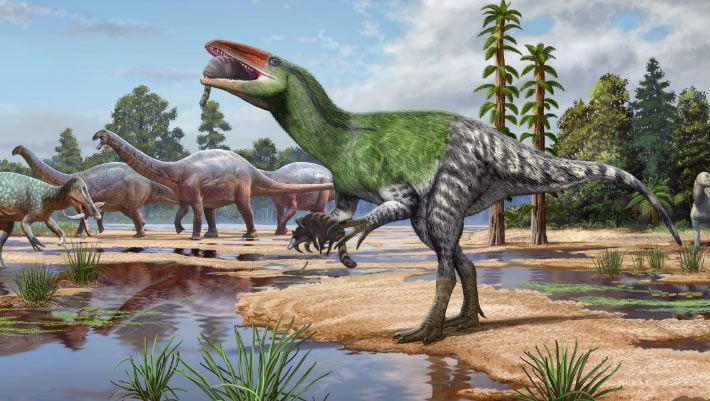
Century-Old Fossil Reveals Europe’s First Megaraptor Dinosaur
A fossilized dinosaur braincase held in London’s Natural History Museum for more than a century has been identified as Europe’s first known megaraptor. The discovery suggests that this group of agile, two-legged predators reached Europe before spreading into the southern hemisphere.
A 120-Million-Year-Old Predator from the Isle of Wight
Named Invictivellatrix amberina, the new species belonged to Megaraptora, a group of agile, two-legged carnivorous dinosaurs that included megaraptors.
The dinosaur lived during the Early Cretaceous, approximately 120 million years ago. Its fossilized braincase was discovered at the foot of cliffs at Sudmoor Point, near Brook, on the south-west coast of the Isle of Wight.
The specimen was purchased by London’s Natural History Museum in May 1924 from Reverend R. W. Hooley.
“It comes from Barremian-age strata of the Wessex Formation, but it has never been formally described,” said Cassius Morrison, a paleontologist at University College London.
One of the Smallest Known Megaraptors
The size of the braincase suggests that Invictivellatrix amberina was a relatively small megaraptor. Researchers estimate that it weighed between 200 and 300 kilograms and measured less than 4 meters long, making it similar in size to the small tyrannosaurid Timurlengia.
Other megaraptors are thought to have reached 6 to 10 meters in length or more and weighed over 2,000 kilograms. Invictivellatrix amberina was one of the smallest known members of the group, if not the smallest.
Its small size supports the idea that megaraptors evolved larger body sizes relatively late in their evolutionary history.
“Based on what we know about its closest relatives, it would have been 3 to 4 meters long and just over 1.5 meters tall—about the same height as a human,” Dr. Morrison said.
“It is likely that it had feathers, and its claws were about 10 to 20 centimeters long.”
The dinosaur probably hunted small dinosaurs, lizards and mammals. Researchers suggest that it occupied a role in the food chain similar to that of modern hyenas.
Although it was not an apex predator, the researchers say it would have been a dangerous predator for an animal the size of a human. By contrast, humans would probably have been too small to attract the attention of a Tyrannosaurus rex.
Clues to How Megaraptors Spread Around the World
The best-known megaraptors include Megaraptor and Australovenator, whose fossils have been found in South America and Australia. However, the oldest megaraptor fossils from the southern hemisphere are younger than the Isle of Wight specimen.
This finding supports the idea that megaraptors spread across much of the world during the Early Cretaceous.
Scientists suggest that the group originated in Asia, reached Europe by about 130 million years ago and later spread through Africa to the southern continents.
“This new species is the first evidence that megaraptors also existed in Europe and that they reached Gondwana in this way, rather than moving farther south down the island,” said Charlie Scherer, a doctoral student at University College London.
The study describing the discovery was published in Royal Society Open Science.
_____
Cassius Morrison et al. 2026. A new megaraptorian dinosaur discovered from the Lower Cretaceous Wessex Formation of Britain and its implications for theropod evolution and biogeography. Royal Society Open Science 13 (10): 260937. doi: 10.1098/rsos.260937.
Source: www.sci.news