


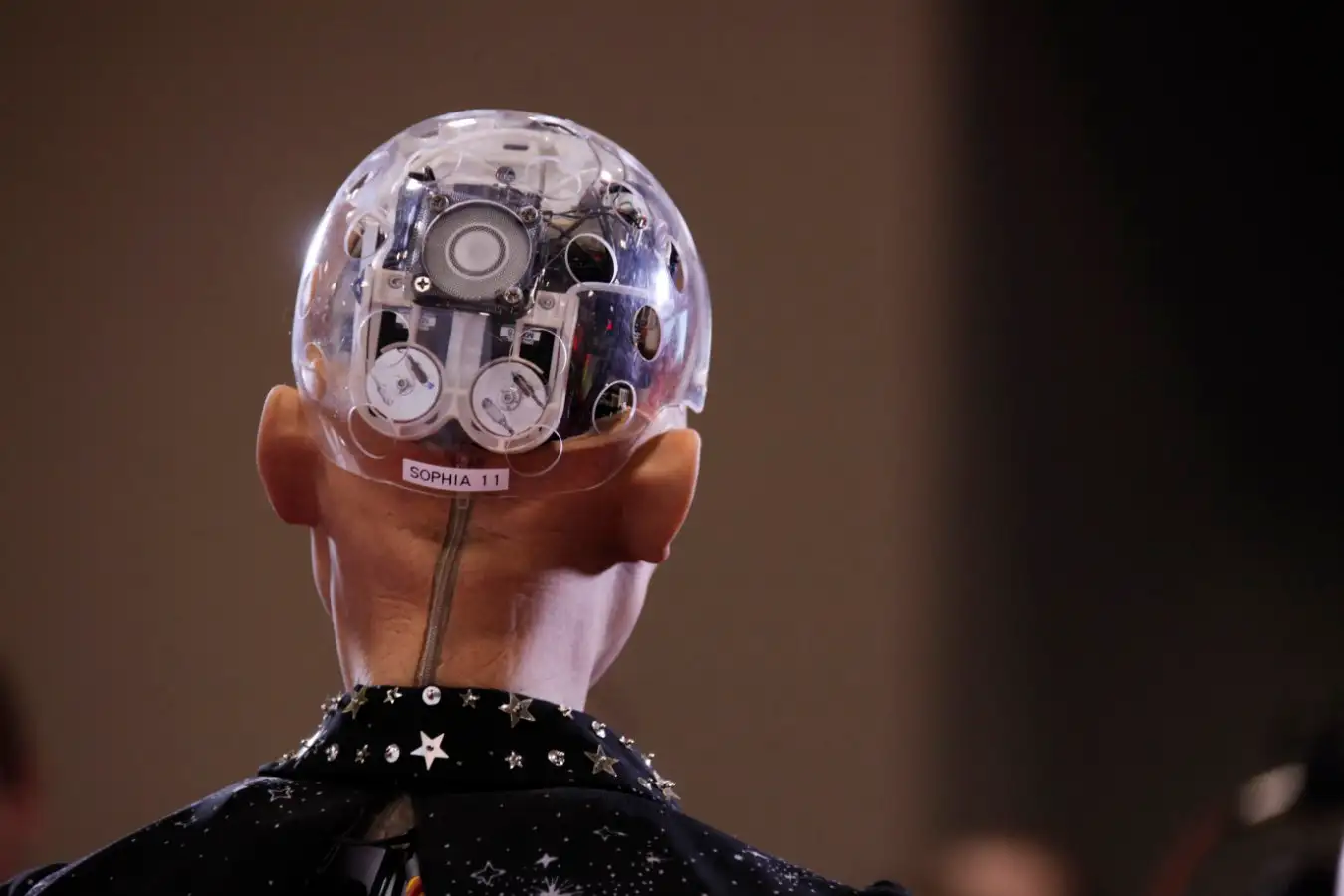
Mr. O’Connor emphasizes that it’s not a new phenomenon for employers to desire machine-like efficiency from their staff.
Yu Ruidong/China News Service/Getty Images
We Are Not Machines
By Sarah O’Connor, Allen Lane (UK). Godine (US, released August 11th)
If you’re a fan of translated films, you may have observed notable shifts in subtitles on streaming platforms recently. While not incorrect, they can feel somewhat, well, lackluster.
“I grasp the meaning, but the language lacks richness,” Czech translator Petr Čermok shared with Sarah O’Connor. We Are Not Machines investigates the impact of artificial intelligence on work dynamics.
This lack of vibrancy often stems from streaming services using AI for script translation, which is then polished by human translators like Čermok. Agencies anticipate quicker work, resulting in pay cuts for translators.
However, this new model poses greater challenges. Translators now juggle between the original text and AI-generated translations, demanding more effort without increasing rewards. “It’s just monotonous work. Dull, bland, lifeless,” notes Čermok.
O’Connor’s striking book highlights our growing acceptance of an AI-driven future. While it’s frequently claimed that AI will supplant human translators, O’Connor highlights the crucial need for a critical lens on how we adapt to an AI-centric marketplace, rather than letting AI dictate our professional landscapes, as discussed in publications like Financial Times.
“
“It feels like we’ve somehow lost faith in ourselves,” O’Connor wrote.
“
O’Connor asserts that the issue isn’t merely about AI potentially taking our jobs; rather, we are changing ourselves to fit an increasingly automated world. This extends to accepting subpar products like translations and trying to compete with workplace AI while blaming ourselves for the inevitable shortcomings. “It seems we’ve lost faith in ourselves,” states O’Connor.

This notion of compromise is evident across various sectors, often reaching startling extremes. We hear accounts of employers unable to hire skilled interns due to poor performance on AI-driven evaluations or of copywriters witnessing their online content sink in rankings because algorithms presume it’s AI-generated. Consequently, writers may need to reprocess their work through “humanizer” tools created by AI to enhance its perceived authenticity. Is this truly the future we aspire to, wonders O’Connor, one that “damages and distorts the essence of the human experience in the process”?
While it would have been enlightening to hear tech executives refute these points, O’Connor consciously distances her dialogue from Silicon Valley, shining a light on perspectives from “the factory gate,” featuring individuals across the globe—from Swedish miners to operators of self-driving trucks in the U.S.
As O’Connor articulates, the desire for employees to mirror machines isn’t a novel concept. Frederick Winslow Taylor, an early management consultant, implemented methods in 1911 that stripped factory laborers of their autonomy, dictating not only their tasks but also precise time allocations for every duty.
However, AI has considerably intensified this trend. O’Connor recounts the experiences of Maria, a telecommuter in Costa Rica. Tasked with viewing Amazon warehouse footage, she must meticulously identify unaccounted items that the cameras fail to capture. Over a nine-hour shift, Maria watches around 1,200 ten-second clips and is held to a staggering 99.9% accuracy rate. By the week’s end, her supervisor demands she make no more than three errors throughout 8,000 videos. “They expect machine-like precision, which is unattainable,” Maria asserts.
Yet, all is not grim. O’Connor visited a mine in Sweden where automated trucks have substantially increased both safety and productivity for miners. The key difference lies in the robust labor unions ensuring that discussions about AI’s role remain transparent. When workers opposed a real-time tracking system, solutions like anonymization were embraced. “Tolerance or resistance are not our only options,” O’Connor notes.
“
“It’s not all bad – she visited a mine in Sweden. There, self-driving trucks have provided miners with safer jobs.”
“
However, advocating for nuanced solutions is easier said than done. The book’s subtitle highlights “The Fight for the Future of Work,” yet at times, We Are Not Machines feels more like an exploration of thought-provoking features than a definitive roadmap for overcoming these challenges. O’Connor suggests that safeguarding fundamental human values may hold the key. “The real danger,” she warns, “is not that we successfully engineer machines in our likeness, but that we inadvertently reshape ourselves into their image.”
O’Connor offers pragmatic strategies for this ongoing struggle. She encourages workers to assert their influence over AI utilization within their industries. For instance, Hollywood writers proactively negotiated guidelines regarding AI applications in their fields while retaining leverage, unlike translators who were slower to mobilize. Collective strategies like union participation are vital in this realm.
If you’re looking for a lighthearted perspective on AI, consider Joanna Stern’s book, I Am Not a Robot. Stern, a former technology columnist for the Wall Street Journal, chronicles a year where AI and robots assisted in various tasks, from dentistry to cooking—offering an intriguing introduction to AI, albeit with some inconsistencies. Stern interjects humor throughout, which sometimes distracts from the serious implications of her topics, including AI’s environmental impact.
Interestingly, even after a year of using AI extensively, Stern arrives at a similar conclusion as O’Connor: we need to collaborate with AI, rather than serve it. “The moment you relinquish control, you begin to decline and lose agency,” Stern writes. As we increasingly integrate AI into our tasks, it remains crucial to hold onto these values.
Tom Knowles is a technology and business journalist based in London.
3 More Insightful Books on Artificial Intelligence

Code Dependent
Authored by Madhumita Murgia
The Financial Times‘ AI editors delve into AI’s encroachment into policing, welfare, justice, and health sectors, shedding light on how it can dramatically change or even destroy lives.

The Infinity Machine
Authored by Sebastian Mallaby
A comprehensive biography of DeepMind, the AI powerhouse acquired by Google in 2014, detailing its potential to revolutionize scientific domains including chemistry and biology.

Empire of AI
Written by Karen Hao
This engrossing narrative follows OpenAI’s evolution from a mission-driven nonprofit to a commercial entity focused on aggressive productization, epitomized by innovations like ChatGPT. Hao voices concerns about the competitive AI landscape and its increasingly disconcerting trajectory.
If you purchase items via links on this page, we may earn a commission.
Topic:
Source: www.newscientist.com