


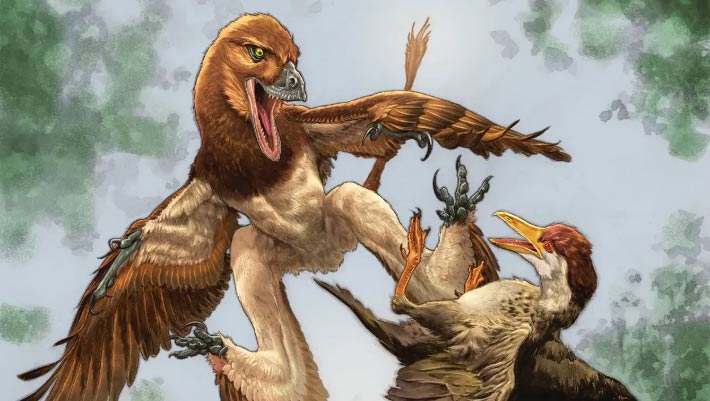
Jiang Changmensis is the first non-avian dinosaur identified in a paleontological site housing over 100 early Cretaceous bird specimens.
Jiang Changmensis (left) engages in an early attack on Gansus yumenensis (right), set in the Changma Basin of northwestern China, approximately 120 million years ago. Image credit: Lewis LaRosa / Jão Canola.
Jiang Changmensis existed in what is now northwestern China around 124 to 120 million years ago, during the Early Cretaceous period.
This species belongs to the Microraptoridae, a subgroup of small, winged dromaeosaurid dinosaurs.
Notable members of this group include Microraptor, a four-winged dinosaur believed to have had gliding capabilities and possibly powered flight.
According to Dr. Jingmai O’Connor, a paleontologist at the Field Museum of Natural History and the Institute of Vertebrate Paleontology and Paleoanthropology at the Chinese Academy of Sciences: “Jiang Changmensis is one of the largest Microraptor specimens ever discovered.”
“The humerus bone we have measures about 10 centimeters (4 inches), suggesting an estimated wingspan of around 4 feet—comparable to that of a barn owl.”
“We suspect that Jiang Changmensis, like other Microraptor species, possessed long feathers on its arms and legs, resulting in the appearance of four ‘wings’ used for gliding.”
“While previous Microraptor species likely lacked the ability for true powered flight, they were probably adept at gliding similarly to modern flying squirrels.”
The skeletal remains of Jiang Changmensis were found in the Xiagou Formation, unearthed near Changma Village in the Changma Basin of Gansu Province.
Over 100 early Cretaceous bird skeletons have been uncovered at this site, with many exhibiting preserved soft tissues, such as feathers and skin.
Until this discovery, no non-avian dinosaur specimens had been identified at the site.
Dr. O’Connor mentioned: “Researchers discovered peculiar clusters of dismembered bird bones in this area, but the cause remained a mystery.”
“This new Microraptor dinosaur, Jiang Changmensis, might provide the explanation.”
“It stands out as the only non-avian dinosaur found, being a carnivore and significantly larger than the other dinosaurs discovered there.”
The discovery of Jiang Changmensis carries implications beyond merely identifying a new species.
Previously, distinct members of the Microraptorinae subfamily were found in the Jehor Group, a series of geological formations in northeastern China, approximately 2,000 km from Changma.
The confirmed range of Jiang Changmensis now extends into northwestern China.
Dr. Matt Lamanna, a paleontologist at the Carnegie Museum of Natural History, stated: “Jiang Changmensis reveals that non-avian dinosaurs cohabited the present-day Changma Basin, renowned for its bird fossils.”
“Our team has recovered over 100 bird fossils in the Chanma region, but this is the sole non-avian dinosaur specimen.”
“Jiang Changmensis” enriches our understanding of the biological history of the Changma area and the ecological context of early bird ancestors.
“Understanding contemporary life on Earth necessitates exploring its origins.”
“Birds represent one of the most successful groups of terrestrial vertebrates today.”
“By studying early birds alongside their non-avian dinosaur relatives, we can gain valuable insights into what makes this enduring group of birds so exceptional.”
The team’s findings have been published in the Carnegie Chronicle Museum.
_____
Zhou Lingqi et al. 2026. A non-avian theropod (Dromaeosauridae, Microraptoridae) discovered in the Lower Cretaceous Xiagou Formation, inhabited by birds, in the Changma Basin, Gansu Province, northwest China. Carnegie Chronicle Museum 92(2):89-110
Source: www.sci.news