


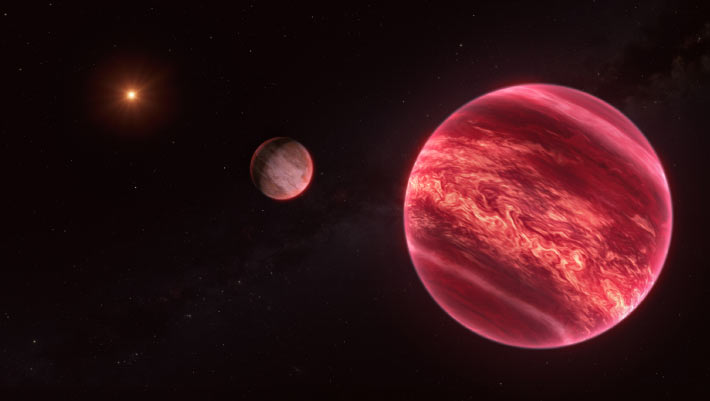
Astronomers using ESO’s Very Large Telescope (VLT) have identified a possible giant exomoon orbiting a brown dwarf in the distant star system CD-35 2722. The discovery could represent the first plausible detection of a planetary-mass exosatellite and further blurs the boundaries between stars, planets and moons.
Artist’s illustration of the CD-35 2722 star system, showing the newly discovered planetary-mass exomoon orbiting a brown dwarf. The star has about half the mass of the Sun, while the brown dwarf appears as the reddish-brown object in the foreground. Image credit: ESO / M. Kornmesser.
CD-35 2722, also catalogued as TIC 201426753, is a star located approximately 73 light-years from Earth in the constellation Columba.
The star is orbited by a brown dwarf with a mass roughly 37 times greater than Jupiter’s. Astronomers have now found evidence that a planetary-mass exomoon, or exosatellite, orbits the brown dwarf rather than the star itself.
The suspected exomoon has a minimum mass of approximately 0.9 times the mass of Jupiter and completes one orbit around the brown dwarf every 170 days.
“This system is difficult to describe using familiar Solar System terms such as ‘planet’ and ‘moon,’” said ESO astronomer Kevin Hoy.
“The exosatellite is massive enough to be considered a planet, but it does not orbit a star. Instead, it circles an object that itself orbits a star.”
“Its position as the third member of this system encourages us to call it a moon, even though it is very different from the small, rocky moons found in our Solar System.”
“The satellite we report is a giant gaseous body orbiting a highly massive companion that is itself several times more massive than Jupiter,” said Universidad Diego Portales astronomer Alice Zurlo.
“In our Solar System, the distinction between planets and the Sun is clear, which makes it straightforward to define moons.”
“In the CD-35 2722 system, however, the boundaries between stars, planets and moons are much less distinct, making the system far more difficult to classify.”
The research team used the CRIRES+ instrument on ESO’s Very Large Telescope to search for tiny changes in the brown dwarf’s motion. These movements, detected through the radial velocity method, were likely caused by the gravitational pull of the orbiting planetary-mass object.
“As exotic as this system is, it is truly unique and represents a major breakthrough: the first plausible detection of an exosatellite,” Dr. Zurlo said.
The findings appear in the journal Nature.
_____
K. Hoy et al. 2026. Planetary-mass exosatellite detected around the substellar companion of a star. Nature 655, 865-869; doi: 10.1038/s41586-026-10751-w
Source: www.sci.news