


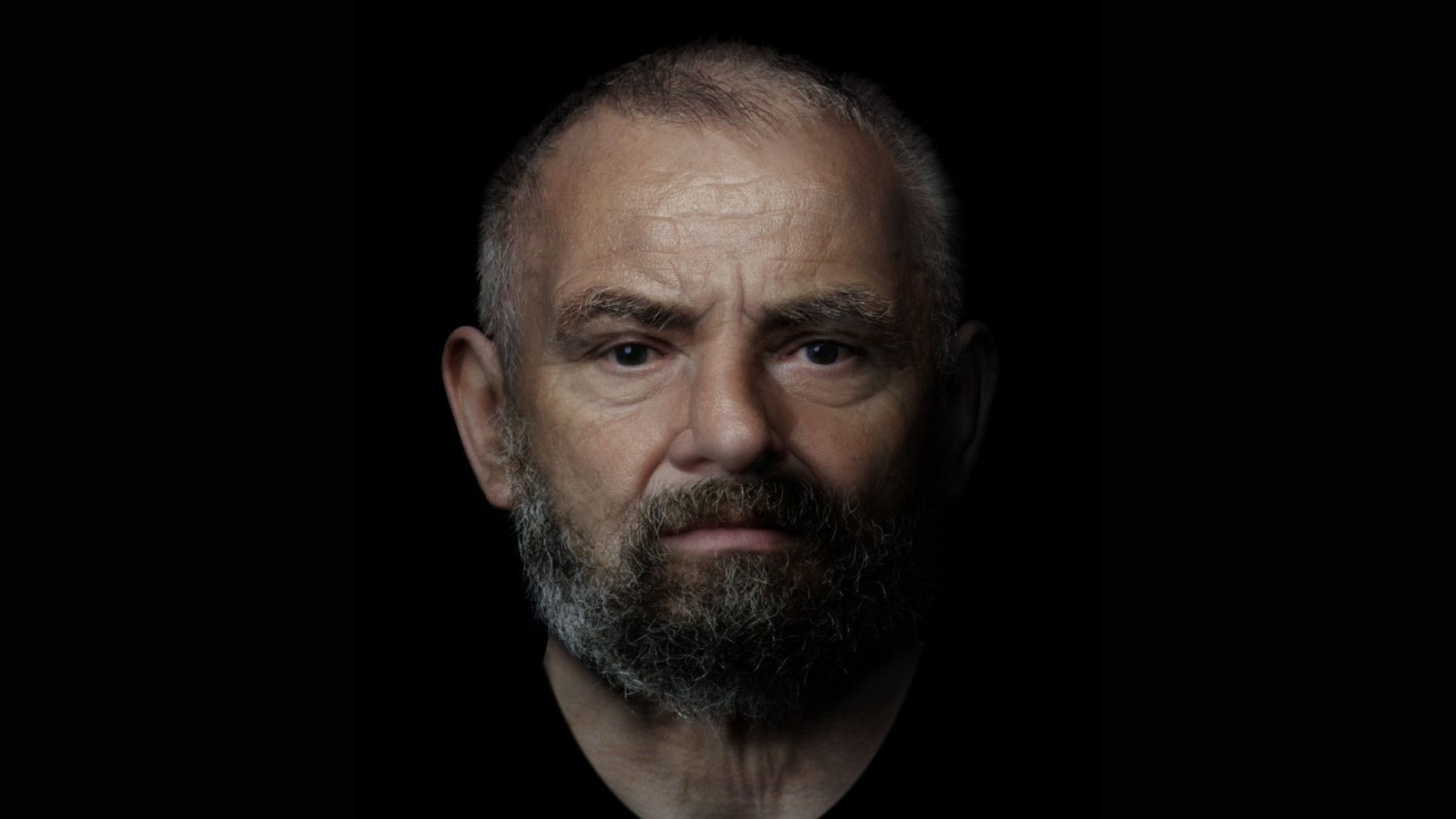
Researchers have digitally reconstructed the face of a man who was decapitated after death and buried near the Roman military fort at Inveresk in Scotland about 2,000 years ago. The man likely grew up in southern England and may have worked with the Roman army, although his limited movement in one arm suggests he was probably not a frontline soldier. His unusual burial may reflect a regional ritual rather than an execution, but why he was beheaded remains uncertain.
John H. Reid, an archaeologist from the Trimontium Trust who was not involved in the excavation, told Live Science that other burial sites hundreds of miles away could help explain the practice. Several headless bodies were found in southern Britain from around the same period, suggesting that decapitation may have been an obscure burial ritual among some southern Britons.
A southern Briton on the Roman frontier
The man was probably about 50 years old when he died sometime between 142 and 165 AD. His remains were buried near Inveresk, on the east coast of Scotland, southeast of present-day Edinburgh.
Researchers at the National Museum of Scotland said another mystery is why a man from southern Britain was living on the Roman frontier and appeared to have been associated with the Roman army. However, the skeleton showed that he had very limited movement in his right arm and could not use a sword, making it unlikely that he was a conventional soldier.
He may nevertheless have worked for the Roman army in a role that did not require fighting, such as a clerk. “He could have been left-handed, or he could have had a ‘desk job,’” Reid said. He is the author of The Eagle and the Bear: A new history of Roman Scotland (Berlin, 2023).
Non-Romans could serve the Roman army in several ways, Reid said. They may have worked as servants or artisans attached to Roman legions, or served as soldiers in auxiliary units or civilian-based legions. By the time the Antonine Wall was built, very few people from the Italian Peninsula would have been serving in the Roman army in Scotland, he added.
Chemical analysis of the man’s remains examined isotopic ratios, which can reflect where a person grew up. The results suggested that he came from southern England. Reid said, however, that nearby regions, including the coast of present-day Netherlands, could have produced a similar isotopic profile.
Evidence of an active life
Analysis of the skeleton indicated that the man had led an active life. His nose had been broken and was healing, while bone growth around his right elbow may have been related to arthritis or an earlier physical injury. Reid said the growth may have been the body’s response to trauma.
Researchers from the National Museums of Scotland and U.K.-based independent forensic anthropologist Christopher Rynn created the facial reconstruction from the shape of the man’s skull.
Romans in Scotland
The Roman fort at Inveresk was built around 140 AD and served as a command and supply center for other Roman forts along the river. It formed part of the military system associated with the Antonine Wall, which followed the shortest route between Scotland’s west and east coasts, approximately along the line between present-day Glasgow and Edinburgh. Neither city existed at the time.
After the Roman invasion of Britain under Emperor Claudius, Roman forces attempted to bring all of Scotland under their control. Following the Battle of Mons Graupius around 83 AD—possibly fought near the present-day city of Perth—Roman forces tried to impose control over the region. By about 120, however, the army had withdrawn to a heavily fortified frontier at Hadrian’s Wall, near the modern border between England and Scotland.
Inveresk was built as part of a later offensive intended to secure Roman control over southern Scotland through the construction of the Antonine Wall. That effort also failed. After 162 AD, the Romans retreated again to Hadrian’s Wall, where they remained until Roman rule in Britain finally collapsed in the early fifth century.
A strange but dignified burial
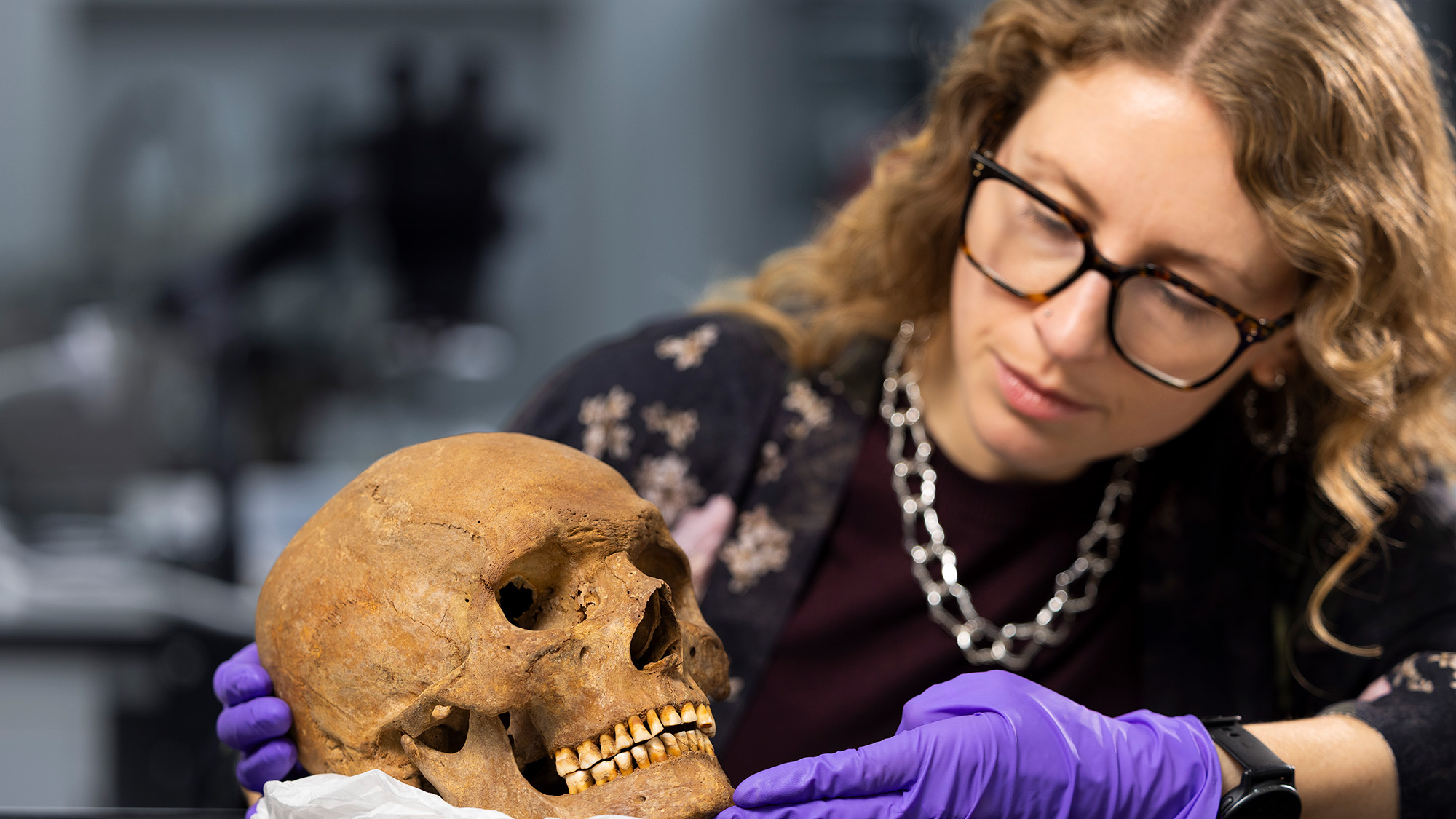
Reid told Live Science that the discovery was unusual because Scottish soil preserves very few human bones. Although the man had been decapitated after death, other features of the tomb suggested that he had been buried with dignity. The burial therefore differed from those of executed criminals, who were often beheaded in Roman Britain, Reid said.
A statement from the National Museum of Scotland said that six Roman-era burials were discovered at Inveresk, and four of the individuals had also been decapitated.
Reid and his colleagues have found extensive evidence of Roman troops at Burnswork in southern Scotland, including a whistling sling bullet that may have been used against “savage” enemies. Archaeological work at the site is ongoing.
Source: www.livescience.com