


James Webb Space Telescope Finds Strongest Candidate Yet for a “Black Hole Star”
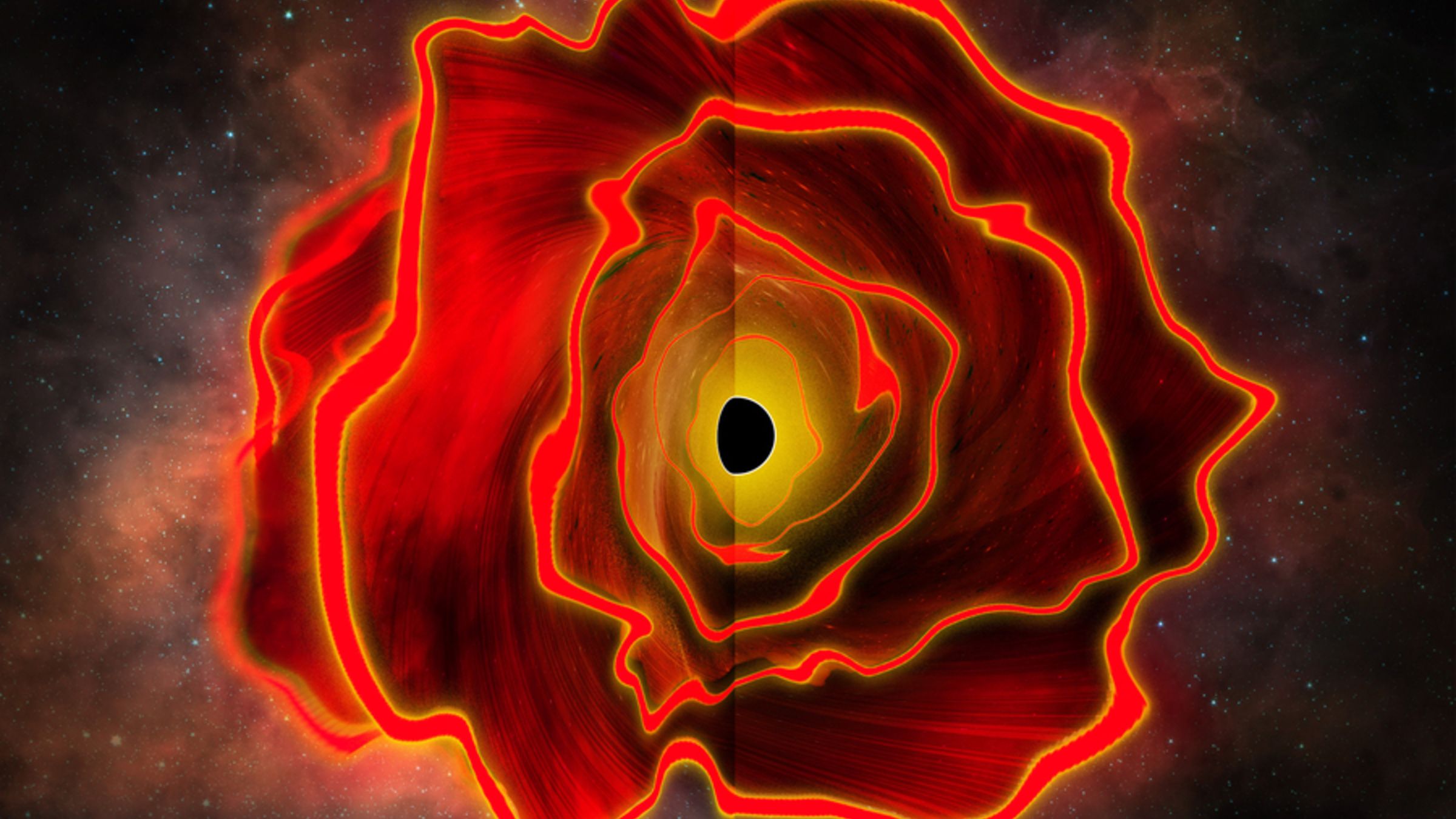
Astronomers using the James Webb Space Telescope (JWST) have identified what may be the most convincing candidate yet for a new type of cosmic object: a black hole star. The object, known as MoM-BH*-1, was detected in the early universe and could help explain the origins of the mysterious “little red dots” discovered by JWST.
If confirmed, MoM-BH*-1 could provide important clues about how the first supermassive black holes formed. The object appears to be a massive black hole surrounded by a dense, superheated shell of gas that makes it resemble an enormous star.
What are the “little red dots” discovered by JWST?
Since the James Webb Space Telescope began observing the distant universe, astronomers have found hundreds of faint, reddish objects known as little red dots, or LRDs. These objects existed when the universe was less than a billion years old and are among the biggest puzzles in modern astronomy.
LRDs are extremely compact but far brighter than ordinary stars. At the same time, they do not appear to have the size or brightness expected of fully developed galaxies. Their unusual properties have led researchers to suggest that they may contain rapidly growing black holes hidden inside dense clouds of gas.
MoM-BH*-1 was discovered during the Miracle, or Mirage (MoM), survey. The reddish light detected by JWST was emitted approximately 660 million years after the Big Bang, when the universe was only about one-twentieth of its current age. Despite its small apparent size, the object is estimated to be around 100 billion times brighter than the Sun.
The James Webb Space Telescope discovered MoM-BH*-1 during its Miracle, or Mirage, survey.
Image source: Getty Images
What is a black hole star?
Researchers propose that MoM-BH*-1 may be a black hole star—a theoretical object consisting of a massive black hole enclosed within a huge, dense cloud of gas. The black hole would draw in surrounding material, releasing enormous amounts of energy and heating the gas cocoon to extreme temperatures.
This process could make the gas shine like a star. Unlike a normal star, however, the object would not be powered primarily by nuclear fusion in its core. Instead, its brightness would come from material falling toward the black hole and being heated by the resulting energy.
The object was named MoM-BH*-1 after the survey that discovered it and the researchers’ nickname for the proposed phenomenon, “Black Hole Star One.” The study’s authors emphasize that the interpretation remains tentative, but they say the evidence is stronger than for previous candidates.
“The overall picture of this object is evolving very rapidly,” study lead author Rohan Naidu, an astronomer at the University of Hawaii and former NASA Hubble researcher at the Massachusetts Institute of Technology, said in a statement. He described the object as “really unique in many ways.”
Evidence from the object’s unusual light
One of the first clues that MoM-BH*-1 is unusual is its striking ruby-red color. Astronomers often associate very red objects with dust, because dust can block shorter blue wavelengths of light and leave behind a redder appearance.
However, the spectrum of MoM-BH*-1 appears to be missing specific wavelengths associated with the Balmer break. This pattern suggests that the light is passing through an extremely dense layer of gas rather than simply being reddened by dust.
The object also appears to contain very few heavy elements. Its gas may be composed mostly of hydrogen and helium, the same lightweight elements that dominated the early universe and helped form the first stars.
According to the researchers, the depth of the observed Balmer break is greater than that seen in ordinary stars. This makes a conventional stellar explanation difficult and supports the possibility that the object is powered by a black hole hidden inside a massive gas envelope.
How a black hole could look like a star
Most black holes are surrounded by an accretion disk, a swirling structure of gas and dust that becomes extremely hot as it spirals inward. The most powerful examples, known as quasars, can consume matter rapidly and emit intense radiation and jets of energy.
The researchers suggest that a rapidly growing, massive black hole surrounded by a spherical gas cloud could heat that cloud until it glows brightly. The gas may also hide much of the black hole’s high-energy radiation, explaining why MoM-BH*-1 does not display the strong X-ray and gamma-ray signals commonly associated with quasars.

Black holes can be surrounded by glowing, superheated material. Researchers suggest that a massive gas cocoon could make a black hole appear similar to a star.
Image credit: Event Horizon Telescope Collaboration
Computer simulations conducted by the researchers indicate that a hidden, massive black hole is the most plausible explanation for the object’s unusual behavior. They estimate that the black hole inside MoM-BH*-1 could have a mass of up to 100,000 times that of the Sun, placing it in the supermassive black hole category.
Could black hole stars explain the little red dots?
MoM-BH*-1 is not the first proposed black hole star candidate. A previous study identified another object, informally called “Cliff,” with some similar characteristics. However, the researchers say MoM-BH*-1 is currently the strongest evidence for this theoretical class of astrophysical object.
Its great distance also makes it especially valuable. Because astronomers see it as it existed very early in cosmic history, the object could help reveal how massive black holes formed and grew soon after the Big Bang.
One possibility is that many little red dots are actually compact galaxies containing black hole stars at their centers. These systems may have formed when a black hole star interacted or merged with a dense cluster of young stars, eventually becoming part of a larger galactic structure.
MoM-BH*-1 may already be associated with a host galaxy. However, the object is so bright that its light appears to overwhelm the surrounding galaxy, giving astronomers the impression that they are seeing almost nothing but the black hole star itself.

Little red dots are among the biggest mysteries revealed by the James Webb Space Telescope. Hundreds have been identified in the early universe.
Image credits: NASA, ESA, CSA, STScI and Dale Kocevski, Colby College
More research is needed
Although the findings are intriguing, scientists have not confirmed that MoM-BH*-1 is a black hole star. Many of the little red dots identified by JWST are larger than this candidate, and their physical properties remain uncertain.
Future JWST observations and follow-up studies will be needed to test whether the black hole star model can explain MoM-BH*-1 and other LRDs. If the interpretation is correct, these objects could represent an important stage in the evolution of the first galaxies and supermassive black holes.
For now, MoM-BH*-1 remains a compelling candidate—not proof—for one of the most unusual objects ever proposed in astrophysics.
Topics
Source: www.livescience.com