


A Heat Dome Bakes the South-Central United States as Summer Winds Down
In mid-September 2026, parts of the south-central United States were sweltering under a persistent heat dome, even as astronomical summer began to wind down.
NASA Map Shows Extreme September Heat
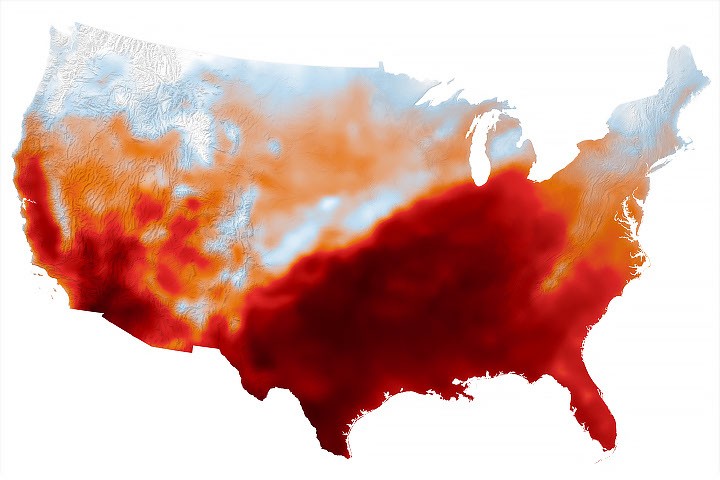
This map shows air temperatures across the continental United States at 4:00 p.m. CST (21:00 UT) on September 15, 2026. Temperatures were modeled at 2 meters (6.5 feet) above the ground using satellite observations and predictions from a version of the Goddard Earth Observing System (GEOS) model. GEOS uses mathematical equations to represent physical processes in the atmosphere.
The darkest red areas indicate temperatures approaching or exceeding 40 degrees Celsius (104 degrees Fahrenheit). Across the United States, more than 41 million people—approximately 12 percent of the population—were under a National Weather Service heat advisory, heat watch, or extreme heat warning on September 15. Alerts spanned large portions of Texas, Oklahoma, Arkansas, Missouri, and Tennessee.
Meteorologists warned that high humidity, limited cloud cover, and light breezes could make conditions feel hotter than thermometer readings indicate, increasing the risk of heat-related illnesses.
Dallas, Memphis, and Nashville Set Daily Heat Records
On September 15, several locations set new daily temperature records. Dallas, Texas, reached 101°F (38°C), Memphis, Tennessee, reached 99°F (37°C), and Nashville, Tennessee, reached 100°F (38°C).
Each city was at least 12 degrees warmer than normal for that date. Nashville set a new daily record, surpassing the previous record established in 1927. The day before, Nashville also recorded an all-time high minimum temperature, with temperatures falling only to 75°F (24°C).
How a Heat Dome Traps Hot Air
A heat dome develops when an area of high pressure in the upper atmosphere pushes hot air toward the surface and traps it there.
The high-pressure system also suppresses convection, reducing clouds and precipitation. With fewer clouds blocking sunlight, the Earth’s surface heats more efficiently, driving temperatures even higher.
Heat Follows the Warmest Summer on Record
The unseasonable heat followed the warmest June-through-August period in the continental United States in 132 years of records, according to NOAA. The three-month period was 0.4°F warmer than the previous records, set in 1936 and 2021.
NASA Earth Observatory image by Michala Garrison, using GEOS FP data from the Global Modeling and Assimilation Office at NASA GSFC. Story by Lindsay Dorman.
Source: science.nasa.gov