


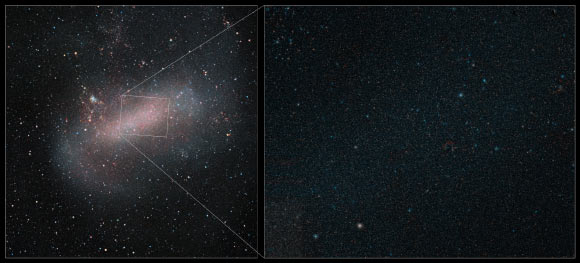
ESO’s VISTA Telescope Reveals Millions of Hidden Stars in the Magellanic Clouds
Using ESO’s Visible and Infrared Survey Telescope for Astronomy (VISTA), astronomers have mapped the dense central regions of the Large and Small Magellanic Clouds. These nearby dwarf companions of the Milky Way have long been difficult to study because their crowded cores are obscured by dust.
Infrared observations penetrate dust and stellar crowding
Professor Maria Rosa Cioni of the Leibniz Institute for Astrophysics and her colleagues explained that the centers of galaxies are challenging to observe. Dust partially blocks the view, while the high concentration of stars makes it difficult to distinguish individual objects.
“We used the VISTA telescope to discover stars hidden in the Magellanic Clouds,” the researchers said.
Over several years, VISTA’s high-resolution infrared cameras penetrated the dust and imaged the cores of both galaxies, creating a detailed view of their inner regions.
A catalog of nearly 2.5 million detections
The astronomers studied an approximately 1.77-square-degree region at the center of each galaxy. Their targets included the dense stellar bar of the Large Magellanic Cloud and the compact central region of the Small Magellanic Cloud.
Stars, gas and dust overlap in these areas, making it difficult for even powerful surveys such as Gaia and the Hubble Space Telescope to resolve individual stars.
After making about 40 observations, the team assembled a catalog containing nearly 2.5 million detections, divided almost evenly between the two galaxies. Approximately two-thirds of the sources are likely to be real stars, while the remaining detections may include blended stars or background galaxies.
What the new Magellanic Cloud data can reveal
The catalog has already been used to investigate stellar kinematics, pulsating variable stars, ongoing star formation and possible substructures within the ancient stellar populations at the centers of the two galaxies.
“With these data, astronomers will be able to measure the subtle movements of stars within their cores, which is key to determining the precise location of the centers of these galaxies,” the authors said.
The observations may also help researchers reconstruct the three-dimensional structure of the galactic centers. By monitoring periodic changes in the brightness of certain stars, astronomers can measure distances and use them to build a 3D view of the regions.
“Now that this unique data set has been made public, the information within it will also be accessible to the broader astronomical community, potentially unearthing even more secrets from deep within our cosmic friends,” the researchers said.
Study publication
The results will be published in the journal Astronomy & Astrophysics.
_____
M.-RL Scioni et al. 2026. Deep VISTA observations of the Magellanic Cloud (VMCDeep). Astronomy & Astrophysics, in press. arXiv:2608.28323
Source: www.sci.news