


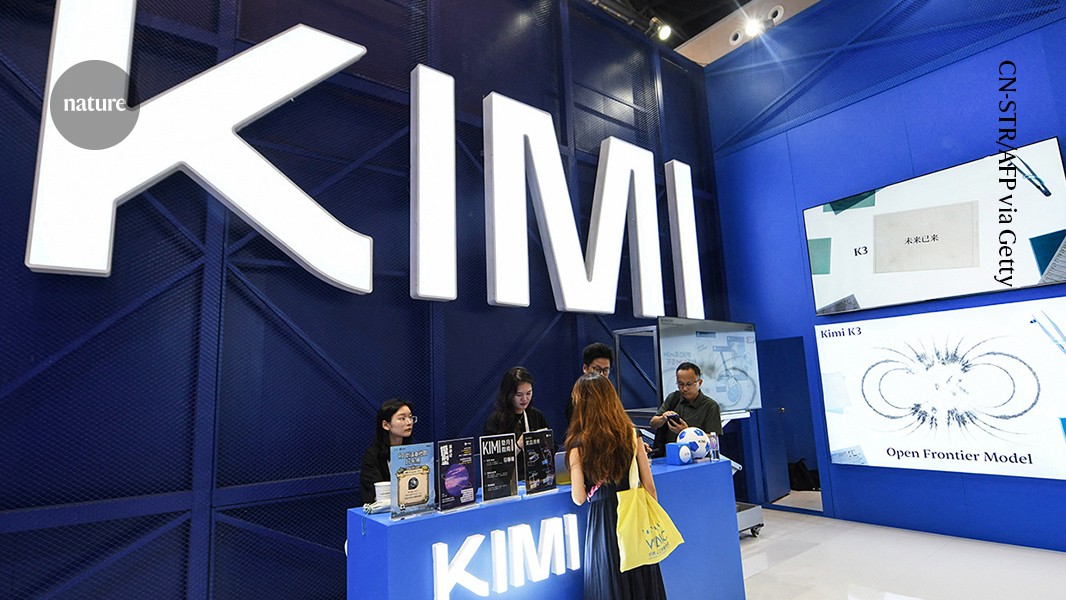
Credit: CN-STR/AFP via Getty
The latest large-scale language model (LLM) developed by China is making waves in the scientific community with its impressive size and capabilities. Last week, Beijing-based Moonshot AI introduced Kimi K3, a robust inference LLM designed to process substantial amounts of text efficiently. Tests conducted by the company indicate that K3 can match or even outperform competing U.S. models in tasks such as coding and managing spreadsheets.
Since the launch of DeepSeek’s Chinese-made AI, K3 has generated considerable buzz. “This is a tipping point,” remarked Joel Pearson, a cognitive neuroscientist at the University of New South Wales in Sydney, Australia. “People are referring to this as the ‘Sputnik moment,'” he added.
Just three days following the model’s debut, Moonshot AI announced the suspension of new enrollments for K3 due to overwhelming demand. The model officially launched on July 16, just ahead of the 2026 World Congress on Artificial Intelligence in Shanghai. The conference commenced with an announcement from Chinese President Xi Jinping, who revealed a global alliance focused on ensuring the safety of AI and establishing beneficial regulations. “In China’s view, all countries should adopt a human-centered approach to AI for positive outcomes,” Xi asserted, emphasizing AI as a catalyst for “shared prosperity and common security.”
The Importance of Timing
Mehwish Nasim, an AI researcher at the University of Western Australia in Perth, highlighted the significance of Kimi K3’s timing. Launched just weeks after Claude Fable 5 by Anthropic in the U.S. and shortly after OpenAI‘s latest GPT-5.6, K3 signifies China’s ambitious intent to not only develop cutting-edge AI systems but also shape the global AI ecosystem and governance, according to Nasim.
K3: The Largest Open Weight Model
K3 is an open-weight model, following in the footsteps of its predecessor, K2, and DeepSeek models from Hangzhou. This means its core components are publicly accessible, allowing researchers to download and modify them at no cost, although training model information remains private. K3 can be accessed via an application programming interface (API), offering a more cost-effective alternative to proprietary LLMs from OpenAI, Google, and Anthropic, which are closed weight and not modifiable.
Moonshot AI plans to release the model’s weights, or parameters, on July 27. Rahul Shome, a robotics and AI researcher at the Australian National University in Canberra, noted an increasing demand among consumers, developers, and researchers for weightless AI models. K3 stands out as the largest open-weight model to date, boasting an impressive 2.8 trillion parameters and a working memory of 1 million tokens (the text units used in AI models). However, Shome cautioned that K3 is likely too large for personal devices and would require substantial institutional investments to operate effectively.
Niusha Shafiabadi, a computational intelligence researcher at the Australian Catholic University in Sydney, stated that K3’s extensive working memory allows it to retain thousands of lines of code or even the entire contents of a book. This feature minimizes the risk of generating inaccurate information, known as hallucinations. Shafiabadi plans to conduct tests herself to evaluate K3’s summarization capabilities.
Narrowing the Performance Gap
Historically, the performance of open-weight models has lagged behind that of U.S. proprietary models. However, Aaron Snoswell, lead AI researcher at Queensland University of Technology’s Generative AI Lab in Brisbane, remarked that this gap is now at its narrowest. Pearson emphasized that China’s open-weight models are changing how investors and users perceive the value of U.S. frontier models. While Google, Anthropic, and OpenAI spend billions on training their models, Chinese companies operate on far lower budgets.
Additionally, Pearson pointed out potential risks for U.S. model users, such as government-imposed restrictions. Last month, Anthropic temporarily disabled access to its latest models, Fable 5 and Mythos 5, for non-U.S. users following directives from the U.S. government. Although access to Fable 5 has been restored, Mythos 5 remains limited to specific U.S. organizations.
Toby Walsh, a computer scientist at the University of New South Wales, stated that Chinese AI companies have succeeded in developing leading-edge models despite U.S. restrictions on access to advanced AI chips, citing national security concerns. “Necessity appears to be the mother of invention here,” he concluded.
Source: www.nature.com