



Vannevar Bush’s 1945 report helped shape the growth of publicly funded research in the United States.Credit: AP/Alamy
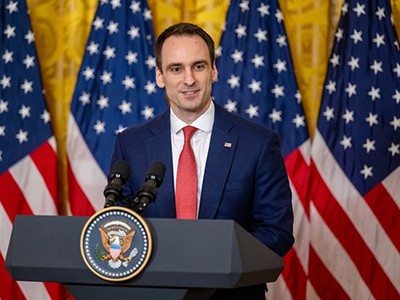
Last month, Michael Kratsios, head of the US Office of Science and Technology Policy (OSTP), published a 123-page report titled Science: A New Golden Age. The document responds to a letter from US President Donald Trump, who asked Kratsios to help create “a new golden age of American innovation” (see go.nature.com/8tyfk4k). The central question is whether the report’s proposals can strengthen US science, research funding and technological innovation.
White House rolls out AI funding — and signals a new era for US science
Presidential letters to the OSTP director are not unusual. They signal the administration’s policy priorities and areas of interest. In this case, however, the letter and the resulting report arrive during a broader effort to reshape the US research system.
The report raises important questions about the future of American science. These include how to fund foundational research that supports technological breakthroughs, how to modernize scientific infrastructure and how artificial intelligence should be used in research. It also examines the federal grant-making process and proposes changes to the balance of government research funding.
Among its recommendations are new approaches to supporting high-risk research, addressing concerns that grant managers and peer reviewers are overly cautious, and expanding funding opportunities beyond universities. These proposals deserve careful consideration, and their implications will require further analysis.
Before examining the report in detail, it is useful to consider its historical context. A major precedent is the 1945 document Science: The Endless Frontier, submitted to President Harry Truman by Vannevar Bush, then director of the Office of Scientific Research and Development (see go.nature.com/4g7nufa). Written after the Second World War, the report became a foundation of US science policy and contributed to the creation of the National Science Foundation. Its development involved extensive contributions from universities, industry and policymakers.

White House proposes vast overhaul of US science funding: what you need to know
Science: A New Golden Age was produced during another turbulent period, although the circumstances are very different. It follows 18 months of executive orders, regulatory changes, abrupt funding reductions, grant delays and political intervention in scientific issues, including vaccine safety and climate change.
Unlike the 1945 report, the new document does not identify the scientists, engineers or technical organizations consulted during its preparation. This lack of transparency reflects a wider reduction in independent scientific advice to the US government, as documented in an April News Feature (Nature 652, 1106–1109; 2026).
At its core, Science: A New Golden Age sets out the Trump administration’s priorities for US research leaders. The highlighted fields include “AI, quantum information science, semiconductors, advanced communications, robotics, advanced manufacturing, nuclear fission and fusion, and space systems”. Directing the research community toward such priorities without clearly documented consultation is unusual for a democratic nation and a leading global center of science and higher education.
The full details of these priorities are not immediately visible in the main text. They appear in an annex containing a memorandum for department and agency heads, signed by Kratsios and Russell Vought, director of the Office of Management and Budget. The annex identifies what it calls “foundational research to drive scientific breakthroughs for emerging technologies”.
Federal science priorities and research funding
The proposed priorities emphasize physics, materials science, chemistry, computer science, engineering, space science and mathematics, with particular attention to “national security-relevant research portfolios”. Federal agencies with annual research budgets of at least US$3 billion have 90 days to explain how they will “prioritize both the absolute level and the relative share of funding”.
To advance the administration’s biotechnology and biomanufacturing goals, agencies are also being asked to “prioritize foundational research in the biological sciences over the life sciences, a broader category not focused on foundational research”. The annex devotes several pages to the fields and research areas that could receive priority under the proposed funding strategy.

Key US science panels are being axed — and others are becoming less open
However, the researchers best positioned to evaluate foundational science are those working directly in the relevant disciplines, together with their professional societies. The report says that stakeholders “across the country’s scientific enterprise” were consulted, but it does not identify them.
Which scientists and organizations in physics, computer science, space science and chemistry helped shape the recommendations? What evidence supports the report’s distinction between foundational biological research and the broader life sciences? These questions remain unanswered.
A notable omission is clear evidence of input from the National Academies of Sciences, Engineering, and Medicine or from scholarly societies representing individual disciplines. These organizations function as stewards of their fields. They convene conferences, publish research, establish standards, represent scientists to policymakers and defend research integrity.
Research areas missing from the White House plan
Entire NSF science advisory board fired by Trump administration
The report’s vision for US science also leaves out several major research areas, including climate change and public health. Social-science research is absent as well, although metascience is mentioned. These omissions are striking, particularly because national security is one of the stated objectives.
Climate change and emerging infectious diseases pose significant risks to the United States and the wider world. Social sciences and humanities research will also be essential for helping societies understand and manage the far-reaching effects of artificial intelligence. Scientific and technological progress cannot be separated from the social, political and ethical contexts in which it is applied.
The annex also rarely refers to the world, global collaboration or international cooperation. This approach aligns with the Trump administration’s decision to withdraw funding from and participation in international scientific initiatives, including the Intergovernmental Panel on Climate Change and the World Health Organization.
The proposal appears to assume that the United States can achieve a new scientific golden age independently, with limited involvement from researchers in other countries. Historical evidence suggests otherwise. Over the past 75 years, international collaboration and the movement of researchers across borders have played a central role in scientific progress. Science is global by nature and cannot be effectively confined within national boundaries.
Lessons from Vannevar Bush’s 1945 science report
The latest White House report presents itself as a successor to Science: The Endless Frontier and uses the words “frontier” or “frontiers” more than 50 times. Yet the two documents differ substantially.
Bush’s 1945 report offered the United States a practical framework for supporting discovery and invention. It built on wartime achievements, including radar, nuclear weapons and the large-scale production of penicillin. Bush established four scientific committees covering medicine, science and public welfare, scientific talent development, and the publication of scientific information. Their recommendations were incorporated into the final report.
Science: The Endless Frontier was therefore an inclusive policy exercise that brought together expert advice and presented a hopeful vision for the future of American research.
The current White House plan could have responded more directly to today’s global challenges, including climate change, public-health threats and the rapid development of AI. A stronger strategy would have crossed national and disciplinary boundaries and involved scientists as trusted partners in decision-making.
Broad consultation is not simply a procedural requirement. It improves the likelihood that research priorities will reflect evidence, identify emerging risks and support discoveries across disciplines. The United States could learn from the best ideas regardless of where they originate and value researchers wherever they work.
By failing to embrace that inclusive and international approach, Science: A New Golden Age misses an important opportunity to define a durable strategy for US science, research funding and innovation.
Source: www.nature.com