


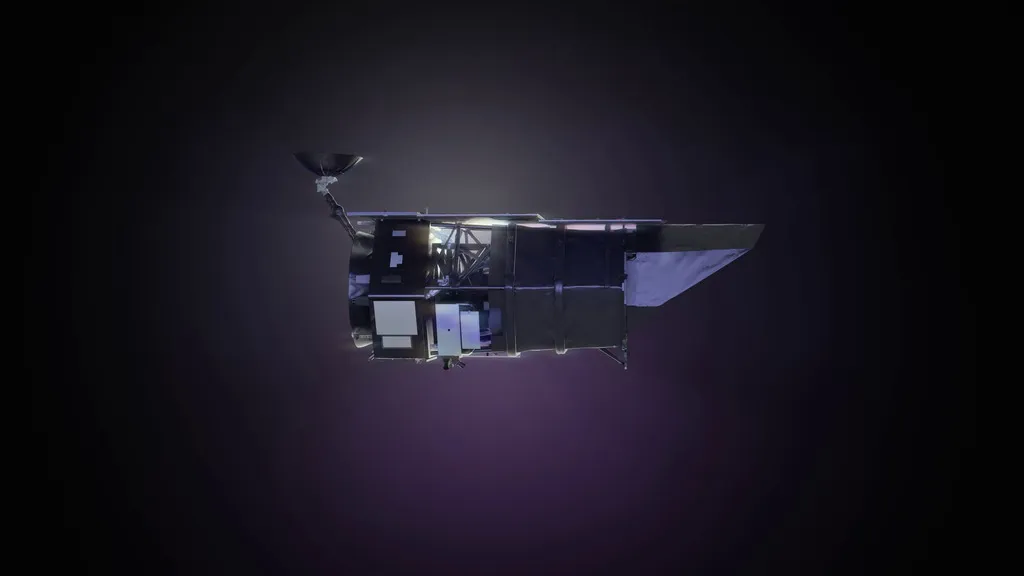
NASA’s Roman Space Telescope Will Team Up With Leading Observatories Around the World
The Nancy Grace Roman Space Telescope will work alongside major international and NASA-led observatories to create one of the most detailed views of the universe ever assembled. Roman’s wide-field surveys will uncover vast numbers of cosmic objects and promising targets that can be studied in greater detail by the Hubble Space Telescope and NASA’s James Webb Space Telescope.
Hubble observes the universe in infrared, visible, and ultraviolet light, while Webb uses its larger mirror and advanced instruments to capture exceptionally detailed infrared images. Roman will complement both missions by showing the broader regions surrounding their targets, giving scientists important context about galaxies, stars, and other celestial objects.
Roman will also work closely with Euclid, a European Space Agency (ESA) mission developed with significant contributions from NASA. Euclid will survey a much larger portion of the sky than Roman, although with less detail. Because the missions will study overlapping areas, astronomers can use Roman’s high-resolution observations to improve the accuracy of Euclid’s data and apply those corrections across its wider survey region.
Scientists will combine Roman’s infrared observations with visible-light data from the ground-based Vera C. Rubin Observatory, a project supported by the National Science Foundation and the U.S. Department of Energy. This partnership will help researchers achieve Roman-like scientific precision across a much larger area of the sky.
By demonstrating technologies for directly imaging Jupiter-sized exoplanets, Roman will also support NASA’s future Habitable Worlds Observatory. This planned flagship space telescope aims to search for and directly image Earth-like planets orbiting stars beyond our solar system.
Source: science.nasa.gov