


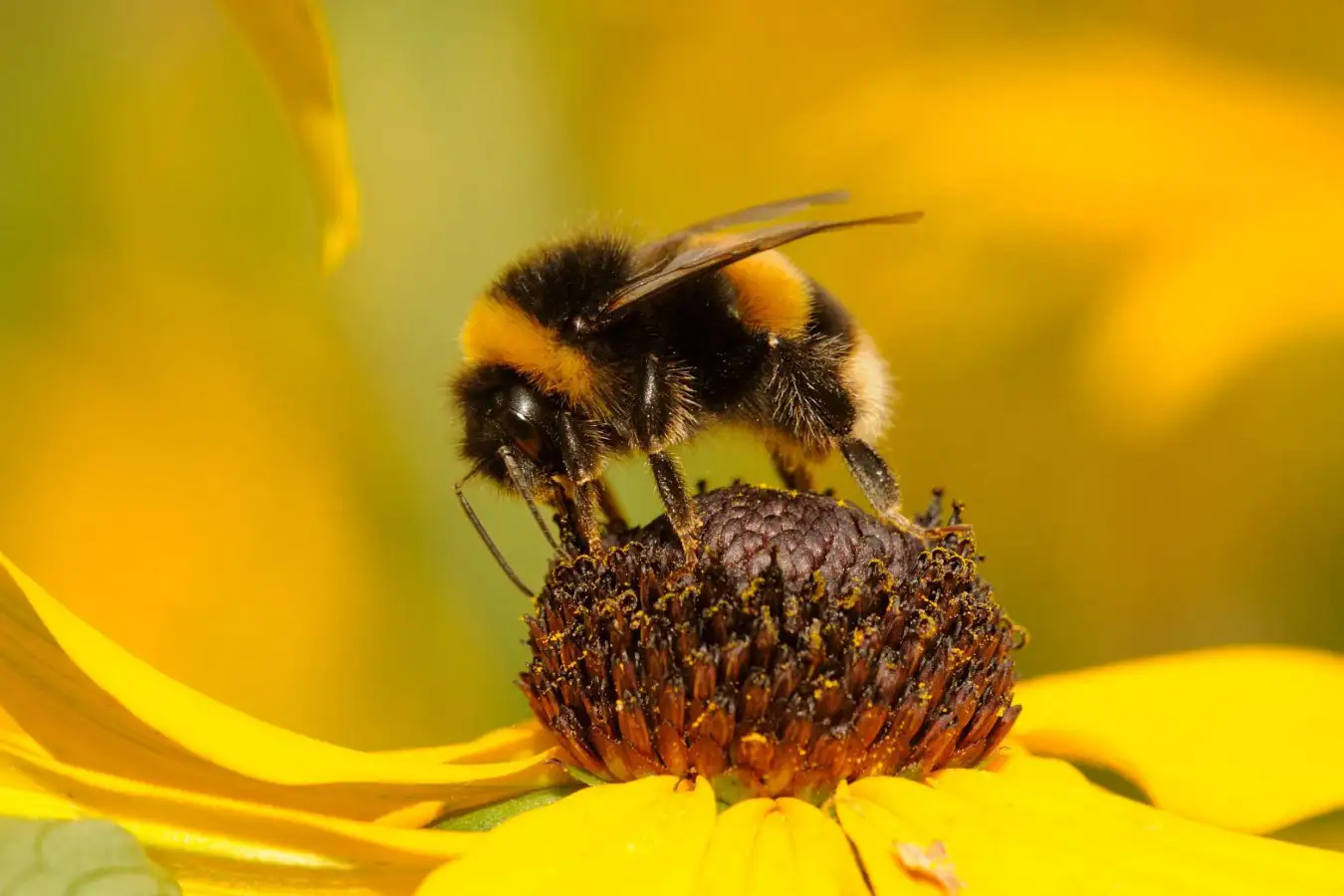

Bumblebees seem to enjoy the sweetness of sugar.
Dawn Monrose/Alamy
Recent studies indicate that bees can express preferences beyond mere necessity, providing strong evidence for the subjective experiences of insects.
In the past few decades, research has revealed that bees exhibit complex behaviors such as counting and rhythm detection. However, determining if they possess emotional states similar to ours poses a challenge, as insects lack the facial musculature found in mammals, which we rely on for emotional expression.
“How can we interpret the behavior of these hard-bodied insects with rigid facial features?” questions Andrew Barron from Macquarie University in Sydney, Australia. “Do bees possess some form of internal awareness?”
To explore this, Barron and colleagues conducted experiments with buff-tailed bumblebees (Western bumblebee).
The researchers provided bees with sugar-infused water droplets alongside salts and quinine, capturing their reactions on high-resolution video.
Upon tasting the sweet solution, the bee consistently extended its glossa, the hairy tongue used for nectar intake. In contrast, after the salty and bitter solutions, the bee wiped its mouth and shook its head.

Bee shaking its head
Honey Bee Laboratory at Southern Medical University
However, these reactions may not signify enjoyment or distress, but merely responses to chemical variations, Baron suggested.
The researchers then reduced the sugar concentration and combined it with a small amount of salt, leading to a significant decrease in tongue protrusion. Following this, they exposed the bees to dehydration conditions at 40 degrees Celsius (104 degrees Fahrenheit) and offered them salty droplets, which resulted in frequent tongue extensions.
“If I handed you an electrolyte drink now, you might think, ‘This tastes bad,'” Baron explains. “But after a long run, you’d appreciate it more due to your shifting internal state. We think this is mirrored in bees’ experiences.”

Bee extending its glossa
Honey Bee Laboratory at Southern Medical University
In the final experiment phase, the researchers investigated how manipulating the chemicals that influence appetite and enjoyment in mammals would affect bees.
When bumblebees received dopamine, typically linked to food motivation in mammals, there was no increase in tongue protrusion, indicating that increased desire did not translate to increased enjoyment.
Conversely, administering endocannabinoids (known to heighten food “liking” in mammals) led to marked increases in tongue extension among honey bees.
“This suggests that even insects like bees possess a form of inner life,” asserts Baron. “They evaluate and experience their environment, rather than functioning solely as programmed entities.”
Ralph Adolphs from the California Institute of Technology described the study as significant and innovative for this challenging topic. “The findings indicate that bees respond flexibly to the value of taste stimuli,” he remarks, though questions remain about whether this equates to pleasure as we understand it.
“It’s evident that facial expressions don’t solely embody emotions. Actors can mimic emotions, and even those with facial paralysis experience feelings,” he notes. “Ultimately, we should conclude that bees possess their own form of emotions, distinct from mammalian emotions.”
Jonathan Birch, a professor at the London School of Economics, commented that this is the first study to clearly differentiate between bees’ “wants” and “likes.”
“We tend to underestimate insects,” he states. “This research signifies a renaissance in insect studies, using advanced methodologies to uncover complex behaviors that previously went unnoticed, often employing high-resolution, high-frame-rate video as seen in this work.”
Topic:
Source: www.newscientist.com