


Utilizing the advanced GRAVITY+ instrument at ESO’s Very Large Telescope Interferometer (VLTI), astronomers have successfully measured the carbon isotope ratio in the atmosphere of the young exoplanet Beta Pictoris b. This groundbreaking research offers new insights into the formation processes of giant planets.
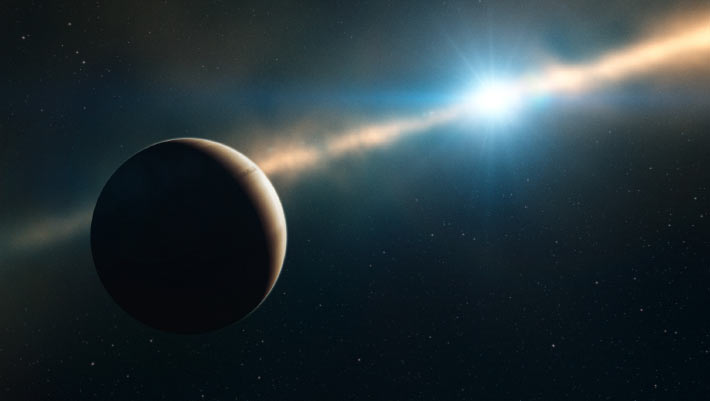
Artist’s impression of a gas giant exoplanet within the disk of Pictoris Beta. Image credit: L. Calçada / ESO.
Beta Pictoris b, a gas giant planet discovered in November 2008 using ESO’s Very Large Telescope, is similar to Jupiter but approximately 9 to 13 times its mass.
This exoplanet orbits its host star, Pictoris Beta, at a distance eight times greater than that of Earth from the Sun.
The star is also known to host at least two additional planets and a circumstellar disk of gas and dust, which may eventually evolve into a frigid torus of icy bodies akin to the Kuiper Belt in our solar system.
In this recent study, Antonia von Stauffenberg, a Ph.D. student at the Max Planck Institute for Astronomy, and her team aimed to explore the origins and potential atmospheric variability of Beta Pictoris b.
They employed the newly upgraded GRAVITY+ instrument for their observations.
“We implemented a method proposed years ago to identify the location of planetary formation within a protoplanetary disk,” the researchers noted.
“By measuring the relative abundances of two carbon isotopes (C) that are trapped in carbon monoxide (CO) gas within Beta Pictoris b’s atmosphere, we aim to determine if the planet formed inside or outside the region of the disk where CO exists as ice.”
“Because the radiation from the host star heats the disk’s center, this directly correlates to the distance from the star at which the planet formed.”
The radius at which temperatures drop low enough for gas to solidify is commonly referred to as the snow line.
“Isotopes contain the same number of positively charged protons but differ in their quantities of neutral neutrons, as seen in the two carbon isotopes: carbon-12 (12C) and carbon-13 (13C).”
“Consequently, they possess slightly different masses yet exhibit similar chemical characteristics.”
“In the universe, carbon is frequently found combined with oxygen, appearing as 12CO and 13CO molecules.”
“Interestingly, earlier assessments utilizing the original GRAVITY equipment yielded relatively low ratios of 12CO to 13CO, leading us to suspect that GRAVITY alone might not sufficiently resolve key signals in this dataset.”
“This raised caution regarding the interpretation of prior results.”
“Nevertheless, our findings suggest that Beta Pictoris b may have formed in the outer disk beyond the snow line, accumulating CO ice rather than CO gas.”
“Currently orbiting approximately 10 astronomical units from its host star, Beta Pictoris b resides in the area between the star and the snow line, where the gas is primarily CO.”
“If validated, this discovery indicates that Beta Pictoris b may have migrated through the disk.”
Astronomers also detected slight indications that the observed levels of magnetic flux from the planet vary over time.
“Although the significance is low, the primary variation seems linked to the planet’s rotation period of about 8.7 hours,” the researchers highlighted.
“If substantiated, this could suggest the presence of clouds or chemical processes within Beta Pictoris b’s atmosphere. However, additional sensitive observations are essential to confirm these results.”
“The proposed plan to analyze the gas giant’s birthplace requires more accurate measurements of 12CO/13CO ratios, which clearly indicates Beta Pictoris b’s position within the warmer inner regions of its protoplanetary disk, consistent with its current location.”
“Moreover, this ratio aligns broadly with values typically found in the interstellar medium spanning the space between stars in our solar system and the Milky Way.”
“Most of the approximately 12 young gas giant planets we examined for CO ratios displayed similar values.”
“This consistency may be concerning, as carbon isotope abundances might not serve as effective probes to ascertain a planet’s distance from its host star.”
“The probable explanation is that fluctuations during planet formation are too minuscule to be captured accurately using the proposed method.”
“Hence, 12CO/13CO ratios currently lack the decisiveness needed to provide specific insights into individual planet-forming environments.”
“There is a strong likelihood that we are overlooking crucial physical processes that influence the chemistry of CO ice in protoplanetary disks.”
“In conclusion, 12CO/13CO ratios may not reveal much about the distinction between a gentle gaseous environment and one dominated by cold CO ice.”
“At present, this distant gas giant continues to withhold secrets about its origins.”
“We require new tools to differentiate between various planet formation scenarios, and GRAVITY+ holds potential for uncovering and evaluating these critical scenarios.”
For more details on these findings, check today’s issue of Astronomy and Astrophysics.
_____
A. von Stauffenberg et al. 2026. 13CO and potential variations in β Pictoris b using GRAVITY+. A&A 711, L2; doi: 10.1051/0004-6361/202660275
Source: www.sci.news