


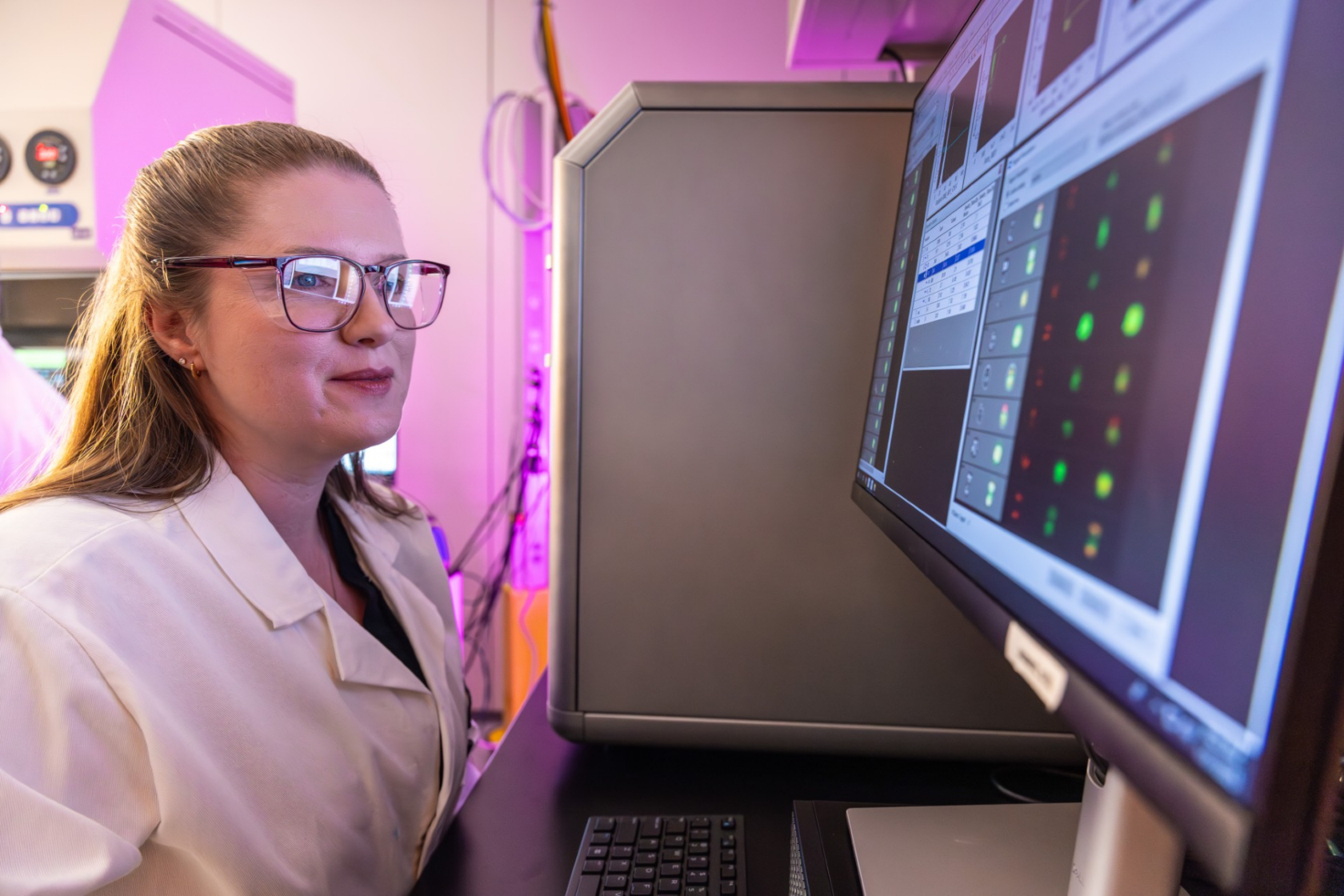
Erin Davis refers to it as “SuperDuperPOD,” a name that encapsulates two significant points. Leading pharmaceutical company Bristol-Myers Squibb (BMS) already operates one of the largest AI clusters in the life sciences sector, achieving notable results—and they are expanding.
Today, BMS announced the launch of a second system, the NVIDIA DGX SuperPOD, built on eight DGX Vera Rubin NVL72 Systems— the most powerful and energy-efficient AI cluster in the life sciences industry.
“Instead of limiting supercomputer access to a select group of researchers, we are literally opening it up to all scientists,” stated Davis, BMS’s vice president of research business insights and technology. “We believe no one should experience limitations or delays in their research.”
The new infrastructure consists of eight rack-scale systems, each featuring an NVIDIA Vera CPU and Rubin GPUs. This setup delivers up to 10x the performance per megawatt compared to previous systems, granting researchers at BMS access to an integrated AI platform that includes the NVIDIA BioNeMo Agent Toolkit, designed specifically for biological AI applications, enabling predictions, model training, and agent workflows throughout the drug discovery process.
Davis and her team aim to leverage this access for accelerated research cycles, increased chemistry capabilities, and a comprehensive drug discovery pipeline that enhances scientific focus instead of logistical concerns.
“Our mission is to transition from theoretical possibilities of AI to real, measurable outcomes,” explained Payal Sheth, senior vice president of therapeutic discovery science at BMS, who has vast experience in drug discovery laboratories.
BMS has been successfully operating its current DGX SuperPOD for about three years, yielding significant outcomes. AI-driven target identification has streamlined scientists’ workflows, allowing more focus on critical scientific decisions. The BMS team has utilized AI to enhance its library of CELMoD compounds, which target and degrade cancer-causing proteins. This innovation opens avenues for new medicines across various diseases.
“We utilize predictions to inform molecular synthesis prioritization through multiparameter optimization, effectively streamlining laboratory experiments toward molecules with the highest likelihood of success,” she added.
These AI-driven research applications are significantly influencing the computational requirements of the entire organization. “We’re encountering limitations,” stated Davis. “We’re currently making extensive predictions involving large molecules, necessitating substantial GPU resources.”
With the introduction of this new system, Davis is ready to encourage researchers on where to advance their work: “Welcome to limitless computing.”
A computational chemist by background, Davis recognized the need for technology advancements within the scientific domain. She spent nearly 15 years developing enterprise platforms at ChemAxon, Schrödinger, and X-Chem, discovering that pharmaceutical companies faced similar challenges.
“The issue isn’t the technology,” she asserted. “The real challenge lies in how we can empower scientists to leverage it effectively.”
She is personally aware of the stakes involved. Her father passed away five years ago from Alzheimer’s disease, leading her to believe that innovations in brain health could significantly impact families coping with dementia. “Even minimal advancements in symptoms could alleviate the suffering of loved ones,” Davis noted.
Davis’ team is integrating existing DGX SuperPODs and new DGX Vera Rubin NVL72-powered systems into a cohesive environment, creating a unified data plane accessible to all BMS facilities globally.
Obstacles from previous systems, such as site-specific limitations stemming from past acquisitions and the necessity for extensive computational expertise, are being replaced with AI-native solutions managed through NVIDIA Mission Control, allowing researchers to make complex predictions in simple terms.
“Our computing infrastructure connects all scientists and institutionalizes our learning,” Sheth elaborated. Data sets from projects in Lawrenceville, New Jersey, can inform models utilized by teams in San Diego, California, thus enhancing the entire research ecosystem.
“The learning loop in drug discovery today is far more sophisticated than it was at the start of my career,” Sheth explained. “Previous projects were treated in isolation and lacked an integrated knowledge framework.”
Now, BMS employs AI to enhance its learning loop, creating a discovery system that amalgamates experiments, clinical data, and collaborations, enabling quicker and more confident scientific decisions.
Agent workflows can further enhance your R&D architecture significantly.
“Agents are versatile,” Davis noted. “They integrate seamlessly, facilitating knowledge sharing across different projects and programs.”
“For scientists, accessing a virtual team of well-equipped professionals with BMS knowledge dramatically enhances their capabilities,” she concluded.
Far from replacing human input, AI augments instinct with quantitative insights and predictions, paving the way for realized impacts as computing capabilities scale, according to Sheth.
“Human expertise is crucial to uncovering caveats and educating personnel on effective utilization of their knowledge,” Davis noted, highlighting the importance of balancing technology and human insight.
Davis outlined that the new system is backed by a comprehensive plan, encompassing detailed operations across various modalities, from small and large molecule design to clinical applications and digital twins. “Our acquisition wasn’t solely for maximum computing power; the SuperDuperPOD is strategically positioned at each crucial step.”
When BMS Chief Digital and Technology Officer Greg Myers inquired about Davis’ confidence in effectively utilizing massive supercomputing resources, her response was straightforward.
“Just give me a moment,” Davis replied.
Featured image credit: Bristol-Myers Squibb
Source: blogs.nvidia.com