


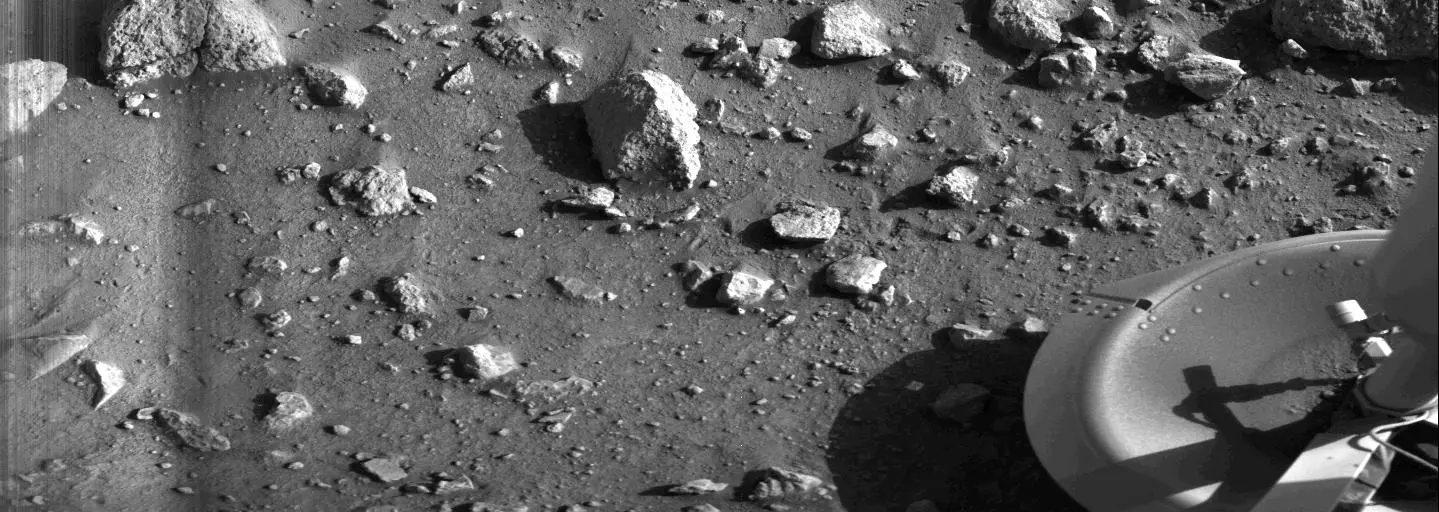
“Touchdown, touchdown!” On July 20, 1976, at 5:12 a.m. PDT, controllers at NASA’s Jet Propulsion Laboratory celebrated as the Viking 1 lander successfully descended through Mars’ thin atmosphere. After a suspenseful 40 minutes, the first stunning images from the lander began to materialize on monitors, revealing the rugged Martian terrain line by line. For the first time, humanity witnessed the surface of Mars up close.
Dr. Thomas Mucci, head of the Viking lander imaging team, recalled the unforgettable moment: “I stared at the black screen, eagerly anticipating the thin strip that would announce the first lines of the initial photo. Then it appeared—a sliver of electronic magic! Images began to flood the screen. We saw rocks and sand, and on the far right, one of the lander’s footpads, a symbolic artifact marking our remarkable achievement. I couldn’t believe my eyes.”
Fifty years ago today, the Viking 1 lander made history as NASA’s first robotic explorer of Mars, initiating the search for signs of life beyond Earth. Six weeks later, its twin, Viking 2, joined to investigate other regions of Mars. Concurrently, the mission’s orbiters continued to gather invaluable data and relay vital communications back to Earth.
For a deeper dive into the discoveries made by the Viking missions and the enduring legacy of NASA’s exploration of Mars, visit: Vikings: 50 Years on Mars.
Image credit: NASA/JPL
Source: www.nasa.gov