


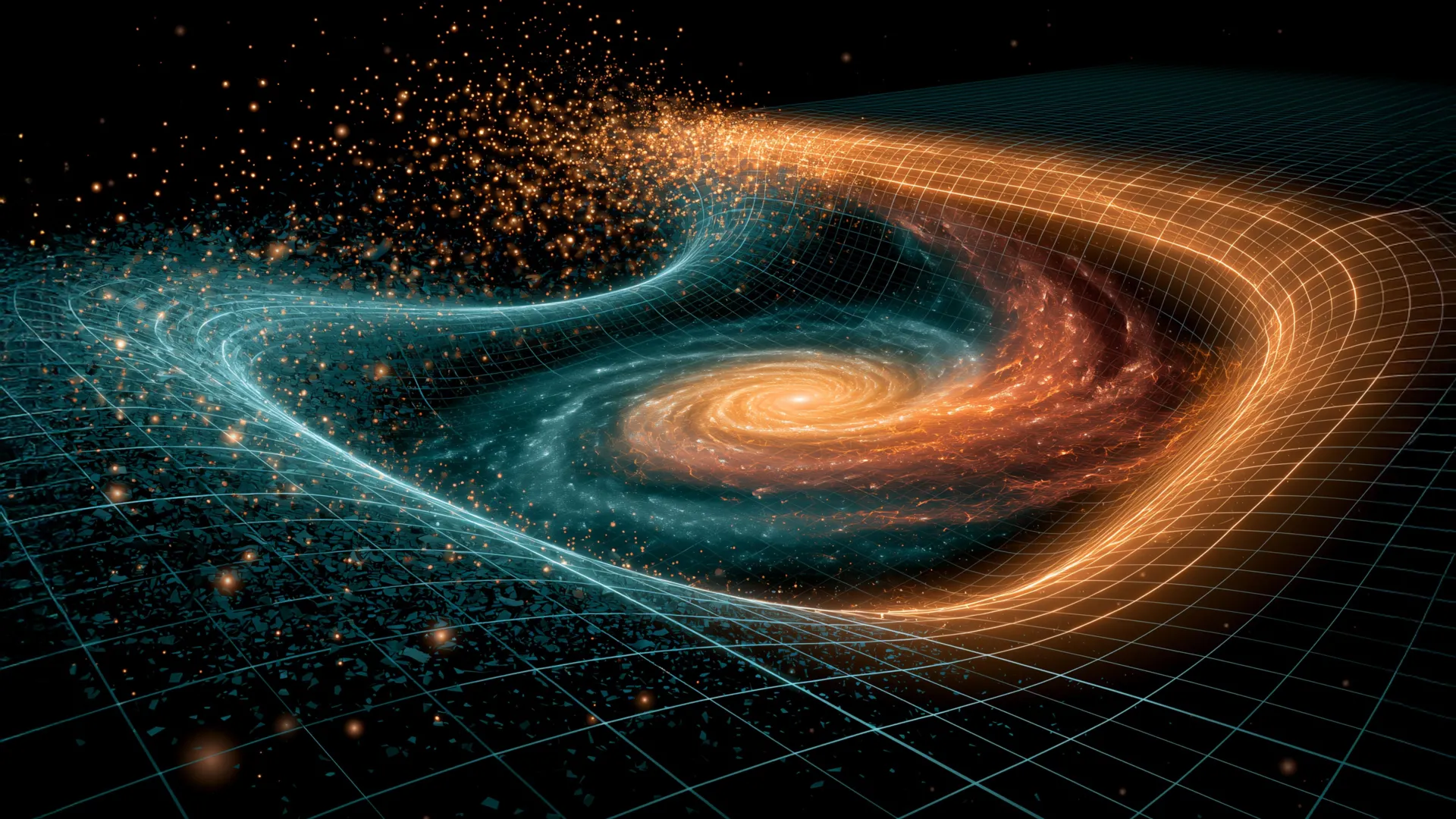
Recent theoretical research proposes a groundbreaking approach to one of modern physics’ most complex challenges: How did the universe form galaxies, stars, planets, and life while adhering to the second law of thermodynamics?
This pioneering study was spearheaded by Professor Ginestra Bianconi, a mathematician at Queen Mary University of London. Her investigation examines whether a theory known as “gravity from entropy” can elucidate how the universe’s complexity arises even amidst an overall increase in entropy.
Understanding the Cosmic Entropy Puzzle
Albert Einstein famously remarked that “the second law of thermodynamics occupies a unique place among the laws of nature,” underscoring its status as one of the most fundamental principles in physics.
The second law asserts that the total entropy of an isolated system tends to increase over time. Entropy is often synonymous with disorder, yet it more accurately gauges how energy and information are distributed within a system.
This principle presents a significant challenge for cosmology. Scientists generally posit that the early universe began in a low-entropy state and progressively transitioned to a high-entropy state, even as matter has been organized into more complex structures, from galaxies and stars to planets and life forms.
Resolving how this increasing complexity can coexist with ongoing entropy growth remains an open question in the field.
A New Paradigm: From Entropy to Gravity
In a recent paper published in Physical Review D, Bianconi tackles this puzzle utilizing Gravity from Entropy (GfE), a novel approach to understanding quantum gravity.
The GfE theory employs concepts from statistical mechanics to frame gravity as emerging from the microscopic characteristics of spacetime geometry. Rather than viewing gravity solely as a fundamental force or the curvature of spacetime, GfE integrates it with information and entropy at the quantum level.
Bianconi’s analysis reveals noteworthy distinctions. While the total entropy of the universe rises over time, the entropy per unit volume actually decreases as the universe expands.
This counterintuitive behavior may offer fresh insights into how localized structured development occurs without contradicting the second law of thermodynamics.
Unifying Gravity and Thermodynamics through Black Holes
The notion that gravity and thermodynamics are intricately linked traces back to the seminal work of Jacob Bekenstein and Stephen Hawking in the 1970s.
Their breakthroughs demonstrated that black holes possess entropy and can emit thermal radiation, fundamentally changing our understanding of black holes while hinting at profound connections between spacetime, information, gravity, and heat.
Gravity from Entropy builds upon this established relationship.
According to GfE, gravity emerges from the informational tension between the actual spacetime metric and one generated by matter and spacetime curvature. A metric serves as a mathematical framework for describing distance and geometry in both space and time.
This concept is mathematically expressed by the GfE Lagrangian, defined through the quantum geometric relative entropy (QGRE) between two metrics.
Exploring Links with Dark Energy
In scenarios characterized by low energy and mild spacetime curvature, the GfE equation mirrors general relativity. However, under more extreme conditions, the predictions diverge significantly.
Beyond this weak limit, the GfE equation suggests a variable dark energy contribution. Because this term evolves dynamically, it may yield testable predictions through forthcoming cosmological observations.
This study examines these thermodynamic effects within the framework of Friedman-Robertson-Walker cosmological spacetime, a widely used model for a uniformly expanding universe.
The results indicate that the local geometric components of spacetime adhere to the first law of thermodynamics. In this interpretation, the emerging dark energy acts as internal energy, while the QGRE quantifies local entropy per unit volume.
Additionally, quantities related to effective temperature and pressure emerge naturally from the theoretical framework. Together, these findings imply that the quantum state underpinning gravity from entropy may possess intrinsic thermal characteristics.
Expansion and Distributed Entropy
This research also emphasizes the significance of local volume elements defined by physical spatiotemporal metrics.
As the universe expands, its volume increases. Within the GfE context, rising volume leads to an increase in total entropy, even as the local QGRE in each unit volume gradually declines.
In essence, while the universe can house more entropy, it becomes increasingly disseminated across the expanding cosmos. This atypical thermodynamic behavior may provide crucial insights into how localized structures and complexity originate.
Gravity and Spacetime: A Thermodynamic Perspective
This discovery bolsters the hypothesis that gravity and spacetime are underpinned by both informational and thermodynamic principles.
Such an interpretation may unveil new avenues for exploring the interrelations among gravity, quantum theory, dark energy, the universe’s evolution, and the emergence of complex structures.
Although still in its theoretical infancy, this proposal could significantly advance efforts to harmonize general relativity, thermodynamics, quantum mechanics, and cosmology into a cohesive framework.
“This study elucidates how entropic gravity theory may address the intricate challenge of reconciling the second principles of thermodynamics with the emergence of complexity in the universe,” stated Professor Bianconi. “These findings might pave the way for new investigations into the age-old issue of reconciling cosmological irreversibility, the evolution of complex structures, and, ultimately, the fundamentals of gravitational mechanics.”
Source: www.sciencedaily.com