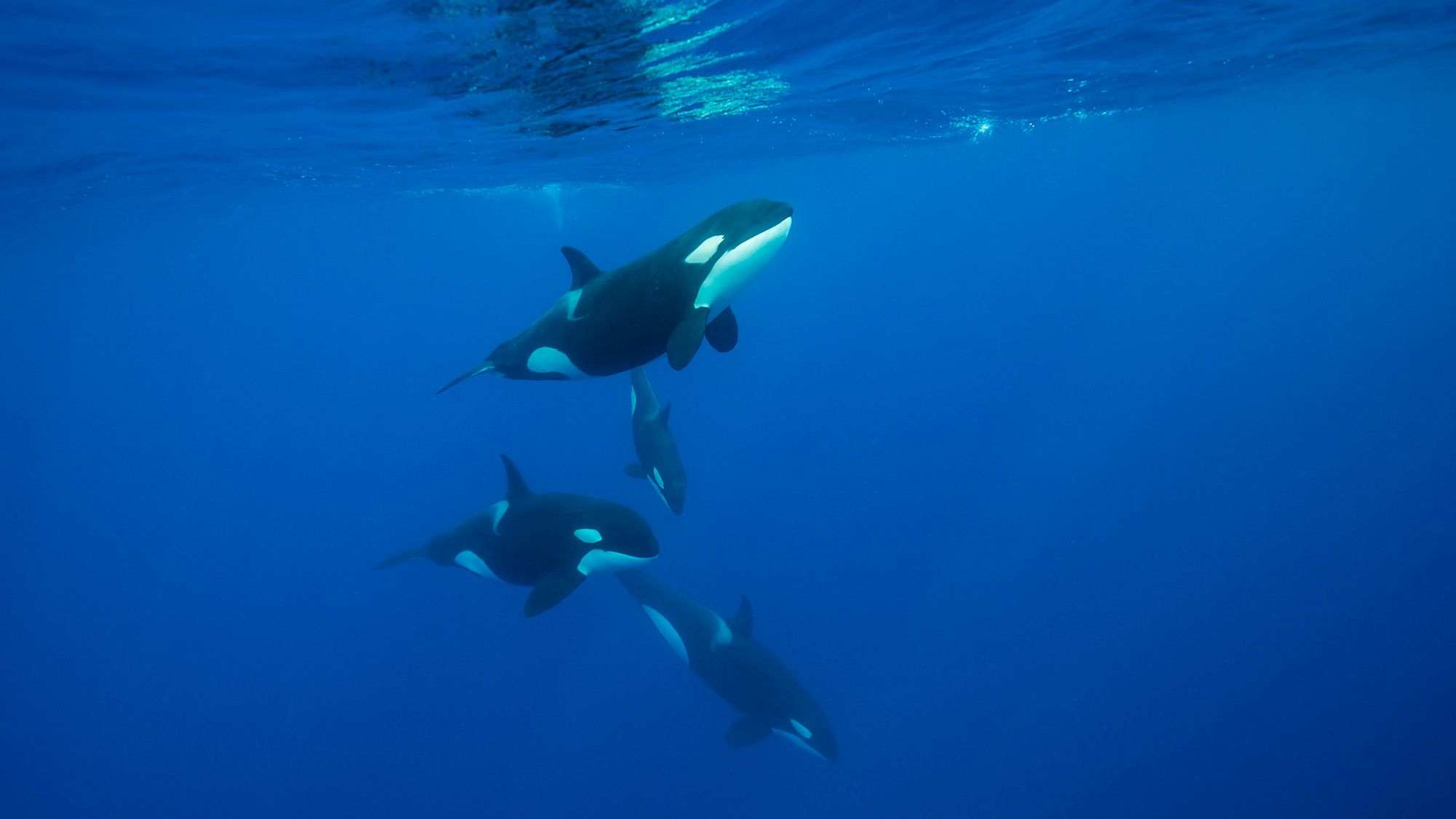
In a fascinating discovery, scientists have observed killer whales, one of the ocean’s most intelligent and formidable predators, engaging in a surprising new behavior. In the Gulf of California, researchers documented orcas collaborating to crush the carcass of a sunfish (Mastrus orchiolatus). This intriguing food processing technique seems designed to make it easier for juvenile whales to consume the enormous bony fish, which can reach weights of up to 4,400 pounds (2,000 kilograms).
In two separate incidents, one killer whale caught a sunfish by its sharp tail, while its partner lunged towards the fish. Just before impact, the first whale released its grip, allowing its mate to ram the fish at high speed, creating a cloud of fish flesh in the water.
“It was unlike anything I had ever witnessed,” said Kathryn Ayers, a scientist at the conservation nonprofit Beneath the Waves, in a statement to Live Science. “As a scientist, moments like this are incredibly exciting because it’s an opportunity to observe something that has never been detailed before.”
Ayers and her colleagues have named this behavior “fragment collision,” as revealed in their study published on July 23 in the journal Frontiers of Animal Behavior. This suggests that the killer whale was not actively hunting the sunfish, which was already deceased, but rather dismantling the bulky carcass to facilitate access for younger members of the pod.
Active Hunting Behavior
The first observation by Ayers took place in July 2024 near a seamount off the coast of Baja California Sur, Mexico. An adult female killer whale grabbed the sunfish by its tail-like collarbone, while a male counterpart surged forward, ramming the fish just as the female released it.
The collision generated a loud sound, causing the sunfish’s tissue to splinter, prompting an audible reaction from Ayers as she exclaimed, “Oh my god!” in disbelief.
Following this event, juvenile killer whales entered the meat cloud to consume small pieces, while the adults feasted on the remaining carcass.
Get the world’s most fascinating discoveries delivered straight to your inbox.
In a second occurrence, diver Hector Franz filmed a similar series of actions in September 2025. One adult killer whale pinned the sunfish while another charged, allowing a calf to feed on the torn remains.
While Ayers had observed killer whales hunting sunfish before, this instance was distinctly remarkable.
“I’ve seen killer whales ram their prey in the past, but I’ve never seen a collision that was powerful enough to completely fragment tissue,” Ayers noted. “That’s what made this observation so extraordinary.”
This behavior mimics the coordinated hunting tactics documented by Ayers and her team against whale sharks (Lyncodon typepus)—the largest fish species in the Gulf of California. During these hunts, killer whales would take turns ramming into each other.
Prior footage captured by diver Kelsey Williamson showcases the orca turning a whale shark upside down to facilitate easier predation.
(Image credit: Kelsey Williamson)
Why Disperse Fish Fragments?
Ramming is not a new technique among killer whales, but the hold-and-release sequence and fragmentation of the carcass may represent innovative behavior. Matthew Hansen, a postdoctoral fellow at the Leibniz Institute for Freshwater Ecology and Inland Fisheries, remarked that these actions may be newly acquired techniques.
The research team proposed various theories behind this behavior. Significantly, they speculated that adult whales were processing food for younger offspring. Killer whales often tear apart their prey and share it with their young. Juveniles were present during both encounters, indicating that they were also participating in the feeding.
However, the two observations are insufficient to confirm whether the adults were deliberately feeding or training the calves. Heather Hill, a professor of psychology at St. Mary’s University in Texas, stated that the context of these behaviors could reflect parental investment, observational learning, or resource sharing.
Hill remarked that the encounters seemed more functional than playful. “For play, I would anticipate multiple attempts with varying speeds and impact points, as play is meant for experimentation,” she explained. “These incidents appeared to be decisive, making the actions seem more pragmatic, possibly aimed at consuming fish, exemplifying foraging techniques, or resource allocation for younger whales.”
The research team also pondered whether dispersing the sunfish’s microbe-rich skin and gelatinous tissue could impact the aquatic environment or expose the orcas to beneficial microbes, though the exact advantages of this behavior remain unclear.
Hansen expressed skepticism regarding the expected benefits of dispersing the skin into the water, questioning if orcas might be using it akin to lotion. He exclaimed, “The world is indeed strange and wonderful.”
Ayres KA, Gallagher AJ, Avena CV, Duarte CM and Higuera Rivas JE (2026) Fragmentation of sharp-tailed sunfish (Masturus lanceolatus) caused by high-impact ramming behavior of killer whales (Orcinus orca). front. Etology. 5:1835536. doi: 10.3389/fetho.2026.1835536
Killer Whale Quiz: Will You Sink or Swim?
This revised content integrates SEO strategies, enhancing keyword density and relevance while maintaining the original HTML structure.