


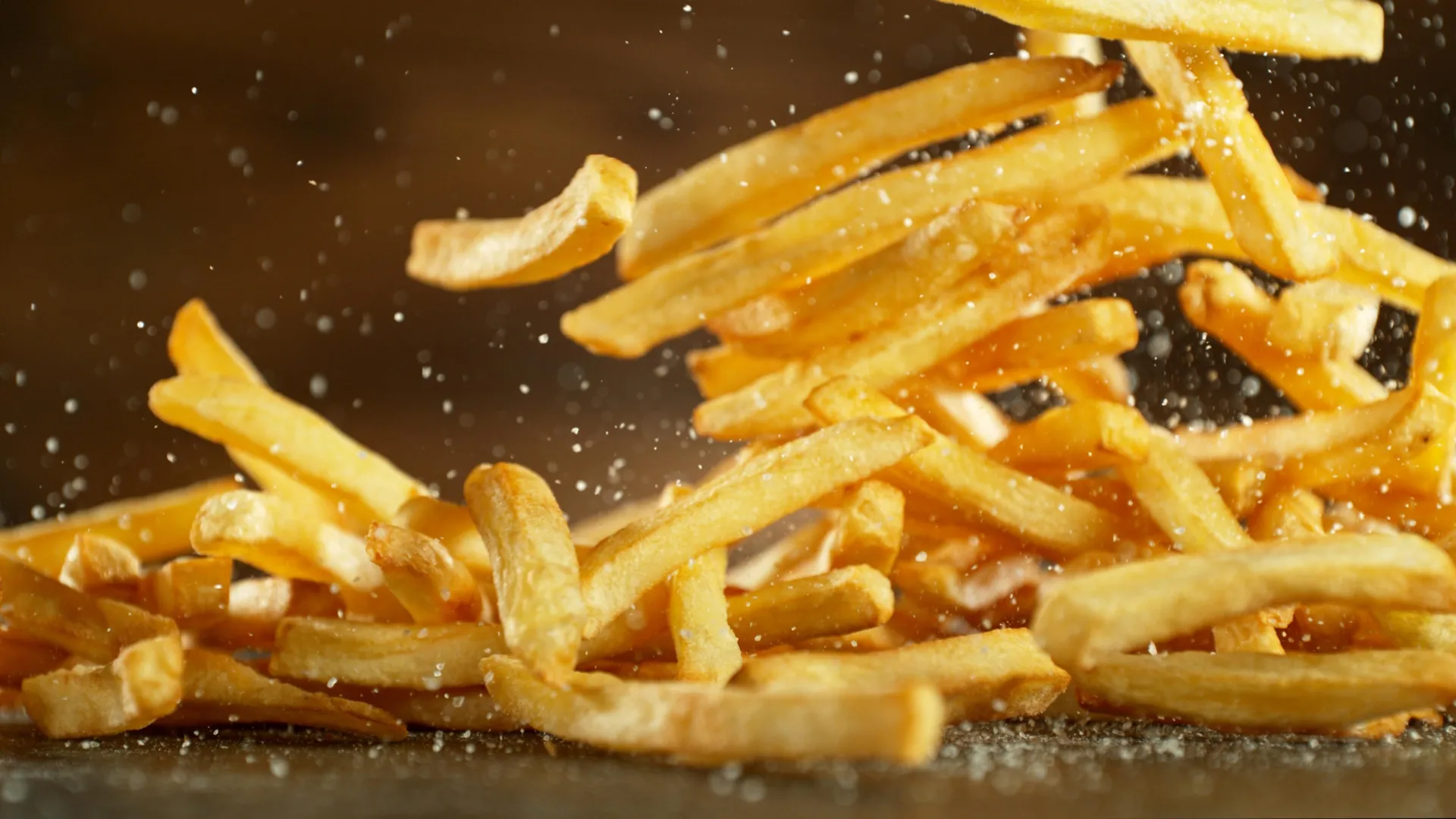
French fries and other fried foods are loved for their crispy texture and rich flavor, but they can absorb significant amounts of oil during cooking. This increases their fat and calorie content, and regularly eating high-fat foods may contribute to health concerns such as obesity and hypertension. New research suggests that microwave-assisted frying could help produce French fries with less oil while preserving their familiar crunch and taste.
Researchers at the University of Illinois Urbana-Champaign are studying whether microwave energy can reduce oil absorption in French fries without compromising the qualities consumers expect. Their findings indicate that combining microwave frying with conventional frying may shorten cooking time, lower oil uptake, and maintain the crisp exterior and satisfying texture associated with traditional French fries.
Developing Lower-Fat French Fries Without Losing Flavor
“Consumers want healthy foods, but at the time of purchase, their cravings often take over. High oil content adds flavor, but it also contains a lot of energy and calories. My research team studies frying with the aim of obtaining lower fat content without significant differences in taste and texture,” said principal investigator Pawan Singh Takhar, professor of food engineering in the Department of Food Science and Human Nutrition, part of the College of Agricultural, Consumer and Environmental Sciences at U of I.
Takhar and Yash Shah, a doctoral student in FSHN, presented their findings in two publications focused on the physical changes that take place when French fries are cooked using microwave energy.
In the first study, the Illinois researchers collaborated with scientists at Washington State University, who developed a specialized microwave fryer. The equipment operated at both 2.45 gigahertz, a frequency similar to that used in household microwave ovens, and 5.8 gigahertz.
Gigahertz is a unit that measures the frequency of electromagnetic waves. Different microwave frequencies can influence how energy travels through food and how quickly water molecules respond during cooking.
Understanding What Happens Inside a French Fry
The researchers rinsed and peeled potatoes before cutting them into strips. The potato strips were then blanched, salted, and fried in soybean oil heated to 180 degrees Celsius.
Blanching briefly exposes food to hot water or steam. In potatoes, this process can soften the tissue and prepare the surface for frying.
During and after cooking, the research team measured temperature, internal pressure, volume, texture, moisture content, and oil absorption. These measurements helped explain how water escaped from the potatoes and how oil moved into the spaces left behind.
According to Takhar, one of the biggest challenges in frying is limiting the movement of oil into food during cooking and in the period immediately afterward.
At the beginning of frying, the tiny pores inside a potato are filled with water, leaving little space for oil. As the potato heats, the water turns into vapor and escapes. This creates open spaces, while negative pressure can draw oil into the potato.
“Think about a straw in a drink. If you push air into the straw, it creates positive pressure and any liquid will be pushed out. But if you suck on the straw, the liquid moves upward. Now imagine food materials have lots of tiny straws. When there is positive pressure, the oil stays out. But if there is negative pressure, the oil starts moving in,” Takhar explained.
Why Internal Pressure Affects Oil Absorption
The researchers found that as much as 90% of the frying process occurs while the food is under negative pressure. This creates a prolonged suction effect that allows oil to enter the pores formed as moisture leaves the potato.
A more effective frying method would maintain positive pressure inside the potato for longer and reduce the time spent under negative pressure. Doing so could help limit the amount of oil absorbed by the French fries.
Microwave energy may support this goal by heating water throughout the potato instead of relying only on heat traveling inward from the surface. When water molecules absorb microwave energy, they move more rapidly and produce additional vapor. The vapor increases internal pressure, making it more difficult for oil to penetrate the food.
“When we heat something in a conventional oven, the heat moves from outside to inside, but a microwave oven heats from the inside out, because the microwaves penetrate everywhere in the material. The microwaves oscillate water molecules, causing more vapor formation and thus shifting the pressure profile towards the positive side. The higher pressure in microwaves helps reduce oil penetration,” Takhar said.
Microwave Frying May Reduce Cooking Time and Oil Uptake
In addition to laboratory experiments, the researchers used mathematical modeling to study the frying process in greater detail. Computer models helped them evaluate how different variables interacted and predict changes that could be difficult to measure during every experiment.
The team compared temperature, pressure, volume, texture, moisture, and oil absorption during frying at 2.45 GHz, 5.8 GHz, and under conventional frying conditions.
Across the experiments and simulations, microwave frying caused moisture to leave the potatoes more quickly. It also reduced overall cooking time and decreased the amount of oil absorbed by the French fries.
Microwave frying alone, however, did not create the desired texture. Fries cooked exclusively with microwave energy tended to remain soft instead of developing the crisp surface consumers expect.
“However, if you just use microwave frying, you get soggy food. To obtain a crispy texture and taste, you need conventional heating. Therefore, we propose combining the two approaches in the same unit. Conventional heating maintains the crispiness, while microwave heating lowers the oil intake,” Takhar said.
Hybrid Frying Could Combine Crispness With Lower Oil Absorption
The proposed hybrid frying system would use conventional heat to brown the surface and create a crispy texture, while microwave energy would accelerate moisture removal and help prevent excess oil from entering the potato.
This combination could help food manufacturers produce French fries with less oil while preserving the flavor and texture that make fried foods popular. A shorter cooking time could also improve efficiency in commercial food production.
The researchers said continuous fryers used in large-scale food processing facilities could potentially be adapted to include microwave generators. Because the necessary components are widely available and relatively inexpensive, the technology may be practical for commercial French fry production.
The first paper, “The Effect of Conventional and Microwave Frying on the Quality Characteristics of French Fries,” is published in the Journal of Food Science.
The second paper, “Predicting the quality changes during microwave frying of food biopolymers by solving the hybrid mixture theory-based unsaturated transport, and electromagnetics equations,” was published in Current Research in Food Science.
The research was funded by the USDA National Institute of Food and Agriculture through Awards 2020-67017-31194, ILLU-698-308, and ILLU-698-926.
Source: www.sciencedaily.com