


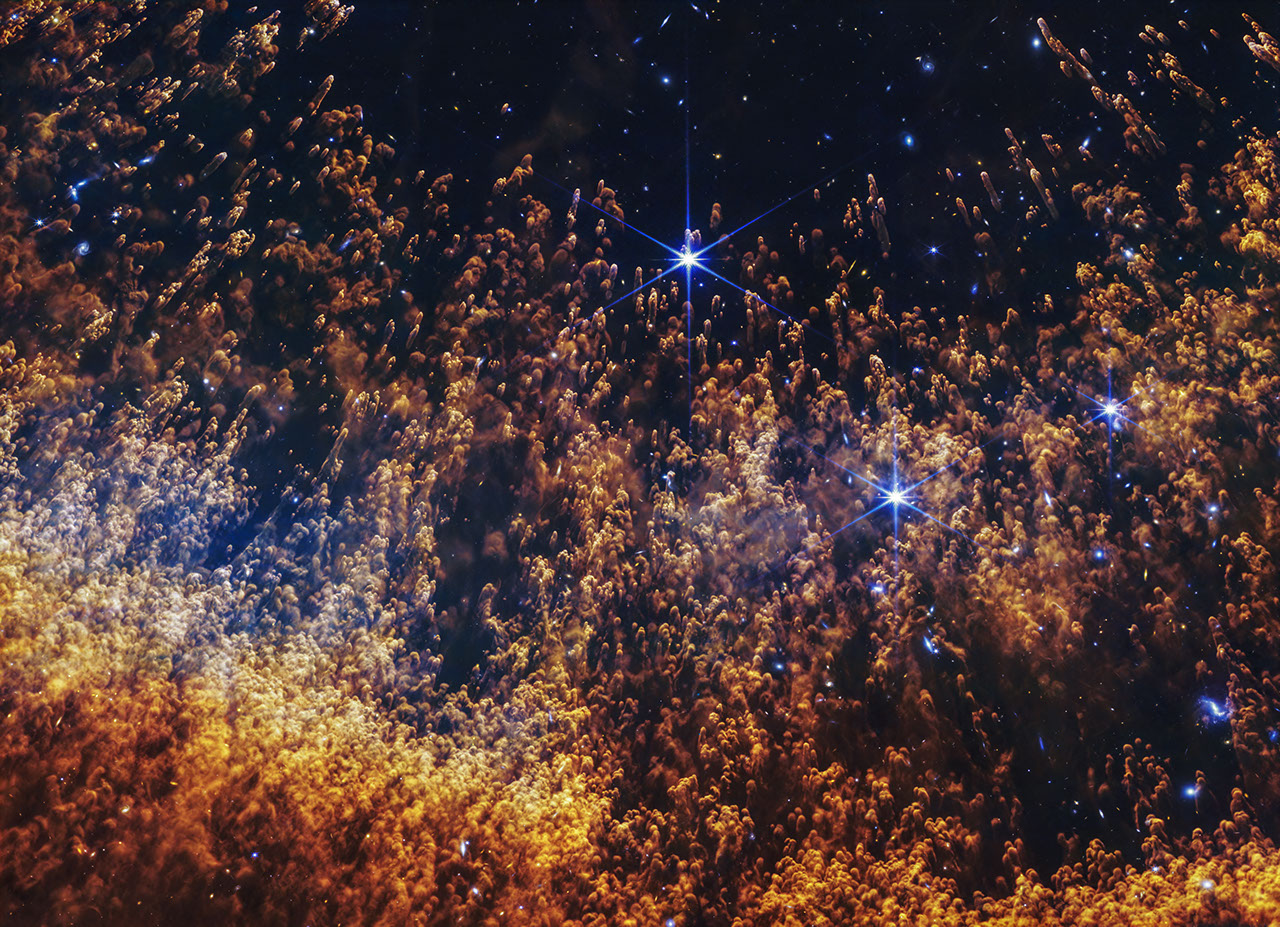
What causes the mysterious knots of gas and dust found inside planetary nebulae? These unusual structures have also been observed in the Ring Nebula, the Dumbbell Nebula, and NGC 2392. Because their formation was not originally predicted, the true origin of these so-called cometary knots remains poorly understood. This remarkable infrared image, captured by the James Webb Space Telescope, reveals intricate details in a portion of the Helix Nebula. Each cometary knot may contain a mass comparable to that of Earth, while its size can extend several times beyond the orbit of Pluto. One scientific hypothesis suggests that the knots form and evolve when existing gas is fragmented and driven outward by the powerful stellar wind of the central aging star. Also known as NGC 7293, the Helix Nebula is one of the closest examples of a planetary nebula, created during the final stage of a Sun-like star’s life. Located approximately 650 light-years away in the constellation of Aquarius, the Helix Nebula offers astronomers a nearby laboratory for studying stellar evolution and cosmic dust.
Source: science.nasa.gov